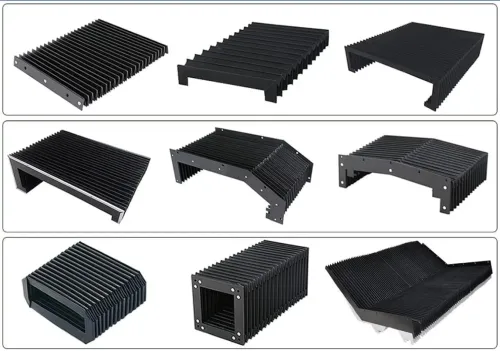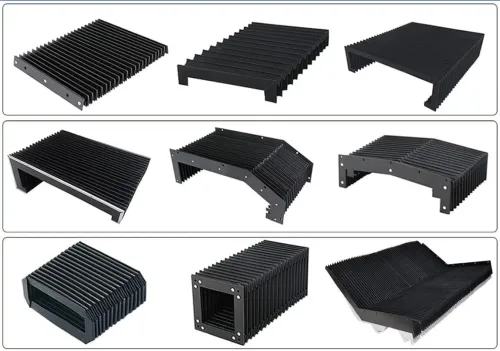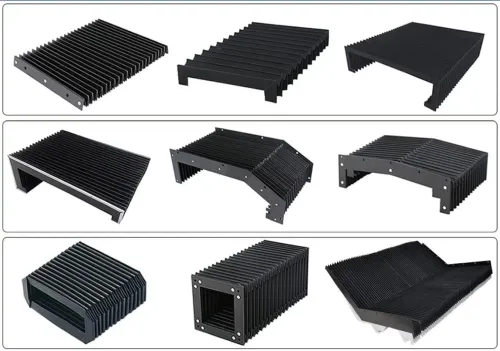

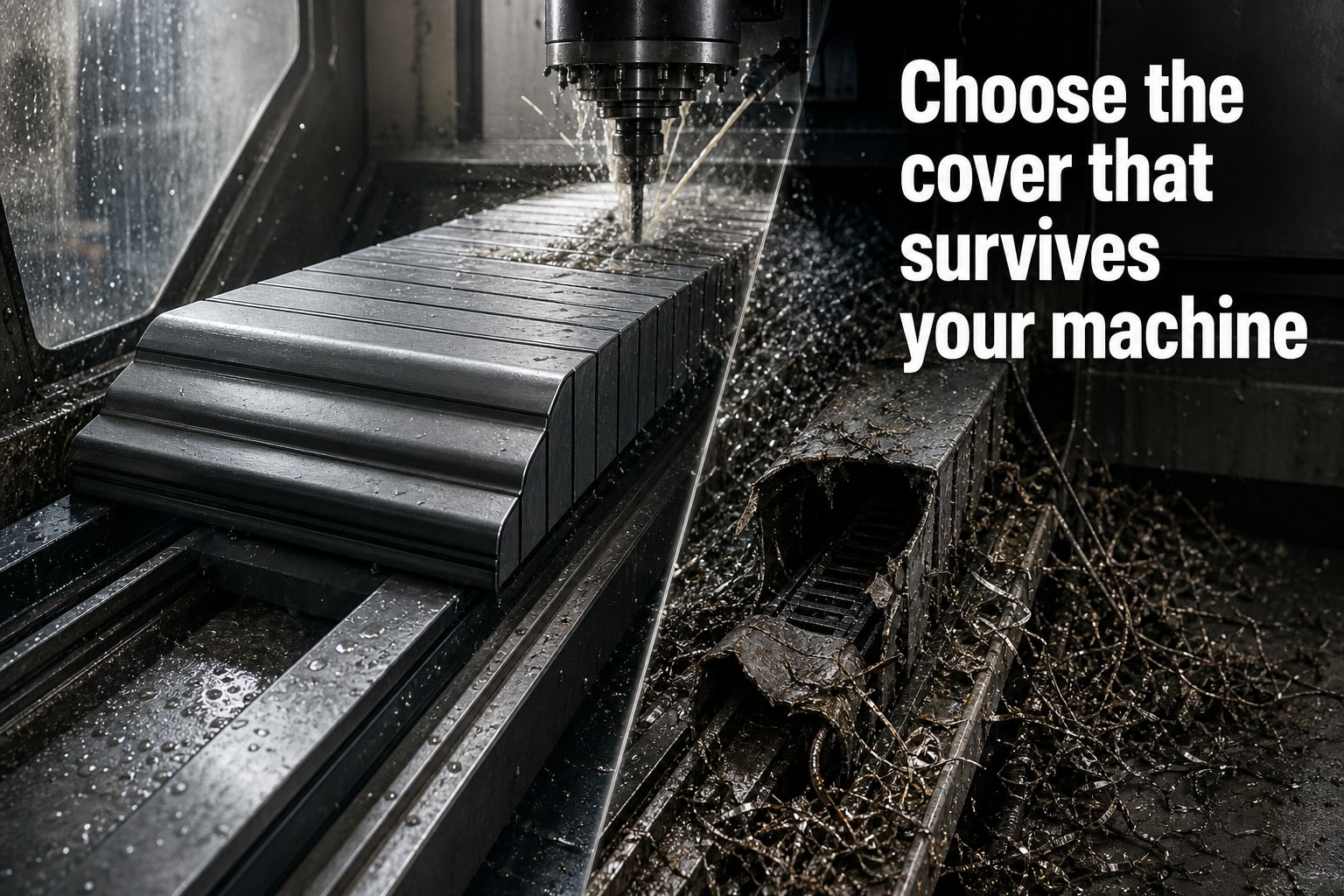
A roll-up cover that survives clean water can still swell, crack or delaminate when exposed to synthetic coolant, cutting oil or alkaline cleaner. By comparing the material, coating, construction and machine motion together, you can specify a cover that matches the real contamination, temperature and cycle demands instead of choosing from a material name alone.
Key takeaways
- Match fabric, coating and reinforcement to the dominant contamination.
- Check temperature and chemical exposure across the full duty cycle.
- Specify travel speed, bend radius and cover dimensions before quoting.
- Validate washdown, welding-spatter and special certification requirements early.
Match the material to the contamination and impact
Choose roll up cover material options by the dominant hazard, not by the word “dust.” Abrasive cast-iron fines, oil mist, flood coolant, welding spatter, hot chips and washdown attack covers differently.
| Option | Best fit | Main limitation |
|---|---|---|
| PVC-coated polyester | Economical splash and abrasion protection; oil mist and flood coolant after compatibility checks | Repeated sharp swarf can cut the coating |
| Polyurethane-coated fabric | Flexibility and lower-temperature flexing; light coolant or oil exposure | Formulation, seams and hydrolysis resistance vary |
| Rubberised or elastomer-coated fabric | Continuous flexible sealing around a moving axis | Sharp, hot or high-velocity chips can cut, puncture or burn it |
| Silicone-coated fabric | Heat, welding spatter and flexible thermal protection | Weak choice for concentrated impact |
| PTFE-coated glass-fibre fabric | High heat, low friction and non-stick performance | Needs support; it is not an impact shield |
| Aramid fabric | High tensile strength and cut resistance | Still needs coating and protection from the specific fluid |
| Aluminium slats | Lower moving mass for high-cycle motion | Less resistant to denting, concentrated impact and abrasion than steel |
| Steel or stainless-steel slats | Sharp chips, heavy swarf and intermittent hot particles | More mass, inertia, joint wear and chip-entry paths |
Fabrics flex and seal more easily; metal resists concentrated impact but adds moving mass and can trap chips at slat hinges and guides. Stainless steel improves corrosion resistance, but it does not guarantee resistance to chlorides, acids or alkaline cleaners. Anodised aluminium remains less impact-resistant than steel.
Check the coating against your exact coolant, oil and washdown cleaner before selection.
Check temperature and chemical compatibility as a system
Select the material by treating temperature and chemical compatibility as one system check. Record three figures: continuous operating temperature, short-duration peak temperature, and heat source. Laser exposure, hot chips, roller friction and nearby tooling impose different thermal loads.
1. Ask the supplier for a temperature rating covering both recorded temperatures and the actual heat source. Silicone-coated or PTFE-coated glass-fibre fabrics suit high-temperature or low-friction duties. PTFE glass fibre is not an impact shield; add support strips, a frame or protected geometry where chips or pressure can strike it.
2. Test the complete construction against the actual mineral cutting oil, synthetic coolant and concentration, hydraulic oil, alkaline cleaner, acid and solvent used on the machine. Request chemical compatibility data at the operating temperature and exposure time, not a generic “oil resistant” claim.
3. Include every part in the check: coating, backing yarn, thread, adhesive, welded seam, edge binding, slat finish and guide material. Water resistance proves resistance to water, not to oil or cleaner; a cover can remain watertight while its coating, seam or adhesive fails.
4. Treat nearby welding or ignition hazards as a separate assessment. For any flame-retardant, self-extinguishing or resistance-to-ignition claim, request the exact test method, specimen construction, thickness and classification. A material test does not automatically represent the assembled roll-up cover.
Let movement decide flexibility, mass and construction
Movement, not tensile strength alone, determines the right roll-up cover. A strong material can still fail through sag, buckling, fatigue at the roll or guide friction. Record travel speed, acceleration, cycle frequency, travel stroke, minimum rolled diameter, number of flexing cycles and whether the cover follows one axis or wraps around an irregular opening.
- Compare flexibility, abrasion resistance, puncture resistance, areal mass, bending stiffness, noise, cleanability and expected service life.
- Define the complete construction, including coating thickness, fabric weight, seams, hems, slats, guide profiles, rollers, fasteners and edge reinforcement.
- Keep cables and hoses in their own carrier. Preserve the specified dynamic bend radius, separation and strain relief; a cover cannot stop failures caused by rubbing or unsupported cable movement.
| Option | Movement and flexibility | Resistance, mass and service life | Main trade-off |
|---|---|---|---|
| Steel-slat | Stiff, with limited flexibility; high areal mass | Strong resistance to sharp swarf, puncture and abrasion; cleanable and potentially long-lasting | Higher moving mass increases acceleration loads; noise rises, and chips can lodge at slat hinges and guides |
| Aluminium-slat | Stiffer than fabric but lighter than steel | Lower inertia suits high-cycle motion; resists corrosion when finished, but dents and abrades more readily | Lower resistance to concentrated impact; surface treatment does not equal steel strength |
| Coated fabric | Highly flexible, quiet and lightweight; suits small roll diameters | Lower puncture and abrasion resistance; coating, seams and edges determine cleanability and service life | Repeated rolling can cause sag, buckling, coating fatigue, guide friction or cracking at the roll |
Measure the machine before you ask for a quotation
Machine measurement must capture the real opening and every interface before you request a quotation. Record the protected opening width and length, travel stroke, available storage space, mounting points, maximum rolled diameter, clearance from tooling, guide locations and required overlap when closed.
1. Measure the obstruction envelope, not the nominal protected area. Include clamps, fixtures, nozzles, moving cables and any part that enters the cover’s path. State the contamination direction, cleaning method, fluid names and concentrations, continuous temperature, peak temperature, movement speed, acceleration and cycle rate.
2. Ask the supplier to confirm the minimum rolled diameter, allowable unsupported span, guide friction, and the cover’s replacement and inspection arrangements. Request the slat or fabric replacement method and identify inspection points before the design is frozen.
3. Request drawings that show seams, hems, edge reinforcement, rollers, fasteners and mounting interfaces. SCUTES INDIA PRIVATE LIMITED can use this machine-specific information to develop a protective-cover specification, but compare the documented construction and test basis rather than accepting a broad material label.
A quotation that lists only “PVC,” “fabric” or “steel” leaves critical risks unresolved. Confirm how the proposed construction handles sag, buckling, roll fatigue and guide contact at your stated speed and cycle rate, then approve production only against the agreed dimensions and interface drawing.
Related product
 | Roll Up Cover A roll-up cover is a highly durable and flexible protective solution designed to safeguard machinery, equipment, and valuable assets from dust,... View product → |
Validate special requirements before committing to the cover
Validate special requirements before committing to the cover. Ordinary contamination and motion tests are not enough when hygiene, static control, ingress protection or unusual heat changes the risk.
Ask for these details before approval:
- For washdown or humid machines, name the stainless grade, such as 316L, specify sealed or shielded joints, and identify the cleaning chemical, concentration and temperature. “Stainless steel” alone is not a specification.
- For combustible dust or static-sensitive processes, require an electrostatic-dissipative or conductive specification, a defined grounding path and a resistance measurement. Conductive fibres alone do not prove system-level dissipation.
- For cleanroom use, assess particles from abrasion, fraying, seams, coating wear and roller contact against the required cleanliness class. A smooth surface is not proof of low particle generation.
- For fire claims, request the test method, specimen construction, thickness and classification. “Fire-rated” does not describe the assembled cover.
Do not call an untested roll-up cover an IEC 60529 IP-rated enclosure. IP ratings apply to an enclosure tested in a defined configuration under specified ingress conditions; ask for the exact test arrangement behind any claim.
| Option | Best fit | Main limitation |
|---|---|---|
| Metal slats | Direct impact | Poorer fine-particle sealing |
| Coated or elastomeric fabric | Flexible sealing | Vulnerable to sharp chips |
| High-temperature fabric | Heat without impact | Not a chip shield |
| Hybrid construction | Multiple hazards | Requires assembly testing |
Choose the dominant option, then approve the complete assembly only after representative motion, fluid, temperature and cleaning trials.
Frequently asked questions
How do I match roll up cover material to machine contamination?
Choose for the dominant hazard: abrasive fines need wear resistance, coolant and oil need compatible coatings, while hot chips and welding spatter require heat-resistant construction.
What temperature and chemical checks should I make?
Record operating, peak and washdown temperatures, then compare them with the fabric, coating, thread, adhesive and fastener compatibility for the complete cover system.
How does machine movement affect roll up cover selection?
Travel speed, cycle frequency, roll diameter, bend radius, available space and moving mass determine the required flexibility, reinforcement and construction.
What machine measurements are needed for a quotation?
Provide opening width and length, mounting surfaces, available roll space, travel direction, fixing points, stroke, clearances and the fully extended and retracted positions.