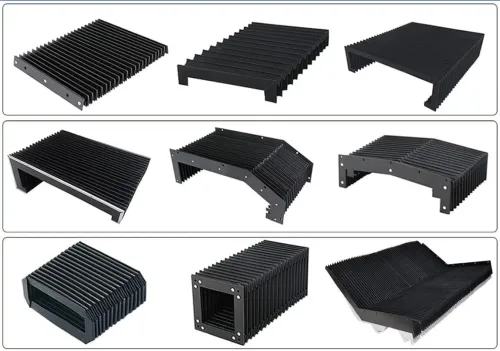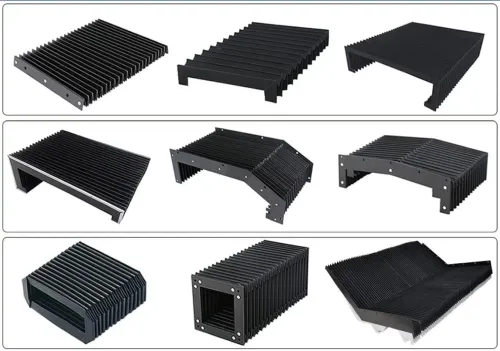

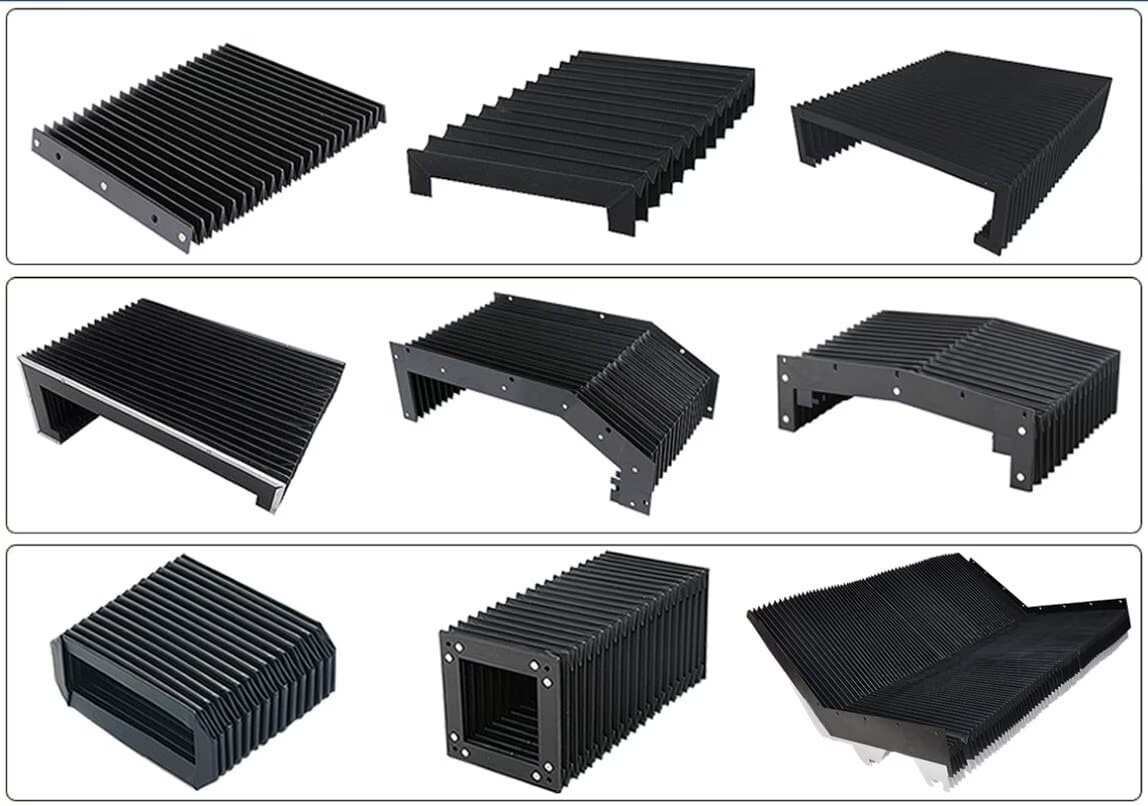
A round bellow can shield a scissor lift’s cylinder rod, linkage, guideway, sensor or pinch-zone opening from dust, chips, oil and splash water, but only when its geometry matches the lift’s full movement. You will be able to identify the problem it should solve, measure the lift, choose a suitable construction and test whether the cover adds protection without creating a new hazard.
Key takeaways
- Use a round bellow to shield exposed rods, screws, guides and linkages.
- Measure compressed and extended lengths, diameter, stroke and mounting space.
- Choose fabric, coating and construction for coolant, oil, chips, heat and dust.
- Include drawings, dimensions, materials and retrofit access in the quotation.
Which scissor-lift problems can a round bellow solve?
A round bellow is installed around an exposed moving part, not beneath the platform as a load-bearing member. It may fit around a hydraulic-cylinder rod, screw, guide, roller, chain, sensor or linkage.
As the platform rises, the circular cover expands along the protected travel; as it lowers, it compresses into folds. This movement maintains coverage without stopping the scissor mechanism.
Its main job is to block workshop dust, abrasive particles, metal chips, oil mist, hydraulic-oil splash, grease and monsoon water. By limiting ingress, it reduces contamination of pivots and linkages, protects exposed rods from scoring and helps keep operators away from selected moving parts or pinch zones.
| Purpose | What the bellow does | What remains essential |
|---|---|---|
| Mechanism protection | Shields rods, pivots, guides and linkages from contamination and contact | Correct alignment, lubrication and component inspection |
| Operator protection | Reduces access to a covered hazard or pinch zone | Fixed guards, safe clearances, interlocks and emergency stops |
| Lift safety | Preserves movement around a protected part | Lifting capacity, load support, prevention of unintended descent and rated safety devices |
A bellow does not increase lifting capacity, correct misalignment, carry platform loads, prevent unintended descent or replace a rated safety device. It must also avoid restricting emergency lowering or concealing a hydraulic leak.
A round bellow scissor lift for problems in Pune is most relevant where dusty construction work, machining residue, humid storage or splash exposure shortens component life. Choose a wider accordion cover when the entire scissor-pack opening needs protection.
How do you size and measure a bellow before ordering it?
Size it from the protected part’s motion envelope, not the lift’s nominal platform height. Measure at full collapse and full extension; record collapsed length, extended length and actual stroke so the bellow matches the cylinder’s complete travel.
Record the internal and external diameters, mounting-ring dimensions, attachment-hole pattern, available clearance, minimum bend radius and fold count. Note distances to hoses, steelwork, rollers, hinges and mechanical stops. Photograph both positions and trace the complete travel path, including lateral movement.
An undersized cover bottoms out; an oversized one overextends. Either can rub, fold into a pinch point, trap chips or restrict emergency lowering. Ask whether a round bellow for scissor lifts in Pune matches the protected hazard.
| Option | Best suited to | Main limitation |
|---|---|---|
| Round bellow | Rods, screws, cylinders and guideways | Cannot cover changing scissor geometry |
| Wide accordion cover | Scissor-pack openings and broad pinch zones | Needs greater surrounding clearance |
| Telescopic or spring cover | Rigid, straight-line protection | Poor fit for changing angles |
| Apron cover | Broad horizontal or vertical surfaces | Less suitable for circular shafts |
| Roll-up cover | Protection where storage space is limited | Requires controlled winding |
| Rigid guard | Load-bearing or impact-resistant protection | Does not accommodate continuous folding |
Choose another form when sharp chips, sustained welding spatter, flame, hot surfaces, severe abrasive rubbing, insufficient clearance or rigid guarding dominate. A circular cylinder bellow is then the wrong selection.
Which material and construction suit Pune’s working environment?
Choose the construction from the exposure, not from a “weatherproof” label. Pune’s indoor fabrication shop, CNC area, construction site, warehouse and outdoor lift impose different failure risks.
| Material or construction | Best fit | Main limitation |
|---|---|---|
| Fabric | Light dust and low-abrasion indoor service | Tears and wears quickly against chips or rubbing |
| Polyurethane-coated polyester | General abrasion, coolant or water splash, CNC areas | Verify cleaning-fluid and coolant compatibility |
| Neoprene-coated fabric | Oil mist, hydraulic-oil exposure and outdoor weather | Oil swelling remains possible with incompatible fluids |
| Elastomer construction | Flexible sealing around rods and repeated movement | Heat, chemicals and cycle life depend on the compound |
| Silicone or high-temperature-coated fabric | Elevated heat or limited welding-spatter exposure | Not a substitute for shielding from sustained flame or heavy spatter |
An indoor shop may need dust protection; a CNC lift needs resistance to coolant, chips and cleaning fluids. Construction sites need abrasive-dust and impact separation, while warehouses need dust and occasional-contact protection. Outdoor storage adds ultraviolet exposure, rain, humidity and monsoon splash.
For round bellow lift protection in Pune, specify these points in writing:
- Temperature range and chemical compatibility
- Abrasion performance and tested cycle count
- Fabric, coating, seam method and mounting-ring material
- Fold orientation, end clamps and drain paths
Water-resistant fabric does not prove a sealed assembly or an IP rating. Stitched seams, clamps, rings and drainage determine whether water stays around the rod. Heat can damage coatings, oil can swell them, UV can embrittle them, and trapped chips can abrade folds from inside.
Select round bellow lift protection in Pune against the actual exposure.
What should a Pune quotation and retrofit plan contain?
Send a scissor lift round bellow manufacturer in Pune a motion envelope, not just the lift name. Include:
1. The lift model, stroke, protected component, operating environment, dust or chip type, water and oil exposure, temperature, cleaning chemicals, cycle frequency, mounting constraints, nearby obstructions and required inspection access. Attach photographs at full collapse and full extension, plus a dimensional drawing if available.
2. Request a drawing showing collapsed and extended length, internal and external diameters, fold count, mounting rings, hole pattern, material, coating, seam method, temperature range, chemical compatibility, tested cycles, cleaning instructions and replacement lead time. Ask for a sample or site-fit process when geometry is uncertain. Custom made alone proves nothing.
3. State the retrofit sequence: immobilise and isolate the lift, then follow the manufacturer’s lockout and support procedure. Confirm whether rings or adjacent components must be removed, while preserving access to lubrication points and hydraulic hoses.
4. After installation, cycle through the full stroke. Check compression, extension, lateral rubbing, minimum fold radius, visibility, emergency lowering and mechanical-stop clearance. Confirm that folds do not trap between members or create a snagging hazard.
SCUTES INDIA PRIVATE LIMITED could be relevant when a Pune buyer needs measurement-led fabrication or local installation support, but the quotation must still document suitability through dimensions, materials and cycle evidence.
Related product
 | SCISSOR LIFT BELLOWS Scissor Lift Bellows are one of the broadly demanded stabilizer for which we are considered an acclaimed designed in the market. View product → |
How do you inspect, clean and replace the bellow?
1. During commissioning, cycle the lift through its complete retracted-to-extended travel. Check that folds do not bottom out or overextend, rub steelwork, contact hoses, enter pinch points, or trap chips between moving members. Static fitment at one platform position is not acceptance.
2. Set inspection intervals in the maintenance plan and examine the folds, seams, end collars, pinholes and mounting points. Look for hardening, oil swelling, heat damage, UV cracking, trapped chips, water pooling, loose fasteners, pulled-out mounting rings and restricted travel.
3. Check the cover’s safety effect, not just its appearance. A loose bellow can become a snagging or entanglement hazard, while a tight or opaque cover can conceal a developing hydraulic leak, damaged hose or lubrication point. Provide inspection openings or a documented removal procedure.
4. Clean it only according to the supplied instructions. Remove chips by hand or with a soft tool; sharp scraping can cut the coating. Use a compatible detergent where approved, avoid solvents that attack the coating, and dry retained water before storage.
5. Replace the bellow when a hole reaches the protected zone, a seam opens, folds no longer return, the material hardens or swells, a mounting point deforms, abrasion exposes reinforcement, or full travel cannot be completed safely. Record the defect and investigate the cause before fitting another cover.
The bellow adds replacement work and can obstruct visual inspection, so retain access in the design. Keep the dimensional drawing, material range, cycle evidence and inspection record with the lift’s risk assessment under ISO 12100.
Frequently asked questions
Which scissor-lift problems can a round bellow solve?
A round bellow protects exposed moving parts such as hydraulic-cylinder rods, screws, guides, rollers, chains, sensors and linkages from dust, coolant, oil, chips and mechanical contact. It does not carry platform loads or correct hydraulic, structural or alignment faults.
How do you size and measure a round bellow before ordering it?
Record the protected part’s outside diameter, required inside clearance, stroke, fully compressed length, fully extended length, mounting diameters, available radial space and attachment method. Check that folds do not buckle, rub or obstruct nearby scissor arms through the full movement.
Which material and construction suit Pune’s working environment?
Match the fabric, coating, seam construction and end attachments to the exposure. Oil, coolant, metal chips, outdoor dust, ultraviolet light and operating temperature each affect the specification, so provide the supplier with the actual fluid names, temperature range and cleaning method.
What should a Pune quotation and retrofit plan contain?
Request a dimensioned drawing, material and coating details, compressed and extended lengths, mounting arrangement, temperature and chemical limits, delivery scope, inspection criteria and replacement access. The retrofit plan must show isolation, safe access, clearance checks and the effect on the lift’s original guards.
How do you inspect, clean and replace the bellow?
Inspect folds, seams, end rings, clamps, rubbing marks, pinholes and trapped chips at scheduled maintenance intervals. Remove loose contamination without forcing debris into folds, use a cleaning agent approved for the coating, and replace the bellow when damage exposes the protected part or restricts movement.