
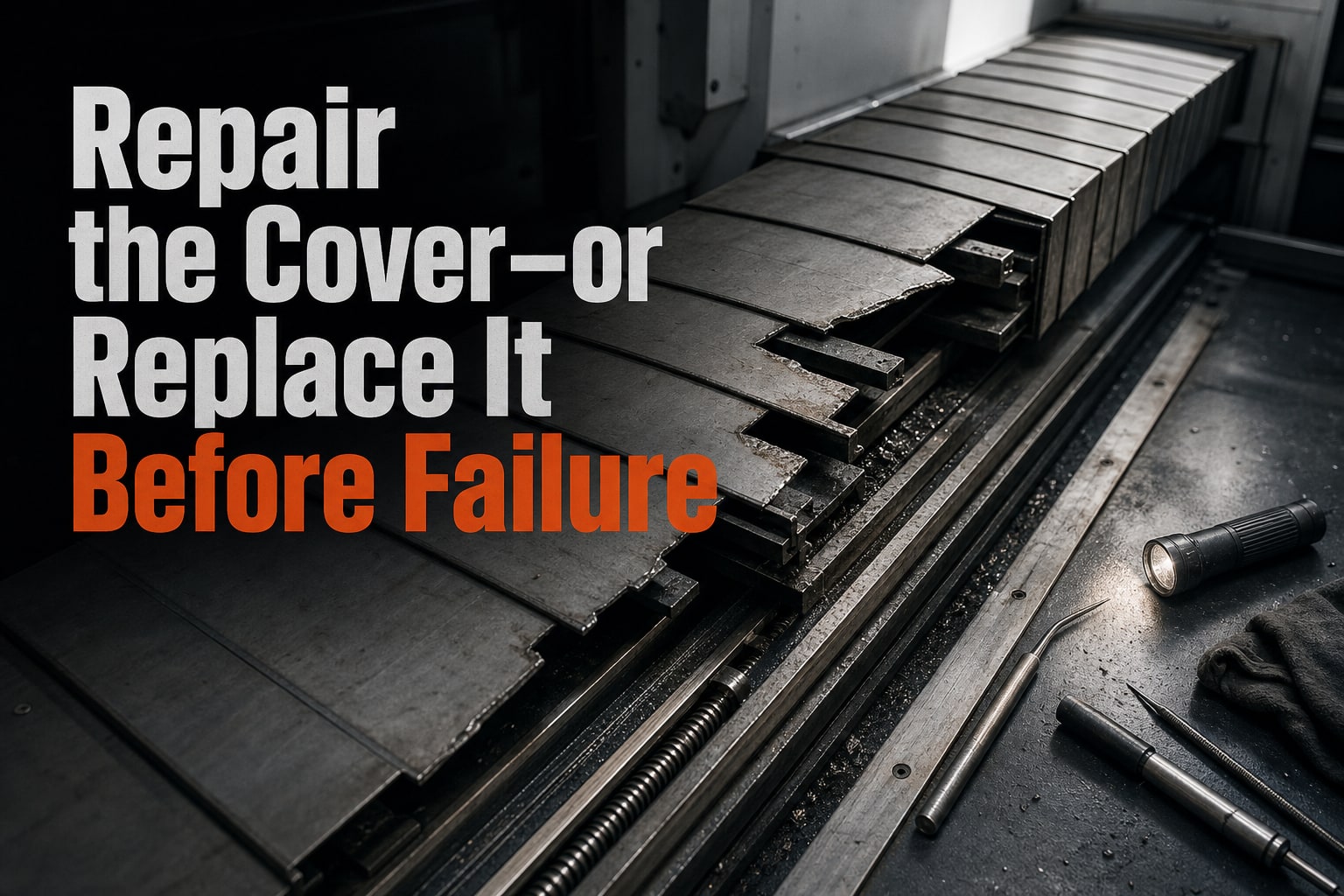
A telescopic cover that still moves can already be damaging guideways, rollers or wipers. By checking movement, clearances, contamination and structural alignment, you can separate a repairable failure from a machine telescopic cover replacement and compare the real cost of each option.
Key takeaways
- Stop and lock out the machine after any cover jam, collision or exposed guideway.
- Replace sections with cracked welds, distorted geometry or failed movement alignment.
- Measure travel, closed length, height, width and mounting points before ordering parts.
- Compare downtime, machining, fitting and guideway damage—not just the cover price.
Stop the machine when movement or protection has failed
Stop the machine immediately when a telescopic cover jams, collides, exposes the guideway, or stops following axis movement. Isolate and lock out the machine before inspection; running it to “see whether it clears” can turn a repairable dent into a destroyed guideway.
Shut down for any of these findings:
- A box will not telescope, sits out of line, or leaves a widening gap.
- Metal fragments or packed chips have entered the slideway.
- The cover strikes the machine, vibrates violently, or produces scraping and grinding.
- A torn wiper or cracked seal lets coolant and chips reach the guideway.
- A panel, hinge, roller, fastener, guide, or mounting point is loose or broken.
- The cover no longer provides the intended barrier or leaves an access opening.
| Finding | Telescopic cover repair options | Replace when |
|---|---|---|
| Local dent with no crack | Straighten the panel and verify designed clearance | Straightening leaves thinning, cracks, or permanent distortion |
| Damaged wiper or seal | Renew the wiper or seal and check contact pressure | The guideway remains exposed after renewal |
| Packed chips or misalignment | Remove debris, correct alignment, and inspect rollers and guides | Distorted guides or mounts prevent smooth travel |
| Broken box or lamella | Replace the individual section if dimensions, overlap, guides, and stroke match | Matching parts are unavailable or several sections are damaged |
Do not treat protection of machine ways as proof of safety guarding. If a replacement changes openings, access, or reach-through conditions, review it against ISO 14120 where applicable. Compare telescopic cover repair options with replacement using total downtime, installation, custom dimensions, and freight—not purchase price alone.
Match the failure to the repair-or-replace threshold
The telescopic cover repair replacement decision should follow remaining service life, downtime, lead time and failure risk, not the repair invoice alone. Repair is economical when the main boxes remain straight and square and the defect is limited to a bolt-on or consumable item.
Replacement becomes stronger when the fabricated cover body cannot regain its geometry.
| Defect | Repair threshold | Replace threshold |
|---|---|---|
| Wipers, felt seals, scrapers, springs or fasteners | Renew the matching telescopic cover repair parts; confirm profile, hardness, preload and attachment | Replace the cover only when repeated renewals fail because the body or guide arrangement is damaged |
| Local dent in one box or lamella | Straighten or replace that section if designed clearance returns without cracks, thinning or permanent distortion | Replace the box or complete cover when heating, welding or straightening leaves distortion or lost flatness |
| Guide shoes, rollers or hinges | Renew the damaged component and correct alignment | Replace the cover when guideways are worn, distorted or cannot hold the original stroke and clearances |
| Several distorted boxes or recurring binding | Repair only if original mounting references and overlaps can be restored | Replace the fabricated cover body when it binds, loses overlap or repeatedly misaligns |
Individual lamella replacement is not automatically interchangeable. Match section dimensions, overlap, guide arrangement, wiper geometry, mounting points and stroke; a similar-looking part can collide or leave the guideway exposed.
Choose complete replacement when repeated repairs consume more downtime than installation, matching telescopic cover repair parts are unavailable, or failure risk threatens the machine. Cosmetic damage alone does not justify it; structural distortion that prevents reliable movement does.
Measure the machine before ordering replacement parts
Measure the existing cover and its machine interface before ordering telescopic cover replacement parts. A machine model number rarely identifies the correct dimensions or mounting arrangement.
1. Record the closed length, fully extended length, required stroke, overall cover height, number of boxes, and each box’s width and height. Photograph every section with a ruler visible, and note overlap between adjacent boxes.
2. Measure the mounting-hole pattern, end-plate dimensions, bracket locations, guide supports, wiper contact surfaces, and clearance around the cover. Record travel direction, installation access, drain provisions, and whether the replacement can enter from above, below, or the machine side.
3. Note operating conditions: axis speed, acceleration, chip type and size, coolant or cutting-fluid chemistry, temperature exposure, and likely chip packing. These details affect guide, wiper, seal, and box design.
4. Specify the original material, sheet thickness, coating, guide arrangement, rollers, hinges, fasteners, and wiper geometry. telescopic cover material options include coated carbon steel, stainless steel, and selected lightweight constructions; choose among stiffness, mass, corrosion resistance, heat tolerance, fabrication cost, and impact resistance.
Before a machine telescopic cover replacement, send these measurements, photographs, drawings, and interface details to the supplier. A visually similar lamella can still have the wrong overlap or mounting points, causing interference, leakage, or insufficient protection. Include any required bracket, guide, drain, or clearance changes in the quotation and downtime plan.
Compare the full cost of repair with a new cover
Compare repair and replacement as total installed cost over the same planning period, not as two purchase prices. A cheaper repair loses its advantage when it requires another shutdown six months later or leaves a cover with little remaining service life.
| Option | Include in the quotation | Decision signal |
|---|---|---|
| Repair | Parts, engineering, freight, technician time, installation hours, alignment checks, production downtime and probability of another failure | Choose it when damage is local and the repaired cover retains useful service life |
| Replacement | Telescopic cover replacement cost, engineering, fabrication, freight, removal, installation, commissioning and interface modifications | Choose it when structural repairs recur, matching parts are unavailable or remaining service life is short |
| Either option | Cost of chip removal, cleaning, guideway inspection and safety review after the work | Add these costs before comparing totals |
Ask each supplier to state these items in writing:
- The planned machine stop, including removal, fitting, alignment and trial-run hours.
- Every interface change: brackets, end plates, drain provisions, guide supports, wiper contact surfaces and clearance.
- The warranty scope and the assumed service life under your speed, acceleration, chip and coolant conditions.
- The cost of a repeat failure, including emergency labour and lost production, rather than assigning that risk a zero value.
SCUTES INDIA PRIVATE LIMITED is one supplier you can ask to separate fabrication, installation and interface-modification costs so its quotation can be compared with a repair estimate on equal terms.
Related products
 | TELESCOPIC COVERS A telescopic cover protects guide-way surfaces and components of moving axis of machines. View product → |
 | Machine Covers Machine covers are specially designed shields used to protect industrial equipment and machinery from environmental elements. View product → |
Use inspection records to prevent a repeat failure
Use the telescopic cover maintenance guide to set a repeatable routine, then record each result against the repaired cover’s baseline. A cover remains serviceable when it cleans out, lubricates at the specified points, and travels smoothly without increasing gaps, noise, friction or contamination.
- Clean after shutdown by removing chips and sludge without pushing debris past the wipers. Clear every drainage opening and inspect the boxes, seals, guide surfaces and fasteners.
- Lubricate only the points and with the lubricant specified by the cover manufacturer. Do not spread grease over exposed sliding surfaces; it can trap abrasive chips and accelerate wear.
- Run the cover through its complete stroke at low speed. Check free movement, parallelism, box overlap, scraping noise, vibration and end-of-travel impact rather than judging it only when parked.
- Record wiper condition, coolant inside the boxes, blocked drains, new dents, uneven side clearance and any guide or roller damage. Photograph changes and note operating hours, coolant concentration and cleaning chemicals.
Compare each entry with the post-repair baseline. Repeated wiper or guide-part replacement is a maintenance pattern; recurring structural repairs, misalignment or contamination after cleaning indicates that the repair has not restored serviceability.
Stop and reassess before further operation if chips continue entering the boxes, because they can damage guide surfaces even when the external panels look sound. Use the record to decide whether another repair is justified or complete replacement will prevent the same failure.
Frequently asked questions
When should you stop a machine with a failed telescopic cover?
Stop the machine immediately when the cover jams, collides, exposes the guideway or stops following axis movement. Isolate and lock out the machine before inspection.
Which telescopic cover failures justify replacement instead of repair?
Replace the cover or affected sections when welds are cracked, panels are badly distorted, movement remains misaligned after adjustment, or the guideway is no longer protected.
What measurements are needed for machine telescopic cover replacement?
Record the cover’s open and closed lengths, width, height, stroke, section count, mounting points, travel direction and available clearance. Include photographs and drawings when requesting replacement parts.
What should telescopic cover replacement cost comparisons include?
Compare the new cover price with repair labour, replacement parts, machining, installation, alignment, downtime and any guideway or machine damage caused by continued operation.