
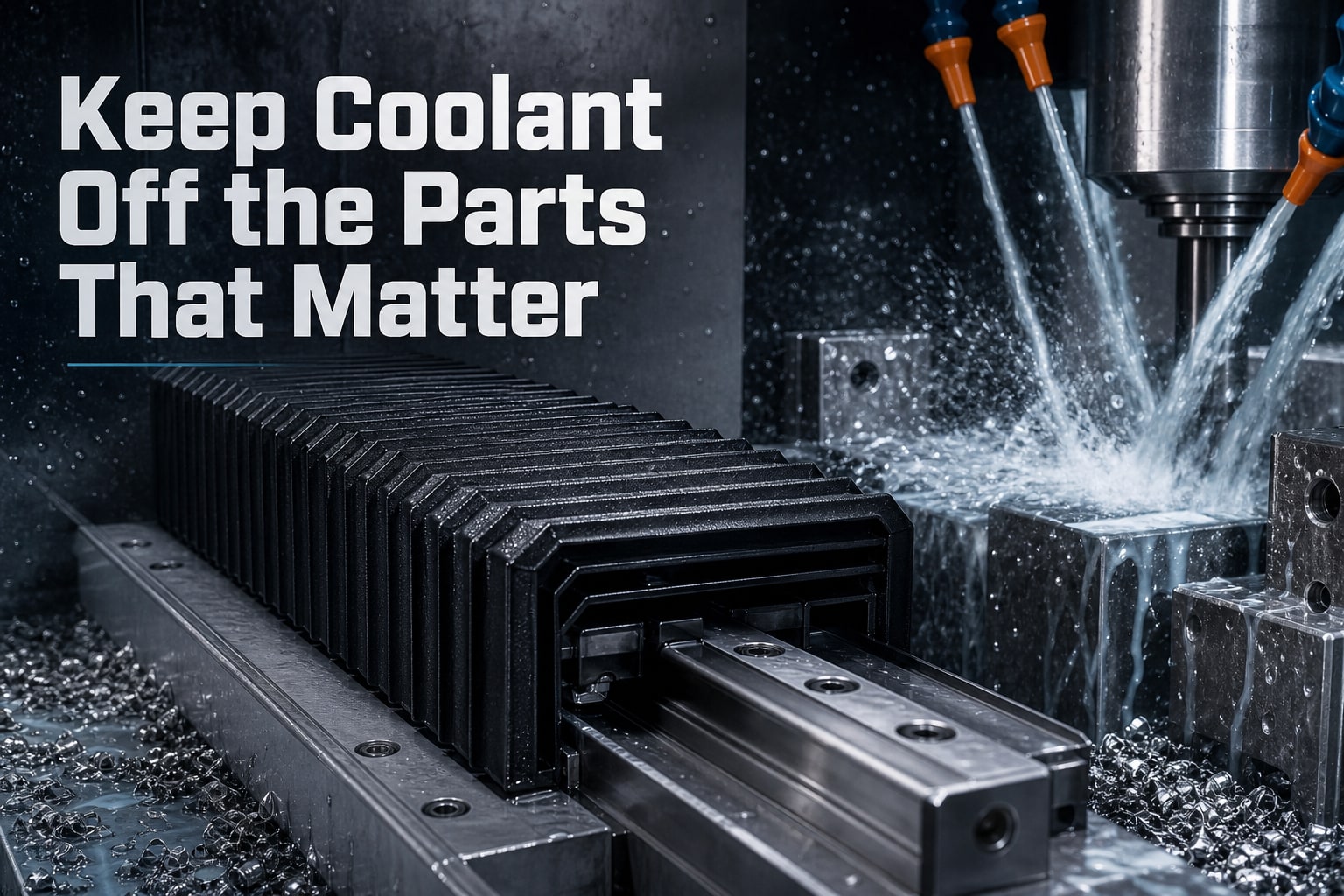
Coolant reaches guideways, ballscrews, encoders and electrical connectors through gaps, worn wipers, open cable routes and poorly drained surfaces. By the end, you will be able to match the cover design, material, dimensions and maintenance plan to the coolant exposure your machine actually faces.
Key takeaways
- Use liquid-tight barriers, sealed joints and drainage paths to keep coolant away.
- Check coolant pressure, concentration, temperature and chemical compatibility before choosing a cover.
- Measure travel, speed, acceleration and clearance before specifying the cover fit.
- Inspect wipers, seams, fasteners and drains regularly to prevent coolant ingress.
Why coolant damages machinery even when chips stay out
A machine cover for coolant protection must stop liquid, not only chips. Water-based flood coolant wets surfaces and travels through worn wipers, joints, drain holes, and capillary gaps at folded bellows sections.
Synthetic coolant can carry alkaline additives or biocides into seals and electrical connectors; soluble oil leaves an emulsion film that dries to residue, while straight cutting oil creeps along surfaces and remains oily. Chips staying outside proves little.
| Coolant type | Main route or damage | Why chip protection fails |
|---|---|---|
| Water-based flood coolant | Wets, pools, and seeps through joints and worn wipers | Liquid reaches guideways even when large chips are excluded |
| Synthetic coolant | Carries alkaline additives or biocides into seals and connectors | Chemical attack continues without visible chips |
| Soluble oil | Leaves an emulsion film that dries into residue | Deposits restrict movement and hold abrasive fines |
| Straight cutting oil | Creeps along surfaces and penetrates narrow gaps | Oil migration bypasses a chip barrier |
Splash and mist settle on exposed surfaces; chip-laden coolant adds abrasive particles. Continuous flood coolant follows drainage paths, while liquid under pressure can drive beneath a wiper or into a bellows fold. A splash-rated cover is not automatically a high-pressure barrier.
Use overlapping panels, sealed edges, wipers, sloped surfaces, and a controlled drain path; excessive wiper pressure raises friction and wear, while insufficient pressure leaks coolant.
How a cover separates coolant from the machine
A cover separates coolant from the machine by combining overlapping panels, moving seals and a planned drainage route. This layered design supports coolant exclusion and machine guideway protection rather than relying on a splash shield alone.
- Overlapping panels give the cover its structure, absorb chip and impact loads, and shield joints as sections move.
- Replaceable cover wipers form the principal moving seal. The metal overlap alone does not stop coolant from passing through a travelling joint.
- Sealed edges close fixed gaps where liquid could run behind the cover and reach a guideway or drive.
- Sloped panels shed coolant instead of allowing it to pool on folds or horizontal surfaces.
- Drainage channels carry liquid toward defined outlets. Low points prevent trapped coolant from collecting inside the cover.
- Controlled cable and service openings use positioned seals or collars rather than leaving an unrestricted path into the protected area.
Wiper pressure is a precise trade-off. Too little contact lets coolant and fine chips pass beneath the wiper; too much pressure increases friction, heat, wiper wear and drive load, forcing the machine to work harder during travel.
Keep the drain route accessible for inspection. A blocked channel or sealed cavity retains coolant and chips until liquid overflows at the cover’s travel limit, turning a small maintenance fault into contamination of the guideway or drive.
Match the cover to coolant pressure, chemistry and movement
Match the cover to coolant pressure, chemistry and movement before selecting a material. A cover that handles splash may fail when a jet drives liquid beneath a wiper or into a folded section.
| Cover type | Axis, movement and speed | Suitable exposure and limits |
|---|---|---|
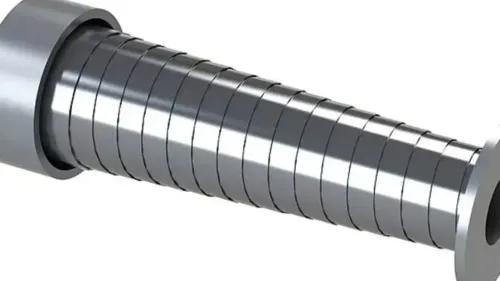
| Telescopic steel covers | Horizontal or vertical linear travel; suited to guided, high-speed axes | Continuous flood and metal-chip impact; specify wipers and drainage for high-pressure coolant |
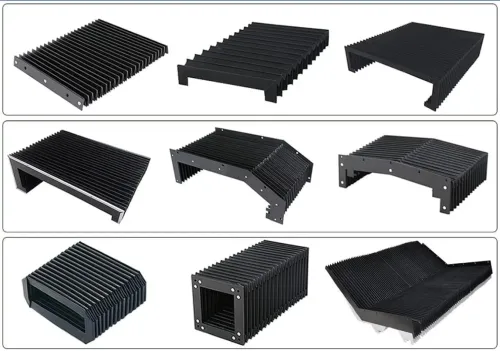
| Bellows covers | Linear or multi-axis travel, including compact spaces; suit the machine’s acceleration and folding rate | Splash, mist and moderate flood; folds require protection from chips and jets |
| Apron covers | Long horizontal or vertical travel; speed depends on slat joints and guidance | Heavy chips and flood coolant; less suitable for tight bends or high-pressure through-tool coolant |
| Roll-up covers | Straight travel with limited installation depth; match winding speed and acceleration | Mist and splash; verify drum sealing before using with continuous flood |
| Fixed enclosures | No travel; openings remain controlled | Flood, mist and high-pressure coolant around stationary zones; provide a deliberate drain path |
Specify coated steel or stainless steel where impact and chip resistance dominate. Use coated fabric or polyurethane bellows when flexibility and low mass matter. Select elastomer seals by immersion and temperature testing, not by appearance.
Check coolant-resistant materials against the actual mixture, concentration, temperature, tramp oil, biocide, additives and cleaning chemicals. “Water-resistant” does not prove resistance to alkaline soluble oil, straight cutting oil or caustic wash fluid. Record pressure, nozzle distance, jet direction and service life, especially for high-pressure coolant.
Specify the fit before choosing a machine cover
Specify the fit before choosing machine protection covers for coolant: provide the cover’s closed length, extended length, width, height, fold height or panel pitch, number of folds, guideway geometry, mounting points, surrounding clearance, and full axis travel.
| Data | What to provide | Why it matters |
|---|---|---|
| Closed and extended dimensions | Fully compressed and fully open lengths | Prevents bottoming out or stretching at either end |
| Machine geometry | Guideway profile, mounting points, openings, width, height, and clearance | Keeps seals aligned without rubbing or blocking adjacent parts |
| Motion conditions | Axis travel and acceleration, speed, cycle frequency, reversals, and vibration | Prevents fold flutter, panel impact, and wiper wear |
Cover sizing must include the machine’s end positions, not only its nominal stroke. A bellows designed for stroke alone can bottom out before the axis reaches its limit, stretch under extension, rub against itself or the guideway, and obstruct motion.
Give the supplier a drawing or measured layout showing fixed and moving attachment points, nearby tools, hoses, and the smallest available clearance. Record whether the cover sits horizontally or vertically, because pooled coolant and liquid running behind an upper attachment require different drainage and sealing details.
SCUTES INDIA PRIVATE LIMITED is useful when these measurements and motion data must become a buildable telescopic, bellows, or roll-up cover design rather than a generic size. Ask for the proposed compressed length, extension, fold pitch, mounting arrangement, and clearance check before approving fabrication.
Related products
 | Machine Covers Machine covers are specially designed shields used to protect industrial equipment and machinery from environmental elements. View product → |
 | TELESCOPIC COVERS A telescopic cover protects guide-way surfaces and components of moving axis of machines. View product → |
Keep coolant protection working after installation
Prevent gradual coolant leakage by scheduling machine cover maintenance around duty cycle, not only the machine’s service calendar. Increase inspection frequency when the axis runs continuous flood coolant, high cycle counts, rapid reversals or heavy chip loads; these conditions wear seals before a calendar-based service is due.
Check the cover for:
- Hardened, cut, swollen or chip-embedded wipers, and replace them before they lose contact.
- Loose fasteners, damaged seams, distorted panels or worn folds that open during travel.
- Blocked drains, pooled coolant and any coolant leakage onto the protected way.
- Unsealed cable openings where liquid can follow a cable into the machine.
- Chips trapped beneath wipers or inside folds, where they create a gradual leak path.
Require replaceable wipers and other wear parts rather than a cover that must be discarded after seal wear. Keep drain paths accessible for cleaning, and confirm that horizontal surfaces shed coolant instead of holding pools; vertical covers must stop liquid from running behind upper attachments.
Put the operating limits in writing: coolant type, concentration range, operating temperature, cleaning agents, chip form, pressure, axis travel and required service life. Record inspection findings and the date of each replacement. A cover marked only “coolant resistant” gives you no testable basis for predicting service life or diagnosing leakage.
Frequently asked questions
Why does coolant damage machinery when chips stay out?
Flood coolant wets exposed surfaces and enters through worn wipers, joints, drain holes and capillary gaps, causing corrosion, lubricant contamination and failures.
How does a machine cover separate coolant from equipment?
A cover forms a barrier over guideways and moving parts, while sealed overlaps, wipers, protected seams and correctly directed drainage limit liquid entry.
What coolant factors determine the right machine cover?
Match the cover to coolant pressure, flow direction, temperature, concentration and chemistry, then confirm its materials resist swelling, cracking and corrosion.
What should you measure before choosing a machine cover?
Record the protected length, compressed and extended dimensions, travel direction, speed, acceleration, available clearance, mounting points and nearby interference.
Related products
 | TELESCOPIC SPRING COVER Telescopic Spring Covers provide protection under extreme conditions. View product → |
 | Laser Machine Bellows Laser Machine Bellows are specialized protective coverings designed to safeguard the vital internal components of laser machines. View product → |
 | APRON COVER Effectively engaged in offering a vast collection of outstanding quality products which include Apron Covers. View product → |