
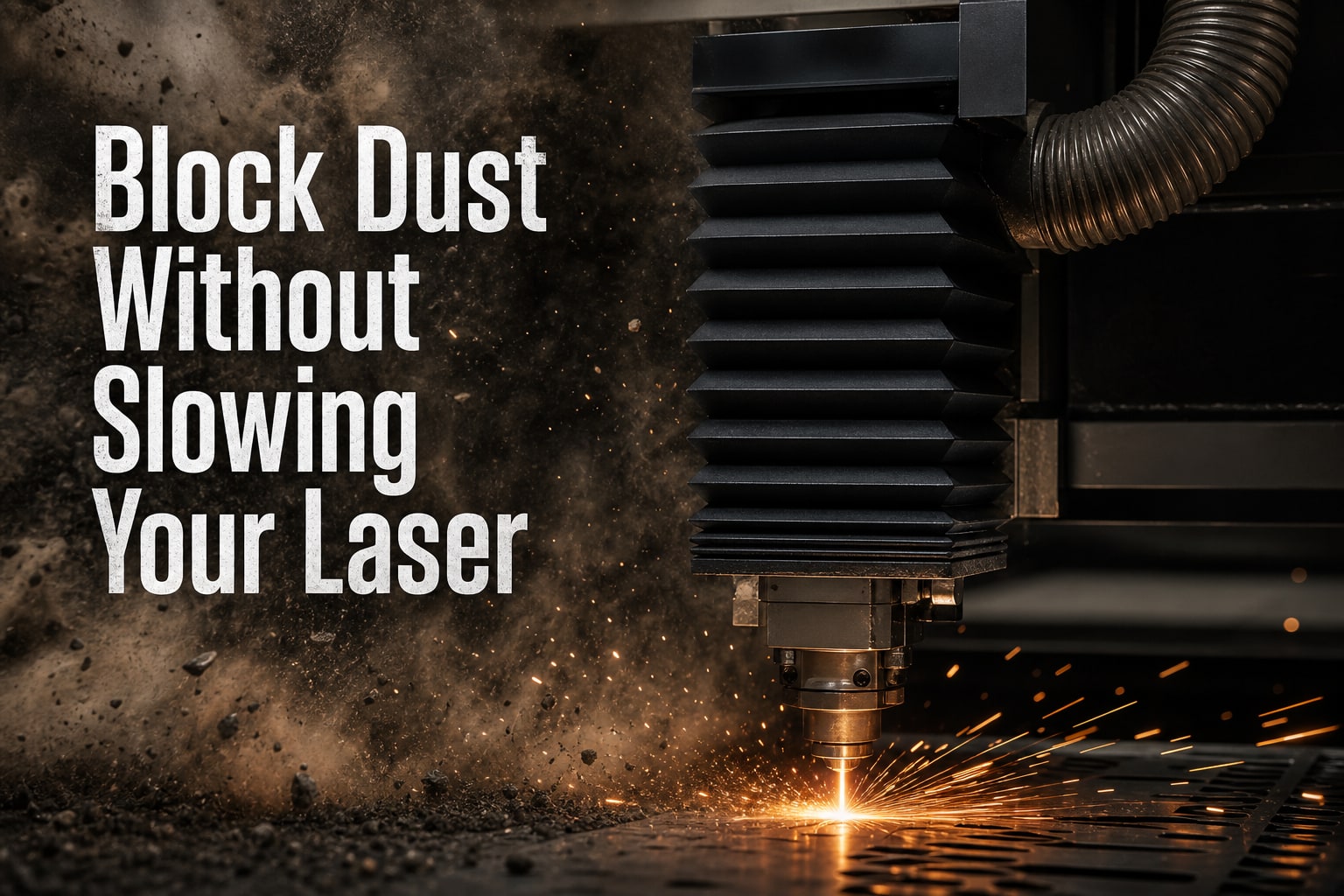
Dust protection fails when a cover rubs against the axis, traps hot debris, or is expected to perform the work of fume extraction. You will be able to match the cover geometry, dimensions, materials and test method to the machine’s actual movement and cutting conditions.
Key takeaways
- Match cover geometry to the machine’s movement and contamination path.
- Leave smoke, airborne dust and heat management to correctly sized extraction.
- Check clearances, bend radius and friction at full production speed.
- Test hot-spatter resistance, sealing, cleaning and service access before approval.
What a dust cover protects—and what it leaves to extraction
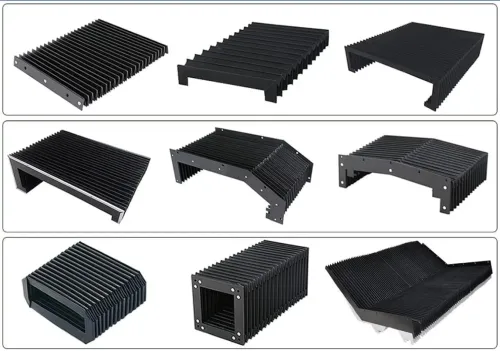
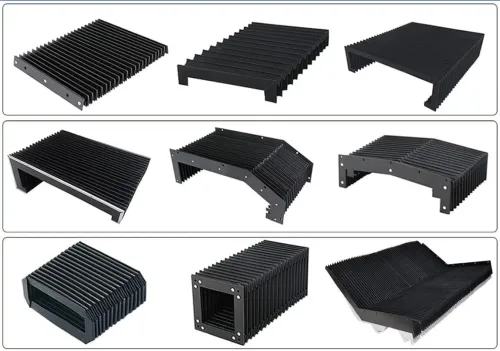
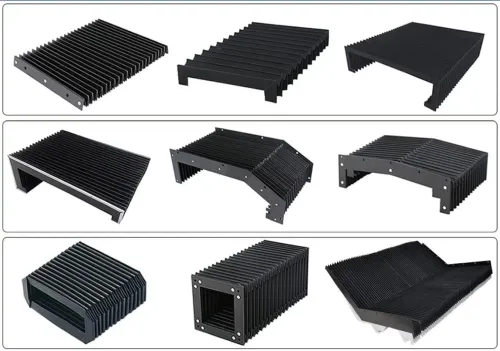
A laser machine cover against dust must stop airborne shop dust, metallic fines, smoke residue, hot spatter, partially molten slag and cutting debris before they settle on the machine’s moving mechanism. Dust pulled through cooling or ventilation systems follows the same route.
It reaches guideways, bearings, ballscrews, racks, cables and linear scales, increasing friction, wearing seals, fouling measurement surfaces or restricting travel. The cover protects these parts and the surrounding structure; it does not make the laser optics or cutting head clean.
| Protection measure | Stops or removes | Boundary |
|---|---|---|
| Bellows or enclosure | Settled dust, fines and cutting debris around axes | Protects guideways, bearings, ballscrews, racks, cables and scales; does not replace extraction |
| Source-capture fume extraction | Smoke and airborne fines at the cut | Removes emissions; does not seal the mechanism |
| Optical protection system | Spatter and contamination at lenses and the cutting head | Protects optics; does not protect guideways |
| Laser-safety enclosure | Direct and reflected laser exposure | Requires a separate safety assessment |
Extraction pressure can pull a flexible bellows inward, causing it to rub the moving member, collapse into the travel path or increase axis load.
Test airflow and cover motion together through the full programmed stroke at maximum speed and acceleration, using representative dust or spatter while checking force, noise, fold interference, seal wear and guideway contamination.
An opaque or dust-tight cover is not automatically a laser-safety enclosure. Assess wavelength, power, reflected exposure, seams, inspection windows and service openings separately against applicable laser-safety requirements.
Choose the cover geometry from the movement and contamination
Choose the cover geometry from the travel path and debris load, not from stroke alone. A laser machine cover against dust must clear the carriage through its full motion; a collapsed cover that is too long, tall or wide can strike adjacent equipment or enter the work envelope.
| Option | Best fit | Trade-off |
|---|---|---|
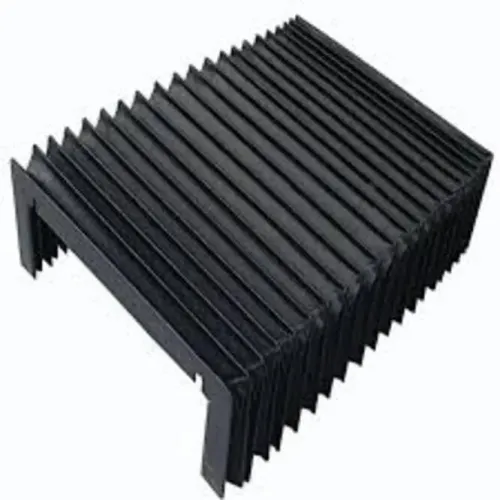
| Bellows | Guided, low-friction movement and moderate dust | Needs sufficient fold radius and sealed interfaces; non-contact folds reduce drive load but do not seal every joint |
| Telescopic steel cover | Hot chips, sparks, abrasive fines and molten spatter | Adds moving mass and needs overlap clearance between steel boxes; wipers wear |
| Roll-up cover | Long travel where side or end space is limited | Saves space when retracted but needs controlled winding and a protected edge |
| Apron cover | Straightforward shielding over a simple linear path | Easy to arrange, but exposed surfaces and gaps can limit exclusion |
| Brush-wiper arrangement | A moving interface that needs a replaceable contact element | Brushes wear and do not create a sealed enclosure |
Measure these before specifying the cover:
- Travel length, compressed length and extended length; include fold height, number of folds and end allowances.
- Width, height, mounting face and minimum bend radius.
- Axis speed and acceleration, including the programmed maximum.
- Clearance around the laser head, cutting head, carriage and complete work envelope.
- Clearance for telescopic overlap, roll-up winding and brush replacement.
Run the selected cover through the full stroke with extraction operating. Check fold interference, cover force, noise, seal or wiper wear, and contamination on the protected guideway.
Keep the cover moving freely at production speed
A laser machine cover against dust can block contamination without increasing axis load when its folds have low-friction faces, the specified compression ratio and enough fold recovery to open fully at speed.
Guide the cover so it follows the axis rather than rubbing sideways; choose mounting points that stay aligned, and preserve clearance from the laser head, carriage and workpiece throughout travel. A compressed cover that exceeds its available envelope can buckle into the work zone.
- Check cover mass and drag at production acceleration, not by hand at rest.
- Run full-stroke reversals and watch for vibration, delayed fold recovery, noise and buckling.
- Test extraction with cover motion: negative pressure can pull a bellows inward, causing rubbing, collapse or added axis load.
- Use separate strain relief and independent support for hoses and cable carriers; torsional or cable-bundle loads must not twist an axis-mounted cover out of alignment.
- Keep the cable carrier’s job separate: it controls cable routing and dynamic bend radius; the cover blocks contamination and mechanical damage.
- Confirm the cable manufacturer’s dynamic minimum bend radius; it controls even when the cover survives a tighter fold.
Run the acceptance test through the full programmed stroke at maximum speed and acceleration, with representative dust or spatter exposure. Measure cover force, listen for abnormal noise, inspect fold interference and seal wear, and check contamination on the protected guideway.
Build for hot spatter, fine dust and cleanable surfaces
Specify a laser machine cover against dust by the debris and chemistry, not by appearance. Fine metal dust needs tightly woven, cleanable fabric or sealed steel, a low-snag coating, sealed seams with compatible thread, and minimal adhesive. Hot spatter and partially molten slag favour overlapping steel, heat-resistant fabric zones, protected fasteners, and sacrificial wipers.
Lubricants, coolant, oil and corrosive condensate require materials tested against the actual fluids.
1. Reject horizontal folds and ledges: they collect dust and slag. Use sloped or outward-facing surfaces, shallow serviceable folds and accessible clean-out areas. Check for incorrect folds, gaps, damaged seams, poor end-frame sealing, unsuitable orientation and excessive reinforcement that makes the bellows stiff.
2. Specify cleaning with the cover. Use a supplier-approved neutral aqueous detergent or isopropyl alcohol only when the coating, adhesive and thread tolerate it; prohibit unapproved solvents, scraping and uncontrolled high-pressure air that drives particles past seals or redeposits them in folds.
3. Inspect the cover at every shift change and examine seams, end frames, fasteners and wipers weekly. Replace a wiper at its wear limit, and replace fabric, adhesive or steel components when tearing, swelling, corrosion, loss of contact or a sealing gap appears; record the interval and findings.
Aluminium, titanium and other reactive-metal dust can burn or explode. Maintain housekeeping, bond and ground conductive parts, control ignition sources, and review dust collection and explosion-control requirements with a competent specialist; the cover does not replace that assessment.
Specify and test the cover before it earns its place on the machine
A laser machine cover against dust earns its place only when it protects the axis without adding drive load, collisions or maintenance delays. Compare the design against the machine’s actual contaminants and envelope, then verify it under production motion, not from a generic size chart.
| Option | Temperature and particle sharpness | Collapsed space | Seal level | Mass | Access and replacement parts |
|---|---|---|---|---|---|
| Bellows | Cool-to-warm fines; blunt particles | Small | Medium; add flanges or wipers | Low | Easy access; folds and seals |
| Telescopic steel | Hot, sharp chips | Needs overlap clearance | High with sound wipers | High | Wipers and boxes need service |
| Roll-up | Cool dust; no sharp spatter | Very small | Low to medium | Low | Roller and curtain access |
| Apron | Warm debris; limited sharpness | Small to medium | Medium | Medium | Slats, guides and fasteners |
| Brush-wiper | Dry fine dust; low heat | Minimal | Targeted, not full enclosure | Low | Brushes are replaceable |
- Request a supplier drawing recording every measured dimension, mounting face, fold radius, compressed and extended lengths, clearances, material construction, compatible cleaners and cable-support arrangement. Ask SCUTES INDIA PRIVATE LIMITED for material justification, a dynamic test plan and a maintenance procedure tied to that drawing.
- Run the full programmed stroke at actual maximum speed and acceleration with representative dust or spatter exposure. Record cover force, noise, fold interference, reversal behaviour, seal or wiper wear, airflow effects and contamination on the protected guideway; reject any design that passes protection but restricts motion or service access.
Related products
 | Laser Machine Bellows Laser Machine Bellows are specialized protective coverings designed to safeguard the vital internal components of laser machines. View product → |
 | Machine Covers Machine covers are specially designed shields used to protect industrial equipment and machinery from environmental elements. View product → |
Frequently asked questions
What does a laser machine cover protect, and what does extraction handle?
The cover shields moving mechanisms from dust, metallic fines, smoke residue, hot spatter, slag and cutting debris. Extraction removes airborne smoke, dust and heat from the cutting area; the cover cannot replace it.
How do you choose cover geometry for a laser machine?
Start with the axis travel, speed, bend direction, available clearance and contamination path. Select geometry that protects the mechanism without rubbing, folding into the travel envelope or trapping debris.
How do you keep a laser machine cover moving freely?
Check the cover’s bend radius, mounting alignment, guide clearances and friction at full production speed. Run the complete travel cycle and inspect for snagging, compression and heat-related distortion.
What should you test before approving a laser machine cover?
Test exposure to fine dust, metallic debris, hot spatter and cleaning methods. Confirm sealing, surface cleanability, service access, movement clearance and performance during production-speed operation.
Related products
 | TELESCOPIC COVERS A telescopic cover protects guide-way surfaces and components of moving axis of machines. View product → |
 | Roll Up Cover A roll-up cover is a highly durable and flexible protective solution designed to safeguard machinery, equipment, and valuable assets from dust,... View product → |
 | NYLON AND METAL BRUSH WIPER Our Nylon and Metal Brush Wipers are high-performance industrial cleaning components designed for efficient wiping, cleaning, and surface finishing... View product → |
 | TELESCOPIC SPRING COVER Telescopic Spring Covers provide protection under extreme conditions. View product → |