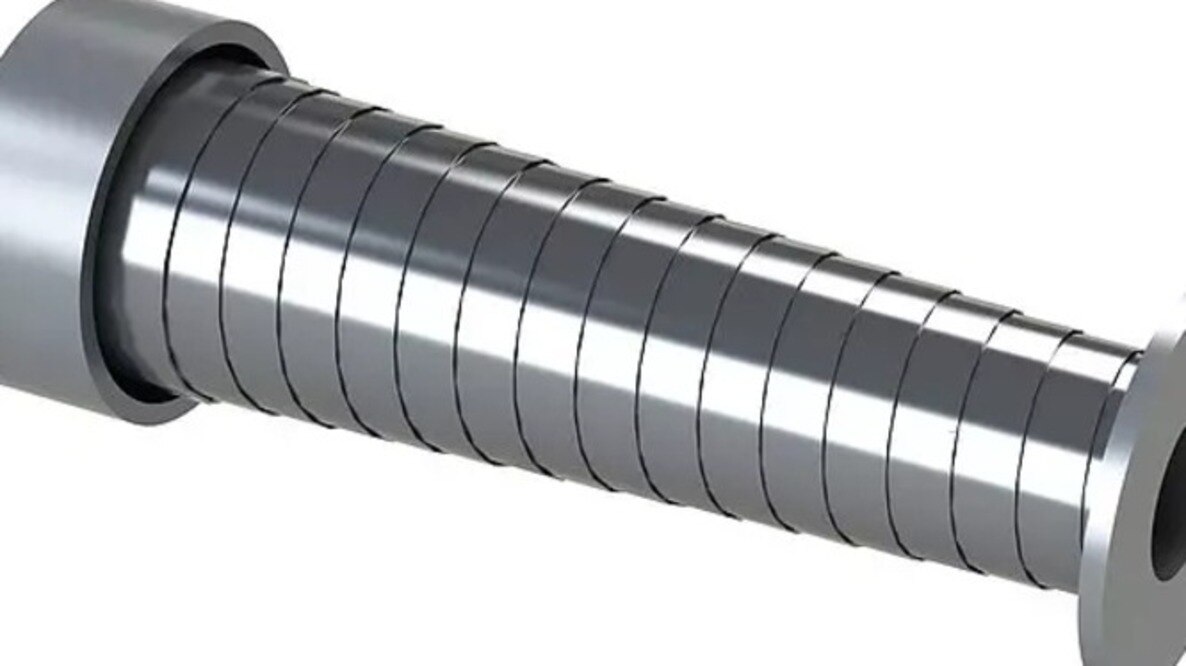
The correct roll-up cover depends first on the direction of travel, not simply the machine’s opening size. By comparing axis orientation, gravity, contamination, clearance and movement data, you can prepare a specification that distinguishes a suitable cover from one that will sag, bind, overload its roller or fail in service.
Key takeaways
- Trace curtain travel before choosing vertical or horizontal construction.
- Measure opening, stroke and the full installation envelope.
- Match materials and seals to chips, coolant, oil and heat.
- Confirm guides, winding space and safe maintenance access.
Match the Cover to the Machine’s Direction of Travel
Choose the arrangement by tracing the curtain’s movement, not by measuring the opening alone: vertical covers travel up or down over an opening, while horizontal covers travel along the machine bed from a roller at one end.
| Installation | Roller and movement | Main design concern |
|---|---|---|
| Vertical | Above or below the opening; curtain rises or descends | Control weight, sag, drainage and uncontrolled descent |
| Horizontal | At one bed end; curtain travels along the axis | Positive side guidance, anti-lift control and buckling resistance |
| Axis-aligned | Parallel with the protected linear axis | Match stroke, guide engagement and moving clearances |
For a vertical machining centre, turning centre or linear-axis enclosure, specify whether the roller is top-facing or bottom-facing and whether the curtain is gravity-assisted, spring-balanced, counterweighted or motor-driven. That choice affects drive torque, drainage and emergency behaviour if a spring, belt or fixing fails.
A horizontal machining centre needs more than a curtain that fits its width. Top-facing installations need support against sag and packed chips; side-facing installations need retention against lateral escape. Roll up machine cover applications also include inspection equipment and automated cells, where axis direction still determines the cover.
A horizontal machine roll up cover in Kolkata must be specified by travel direction and mounting face, not by width alone. Record the bed direction, roller end, support span, anti-lift arrangement and whether chips fall onto the curtain before requesting a quotation.
Measure the Opening, Stroke and Installation Envelope
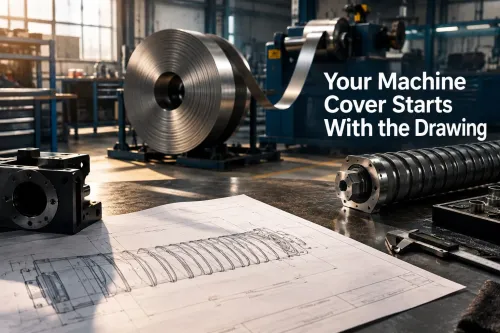
1. Record the protected width, opening height and full axis stroke in millimetres. Mark whether the curtain travels upward, downward, sideways or along the axis; note the roller location, mounting face, fixed-end position and moving-end position.
2. Measure guide length, end clearances, attachment and clamp zones, available rolled-pack diameter, required bend radius and every interference point, including axes, tooling, doors, hoses, cable carriers, chip conveyors and guarding. Photograph the machine with a scale in view.
3. Specify curtain length as the opening or stroke plus the rolled portion, guide engagement, fixing allowance and service reserve. Without the reserve, the curtain can pull out of its clamp or reach the roller before full travel.
A smaller roller saves space but can exceed the curtain’s bend stress, raise drive torque and shorten service life.
4. Add maximum speed, acceleration, deceleration, reversals per hour, cycle count per shift and moving curtain mass. For a roll up cover for vertical machine in Kolkata, state whether chips fall onto the curtain and whether the roller sits above or below the opening.
5. Attach an enquiry schedule containing: dimensioned plan and elevation drawing; opening, stroke and all clearances; roller and guide positions; travel direction and mounting face; bend radius and rolled diameter; fixed and moving end coordinates; attachment zones; machine photographs; and a marked-up machine layout showing every interference point.
Ask the supplier to confirm the proposed curtain length, roller diameter and service reserve against those measurements.
Select the Construction for Chips, Coolant and Heat
Loose dry chips suit a light roll-up design; sticky swarf, hot impact and flooding do not. The right choice in roll up machine cover applications depends on how contamination arrives, where it drains and whether the cover must carry a load.
| Construction | Best fit | Main limit |
|---|---|---|
| Fabric or coated curtain | Dry chips, abrasive dust, coolant mist, oil | Tears from sharp swarf, sparks and hot chips |
| Slat-based roll-up assembly | Dry or abrasive chips; moderate coolant | Joints need overlap, wipers and cleaning |
| Bellows | Mist, dust and axis movement | Packed chips, sharp swarf and direct jets |
| Apron cover | Chips, oil and coolant on broad openings | Poor choice for tight winding or high-speed reversals |
| Telescopic steel cover | Sharp swarf, hot chips and rigid protection | Heavy, space-intensive and not hermetic |
| Telescopic spring cover | Compact, light-to-moderate contamination | Not for heavy chips, flooding or high-temperature impact |
Direct hot-chip impact, sharp swarf, coolant flooding, high-pressure jets, packed chips on a top-facing cover or a requirement for rigid load-bearing protection can rule out a standard roll-up design. A top-facing cover needs slope, chip-shedding geometry, drainage and accessible cleaning points; otherwise debris increases curtain load and blocks guides.
Ask for:
- Curtain material, coating, temperature range, coolant and oil compatibility
- Strip overlap, wipers, scrapers, seals and resistance to welding sparks
- Drainage route, cleaning access and the supplier’s stated chip-size and coolant-pressure limits
A roll-up cover is not hermetic. Drainage and maintenance matter more than the product name.
Check the Guides, Winding System and Safety Boundary
Attachment, guides and the winding method determine whether the cover tracks reliably or jams. Specify the curtain fixing, side-guide profile, minimum guide engagement, tensioning method, end stops, seals, winding direction and how technicians will remove the curtain without dismantling the machine.
| Balancing method | Drive torque and emergency behaviour |
|---|---|
| Spring-balanced | Reduces lifting torque; a broken spring can cause sudden descent or loss of control. |
| Counterweighted | Reduces motor load; a failed cable, pulley or fixing can release stored counterweight energy. |
| Gravity-assisted | Simplifies downward travel; the drive and end stops must prevent uncontrolled descent. |
| Motor-driven | Handles heavier curtains directly; loss of power requires a defined brake, holding system or safe stopping method. |
For horizontal travel, require anti-lift retention, a stated maximum unsupported span and resistance to flutter during acceleration, deceleration and reversal. Poor support lets the curtain buckle, lift from its guides or strike the moving axis.
Check these fitting risks before approval:
- Rolled clearance is too small for the curtain pack.
- The curtain rubs against the spindle, slide or moving axis.
- A span lacks support, or the winding direction is reversed.
- Coolant collects behind the lower edge instead of draining.
- Chips fall directly onto a roller and damage its bearings or seals.
A cover protects a guideway, cable or hose from contamination; it is not personnel guarding. Keep fixed guards, interlocks and safety-distance controls required by the machine risk assessment. Power and signal cables still need a separately engineered energy chain or cable carrier with suitable bend radius, attachment and strain relief.
Prepare a Kolkata Supplier Brief and Plan Service Access
Send an industrial roll up cover supplier in Kolkata a complete machine pack, not only the opening width. Include plan and elevation drawings, photographs with a scale, machine make and model, opening and stroke dimensions, axis speed and acceleration, contamination details, mounting constraints and service-access requirements.
Ask the supplier to return:
- A dimensioned installation drawing showing roller, guide, fixing and service clearances.
- Curtain material, coating, temperature range, compatible coolant and oil data.
- Rated speed, acceleration, cycle count, reversal limits, chip-size and coolant-pressure limits.
- Cleaning instructions, tensioning and end-stop adjustment procedures.
- Spare curtain or slat availability and replacement lead time.
Compare quotations against the same technical scope:
| Option | Check before approval | Why it matters |
|---|---|---|
| Vertical roll-up | Gravity control, roller access and descent behaviour | Prevents sag, overload or uncontrolled movement |
| Horizontal roll-up | Side guides, support span and anti-lift arrangement | Limits flutter, buckling and lateral escape |
| Any arrangement | Installation time, downtime, guide access and rolled-pack clearance | Exposes the real cost beyond purchase price |
A Kolkata manufacturer such as SCUTES INDIA PRIVATE LIMITED should be evaluated by its proposed mounting arrangement, maintenance procedure and declared operating limits, not by price alone.
Before handover, check chip removal, curtain tracking, fabric or slat damage, guide wear, seal condition and winding performance. Record failures after cleaning and after full-speed reversals; a cover that runs empty can still jam when chips pack into its guides.
Related products
 | Roll Up Cover A roll-up cover is a highly durable and flexible protective solution designed to safeguard machinery, equipment, and valuable assets from dust,... View product → |
 | Machine Covers Machine covers are specially designed shields used to protect industrial equipment and machinery from environmental elements. View product → |
Frequently asked questions
How do you choose a roll up cover for a vertical machine in Kolkata?
Choose a vertical arrangement when the curtain travels up or down over the machine opening. Confirm the opening size, stroke, winding space, guide arrangement and the contaminants the cover must resist.
When does a horizontal machine roll up cover in Kolkata fit?
Use a horizontal arrangement when the curtain travels along the machine bed from a roller at one end. Check the travel length, available roller space, support guides and clearance from moving machine parts.
What measurements does a roll up machine cover application require?
Provide the opening width and height, travel or stroke, mounting points, roller location, guide clearance and the complete installation envelope. Include obstructions, access panels and the machine’s safe boundary.
What should you include in an industrial roll up cover supplier brief in Kolkata?
State the machine direction, opening and stroke, chip and coolant exposure, operating temperature, required materials, guide layout, winding system, safety boundary and planned service access.