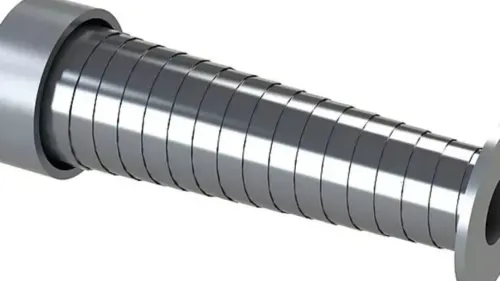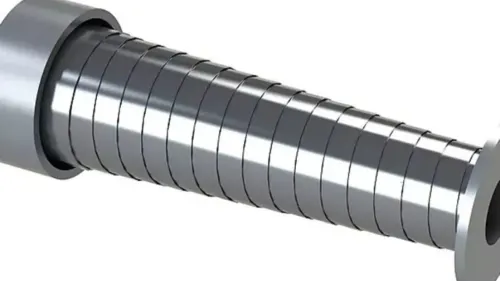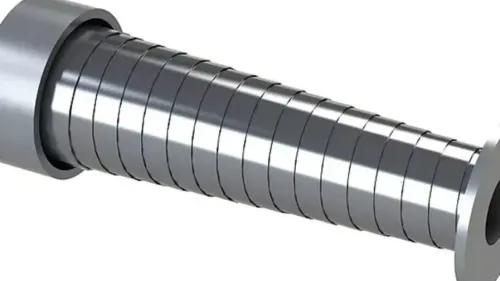
A spiral spring machine cover is built around a continuously wound steel strip, but reliable operation depends on far more than rolling metal into a coil. You will learn how to read the machine drawing, follow each factory production stage, compare cover types, and prepare the measurements and service details needed for a sound design.
Key takeaways
- The cover extends by uncoiling and retracts through nested spring-steel turns.
- Machine travel, opening size and mounting space determine the cover design.
- Factory production includes strip preparation, winding, fittings, treatment and assembly.
- Check travel clearance, mounting alignment and smooth retraction before commissioning.
What a Spiral Spring Machine Cover Is and How It Moves
A spiral spring machine cover protects an exposed guideway or shaft with a continuously wound spring-steel strip. As the machine moves, the strip uncoils from a compact roll to span the opening, then retracts as nested turns. The cover travels with the machine instead of folding into fabric pleats through every commanded extension and return.
How spiral spring machine covers are made depends on controlled winding, not simply rolling sheet metal. In spiral spring cover production, the strip is formed around a mandrel so its coil diameter, winding direction, residual stress, and retraction force remain predictable. Overlapping turns preserve coverage; overlap changes with travel, speed, strip width, and coolant exposure.
Aligned end attachments prevent binding; skewed faces make retraction uneven. This compact design handles chips and splash, but carries little load and is not an impact guard. Unlike a telescopic steel cover, it retracts into a smaller roll; unlike a sealed bellows, it does not form a continuous flexible envelope.
How the Machine Drawing Determines the Cover Design
The machine drawing fixes the cover geometry before any strip is wound. Measure the opening width, required travel, retracted length, installation envelope, and fixed and moving mounting faces; then add the operating loads that the drawing alone cannot show.
| Input from drawing or application | Design decision | Why it matters |
|---|---|---|
| Opening width and required overlap | Strip width | A narrow strip leaves gaps; excessive width increases coil size and rubbing at the edges. |
| Travel, acceleration and stopping distance | Strip thickness and spring force | High-speed reversals or sudden stops can buckle a light strip or make the cover rebound. |
| Retracted envelope and available diameter | Coil diameter and winding direction | A coil larger than the envelope collides with nearby guards, tooling or the machine frame. |
| Travel, strip thickness and overlap per turn | Number of turns and compressed length | The retracted package must fit without forcing adjacent turns apart. |
| Fixed and moving mounting points | End fittings and alignment | Skewed faces make a correctly wound cover bind or telescope unevenly. |
| Chips, coolant, dust and temperature | Edge form, clearances and material allowance | Abrasive chips can enter a loose seam, while heat and coolant affect spring force and service life. |
The spiral spring machine cover process therefore uses the motion profile, not travel alone, to set dimensions. Confirm the machine’s maximum speed, acceleration, stopping behaviour, chip load and coolant direction before approving the design. The final compressed length includes the wound coil plus end attachments, so reserve clearance for both.
The Material and Strip-Preparation Stages
The strip is selected from the duty, not from width alone. Manufacturers compare spring-steel grade, thickness, width, temper, yield strength, residual stress and forming radius against the required travel, coil diameter and return force. Stainless spring steel suits corrosive coolant or washdown exposure; carbon spring steel suits controlled environments when corrosion protection is available.
The material and edge-preparation sequence is:
1. Review the drawing and operating conditions, including acceleration, stopping shocks, chip size, coolant chemistry, temperature and daily cycles. These loads determine whether the strip needs greater thickness, higher strength or corrosion-resistant steel.
2. Receive strip with traceable grade, thickness and temper records. Check thickness across the coil and reject material with waviness, cracks, laminations or excessive residual curl; those defects can create uneven winding and permanent set.
3. Slit the coil or blank sheets to the specified strip width. Hold the width consistently because variation changes the nested-turn fit and can make the cover bind during extension.
4. Remove slitting burrs and sharp corners by controlled deburring, edge rolling or light edge radiusing. A neglected burr can score guide surfaces, cut seals, shed chips into the mechanism or start a fatigue crack.
5. Clean and inspect both faces and edges before winding. Remove oil, loose particles and abrasive residue, then verify that the prepared edge is continuous rather than locally sharp or thinned.
These machine cover manufacturing steps protect the strip before forming begins. Edge treatment does not compensate for poor alignment or trapped chips; the finished coil still needs a clean winding path and suitable drainage.
The Ordered Factory Process: Winding, Fittings, Treatment and Assembly
After the strip has been slit, deburred, and edge-radiused, spiral spring cover production proceeds in a controlled sequence. Each operation preserves the coil’s geometry and ensures that the finished cover follows the machine axis instead of binding or tracking sideways.
1. Wind the strip around a specified mandrel or forming tool. The operator controls winding direction, coil diameter, pitch, and forming force; too much force flattens the strip, while too little leaves inconsistent spring set.
2. Set the coil through controlled forming or stress-relief operations. This stabilises residual stress so the cover retracts evenly and does not retain a permanent bend after extension.
3. Prepare the strip ends. Cut them to the drawing, remove sharp corners, and create the profiles needed for fixed and moving attachments.
4. Fit end flanges, brackets, pins, or other mounting hardware. These parts transfer spring force into the machine frame and moving member, so their faces must match the specified mounting points.
5. Align the hardware with the travel axis. A skewed flange can make an otherwise accurate coil rub, bind, or telescope unevenly.
6. Clean and apply the specified surface treatment. Degreasing, protective coating, plating, or another finish is selected for coolant, moisture, heat, and abrasion exposure; sliding and contact surfaces must retain their required movement.
7. Complete final assembly with guides, spacers, fasteners, and any protective seals shown on the drawing. Extend and retract the assembled cover by hand or on a fixture to detect interference before it reaches the machine.
These machine cover manufacturing steps turn a prepared spring strip into a mountable, application-specific assembly rather than a simple rolled sheet.
Inspection, Installation Fit and Choosing the Right Cover Type
A finished spiral cover is tested for smooth travel, correct spring force, and mounting alignment. Inspect the strip for sharp edges, cracks, dents, uneven winding, and contact marks; then extend and retract it through the full stroke without binding, rubbing, or uneven telescoping.
Check the fixed and moving end attachments against the machine drawing. Their faces must sit square to the travel axis, with the specified gap, retracted length, and opening coverage. Run the cover at operating speed, including stops and reversals, and confirm that guides or rollers prevent unsupported strip buckling.
The spiral spring cover production record should capture dimensions, surface treatment, test stroke, and any load or cycle test performed.
| Option | Choose it when | Do not use it as |
|---|---|---|
| Spiral spring cover | You need compact retraction, moderate chip or splash protection, and a guided opening | A rigid impact barrier or unsupported load-bearing bridge |
| Telescopic steel cover | The guideway needs rigid, overlapping protection against heavy chips or impact | A solution where very short retracted length is the priority |
| Roll-up cover | Space is tight and the hazard is mainly dust, light chips, or splash | A rigid guard over a wide unsupported span |
| Bellows | You need flexible, close-fitting, sealed coverage around irregular movement | A high-impact metal shield |
| Apron cover | A broad, flat machine surface needs sliding or folding protection | A compact coil around a narrow opening |
| Cable drag chain | Cables and hoses need controlled routing and bend-radius protection | Direct guideway shielding |
The spiral spring machine cover process should end with a fit check on the actual machine, not only a bench test. When ordering, give SCUTES INDIA PRIVATE LIMITED the drawing, travel profile, contamination type, mounting faces, and available guide support so the cover is selected for its real motion.
Related products
 | TELESCOPIC SPRING COVER Telescopic Spring Covers provide protection under extreme conditions. View product → |
 | TELESCOPIC COVERS A telescopic cover protects guide-way surfaces and components of moving axis of machines. View product → |
Frequently asked questions
What is a spiral spring machine cover?
It is a continuously wound spring-steel strip that spans an exposed guideway or shaft as the machine moves, then retracts into nested turns.
How does a machine drawing determine the cover design?
The drawing provides the travel length, protected opening, mounting points, available space and moving-part clearances needed to size the cover.
What are the main spiral spring cover production stages?
The process includes material and strip preparation, winding, fitting installation, surface treatment, assembly and final inspection.
What should you check before installing the cover?
Confirm the cover matches the mounting points, clears adjacent parts throughout travel and extends and retracts smoothly without binding.