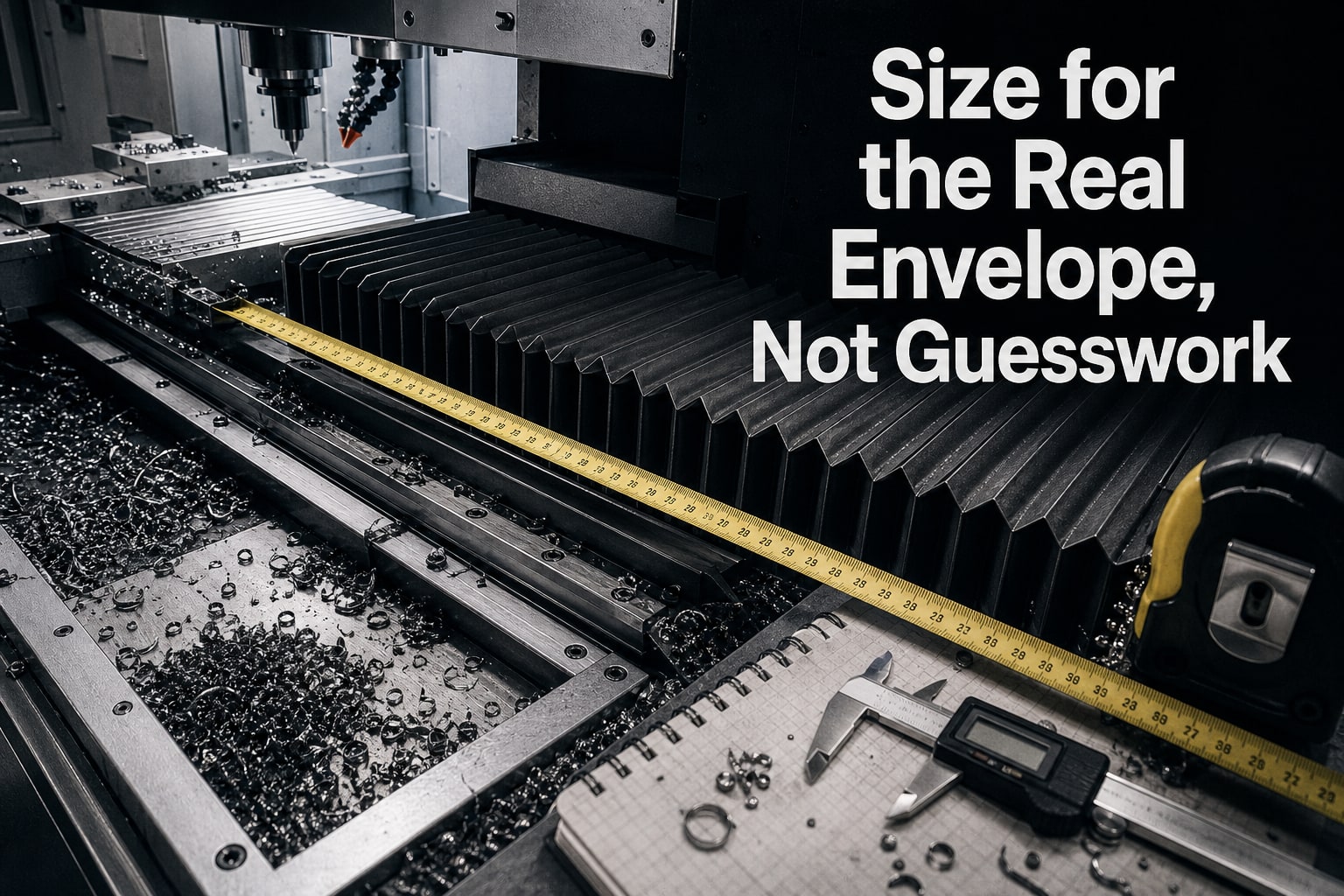
The correct size comes from the machine’s complete moving envelope, mounting geometry and storage space—not from axis stroke or opening width alone. By the end, you will have a measurement checklist, a working-length calculation, a selection framework and a defensible budget request for suppliers.
Key takeaways
- Measure the full protective envelope, not only the machine axis stroke.
- Add working clearances for movement, overlap, sag, guides and the take-up package.
- Match apron construction to chip size, coolant exposure, speed and cover orientation.
- Compare material, fabrication, testing and installation costs in separate line items.
Measure the machine’s real protective envelope
Record the machine’s real protective envelope, not just its axis stroke, before requesting an apron-cover quotation. These apron cover size requirements also depend on whether the cover protects a horizontal, vertical, inclined or inverted way; orientation affects support, sag and take-up.
- Measure the clear protected width across the full moving envelope, including maximum side offset, guide hardware, sealing margins and installation tolerance.
- Record maximum travel, plus the minimum and maximum coordinates with the cover fully retracted and fully extended.
- Measure the mounting-face height, width, angle, hole pattern and usable mounting length at both ends.
- Reserve the folded-pack length, roller or cassette space, end overlap, guide clearance, wiper thickness and nearby obstructions.
- Note the available side clearance, strip pitch, allowable sag, acceleration profile and travel direction.
- Mark coolant and chip flow, cable carriers, hoses and any part that could strike or rub the cover.
- Send a dimensioned layout or CAD section showing these points, rather than a nominal opening size.
| Dimension | Record this | Why it matters |
|---|---|---|
| Clear protective span | Width over the complete protected envelope | Prevents side gaps and guide interference |
| Overall cover length | Compressed length plus required extension and overlap | Confirms retraction space and full coverage |
| Mounting envelope | Faces, guides, roller space and hole positions | Prevents a cover that cannot fit or fully retract |
An apron cover protects machinery from contamination; it is not automatically a personnel safety guard. Assess guarding, interlocks, visibility and safety distances separately under the applicable machinery rules.
Calculate clear span, working length and package dimensions
Turn the machine measurements into three separate figures: clear span, working length, and the retracted package envelope. Clear span is the unobstructed width the apron must protect, measured between the guide or mounting faces; it is not the frame’s outside width.
Use this first-pass apron cover size calculation:
- Clear span = protected opening width plus the side clearance or mounting margin required by the guide design.
- Working length = axis travel plus the fixed engagement or overlap at the stationary and moving ends.
- Extended overall length = working length plus end frames, wipers, roller, cassette, and mounting hardware.
The working length is the useful protective cover, not the total assembly length. Confirm the cover’s minimum compressed position and maximum extended position against the machine’s available mounting coordinates; a correct travel figure still fails if the retracted package hits a guard or the extended cover cannot reach its engagement points.
For a rolling slat apron, record the retracted package diameter or height, width, roller-axis location, and side clearances. Slat pitch, slat thickness, overlap, core diameter, and the number of wraps determine the roller diameter, so ask the supplier to calculate the rolled package rather than applying a percentage of cover length.
Apron cover dimensions and pricing do not follow area alone. A narrow, long cover can need a large roller and heavy guides, while a wide, short cover can use more material. Budgetary pricing ranges from low thousands of U.S.
dollars for simple custom covers to several thousand for engineered rollers and guides; large stainless or multi-axis systems can reach the low five figures.
Choose the construction around chips, movement and clearance
Specify the construction from two facts: what will strike the cover and how the machine will move it. Abrasive chips, hot chips, welding spatter, alkaline washdown, coolant chemistry, corrosion and ambient temperature determine the slat, strip, seal, wiper and scraper materials.
| Condition | Construction choice | Clearance or movement consequence |
|---|---|---|
| Dry chips and moderate travel | Painted steel slats with standard guides | Check chip escape paths and allow guide access for cleaning |
| Coolant, corrosion or washdown | Stainless steel or protected components with sealed edges and wipers | Reserve space for drainage, seals and inspection |
| High speed, frequent cycling or vertical travel | Engineered slat overlap, robust guides, controlled roller tension and scrapers | Confirm allowable sag, acceleration loads and the retracted roller package |
A rolling apron’s storage diameter is not a percentage of extended length. Slat pitch, slat thickness, overlap, core diameter and wrap count determine it, so ask the supplier to calculate the complete rolled package. A narrow, long cover can need more guide and roller hardware than a wide, short one.
Treat apron cover size requirements separately from personnel protection. A slat cover that blocks chips and coolant does not automatically prevent access to hazardous motion; assess guard geometry, interlocks, visibility and safety distances under the applicable machinery rules.
Budget by construction, not square area. Simple custom covers often sit in the low-thousands-of-U.S.-dollars range; engineered rollers and guides can reach several thousand, while stainless, high-speed or multi-axis systems can reach the low five figures or more. Freight, labour and engineering alter the final price.
Compare an apron cover with other protection methods
An apron cover is the right choice for a broad, mostly flat guideway exposed to chips, coolant and repeated linear travel. Its slats tolerate abrasion better than fabric, but the cover needs a supported path; forcing it to match the machine’s full acceleration can cause buckling, wear or leakage.
| Option | What it does best | Choose it when |
|---|---|---|
| Apron cover | Rolls slats into a compact package | You need durable protection across a wide horizontal or vertical way |
| Bellows | Folds away from the protected area | The motion is multi-axis, the shape is irregular, or contamination is moderate |
| Roll-up cover | Winds a flexible curtain onto a drum | Space is tight and the machine produces light chips, dust or splash rather than sharp, heavy swarf |
| Telescopic cover | Uses overlapping rigid boxes | Heavy cutting, hot chips and high coolant loads demand maximum rigidity |
| Brush wiper | Wipes debris from a narrow exposed edge | You need a secondary seal or scraper, not full enclosure of the guideway |
Use apron cover size calculation to include the moving envelope, end overlap, side guides, sealing margins and the roller’s actual storage diameter. Slat pitch, thickness, overlap, core diameter and wrap count determine that diameter; a percentage of cover length does not.
Do not treat an apron as an automatic personnel guard. A chip cover may leave hazardous motion accessible, so guard geometry, interlocks, visibility and safety distances require a separate machinery-safety assessment.
Build a transparent apron cover cost estimate
Build an apron cover cost estimate from a complete quotation package, not from width multiplied by length. Price depends on the retracted package, guides, frame, orientation, materials and engineering as much as the protected area.
1. Send a dimensioned drawing or CAD section showing mounting faces, travel direction, maximum and minimum coordinates, available retracted space, guide clearances, coolant and chip direction, and nearby cable carriers. Mark the required mounting holes and any fixed obstructions. Missing geometry can leave the quotation covering only a nominal cover that cannot operate reliably.
2. State the operating conditions: slat or strip material, pitch, extended length, travel speed, cycle frequency, coolant type, chip size, temperature, abrasive exposure and cleaning method. Smaller pitch improves flexibility but adds joints and cleaning interfaces; larger pitch can lower part count while demanding more bending radius.
3. Request a line-item price for slat or strip material, frame and guides, roller or cassette, wipers and seals, end attachments, drive or counterbalance parts, sensors, engineering, drawings, tooling or setup, testing, packaging, freight and installation. Omitting the roller, guides or engineering can seriously understate the total.
4. Ask the supplier to calculate the rolled package diameter from pitch, strip thickness, overlap, core diameter and wrap count. Do not accept a folded-length percentage as a substitute.
For comparable apron cover dimensions and pricing, define a painted-steel rolling apron with standard guides and wipers as the reference. Show separate allowances for stainless steel, coatings, high-temperature or abrasive-chip service, unusual mounting, sensors and installation.
SCUTES INDIA PRIVATE LIMITED can use this same breakdown to distinguish a genuine design quotation from a nominal area-based price.
Related product
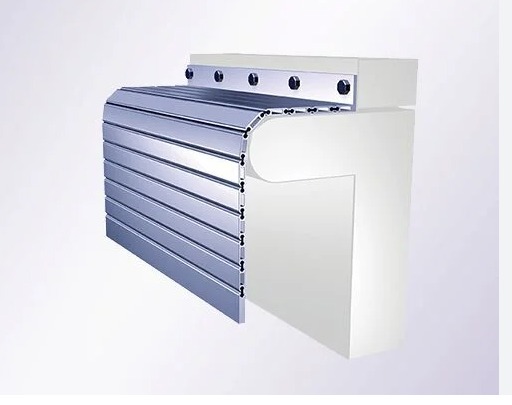 | APRON COVER Effectively engaged in offering a vast collection of outstanding quality products which include Apron Covers. View product → |
Frequently asked questions
What measurements are needed for an apron cover size calculation?
Record the machine’s real protective envelope, including clear span, working length, movement direction, mounting points, guide clearances and the space available for the retracted package. Measure the cover’s horizontal, vertical, inclined or inverted orientation because it affects support, sag and take-up.
How do you calculate apron cover dimensions?
Calculate the clear span across the protected way, then add the required side clearances, overlaps and attachment margins. Calculate working length from the full travel plus the cover’s fixed and moving connection zones, then check the resulting retracted package against the available machine space.
What should determine an apron cover construction?
Choose construction around chip size, coolant and oil exposure, travel speed, cycle frequency, heat, impact risk, movement orientation and available clearance. Confirm guide, roller, hinge and sealing details before comparing quotations.
How do you build an apron cover cost estimate?
Separate the estimate into material, segmented or slat construction, frames and guides, seals, fasteners, machining, testing, packing, freight, installation and commissioning. Compare quotes using the same dimensions, materials, protection requirements and included services.