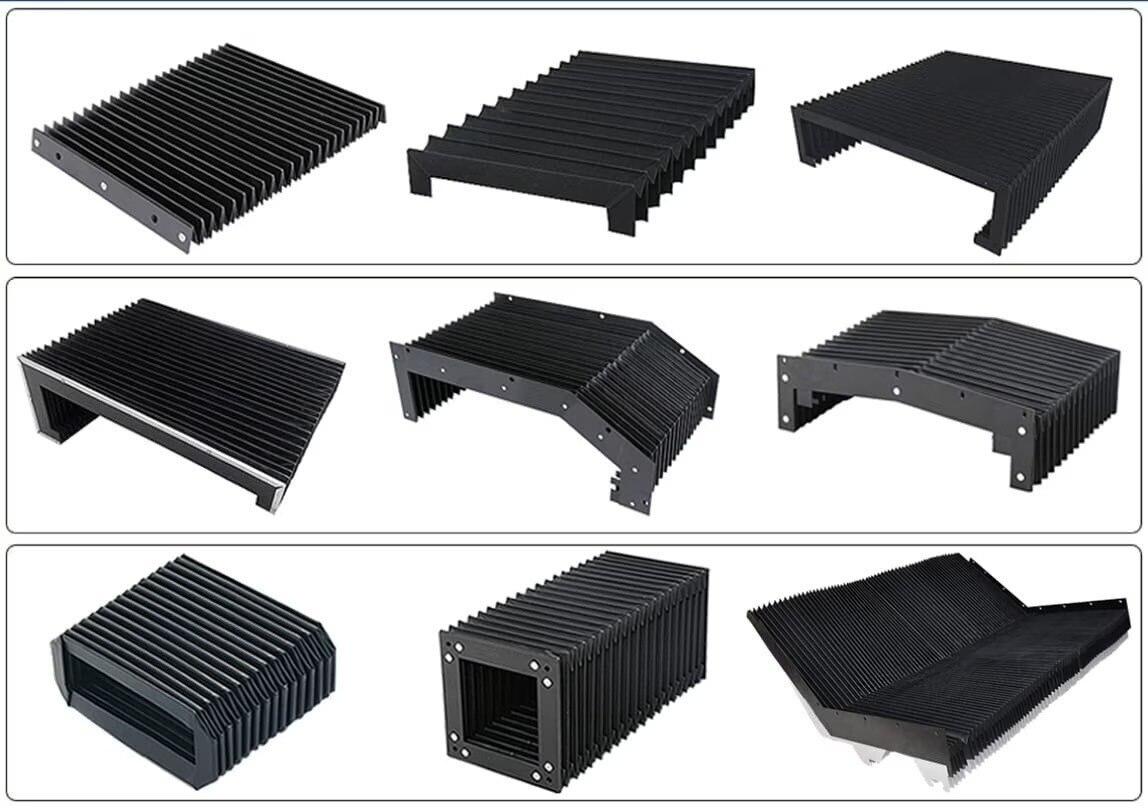
Choose the cover from the duct’s movement envelope and exposure, not from its nominal width alone. By the end, you will have a measurement checklist, a way to calculate installed and folded dimensions, and criteria for separating a protective cover from a pressure-carrying expansion joint.
Key takeaways
- Classify whether the cover contains pressure, prevents leakage, permits movement, or shields equipment.
- Measure connection dimensions and calculate the required duct bellow size before requesting quotes.
- Match bellows cover material to heat, chemicals, abrasion, and pressure exposure.
- Approve fold geometry, end connections, and supplier drawings before ordering.
Classify the duct function and collect the design inputs
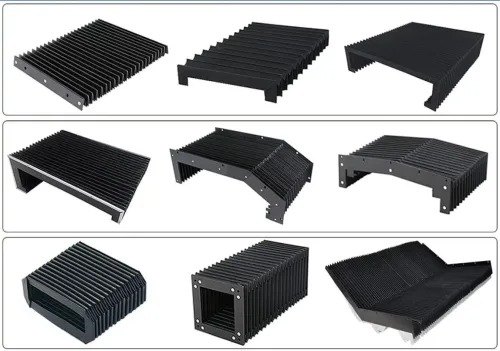
Classify the function before choosing a bellows cover for industrial ducts: does it contain pressure, prevent leakage, accommodate duct movement, or shield people and moving parts from hot surfaces and contamination?
| Option | Primary job | Load it must handle |
|---|---|---|
| Protective machine bellows | Shields a moving duct or nearby equipment | Chips, coolant, heat, dust, and mechanical contact |
| Fabric expansion joint | Accommodates duct movement | Pressure and thermal movement when designed for that load |
| Elastomeric connector | Seals between equipment sections | Flexible alignment and leakage control |
| Metal expansion joint | Handles severe duct service | High temperature, pressure, or demanding cycles with anchors and guides |
A protective machine bellows is not automatically a pressure-retaining expansion joint. Internal pressure can balloon a flexible cover and create axial thrust at the connections, so pressurized or evacuated ducts may need anchors, guides, limit rods, or an independently supported joint.
For duct bellows selection, record these inputs before requesting a design:
- Duct material, cross-section, connection type, airflow, internal pressure or vacuum, and operating temperature
- Required axial, lateral, and angular movement, plus available installation length and side and top clearance
- Motion speed, cycle rate, unsupported spans, and minimum bend radius
- Acceleration, deceleration, dwell, reversing, and emergency stops in reciprocating service
- Chips, abrasive dust, coolant, oil mist, sparks, laser debris, cleaning chemicals, washdown, and condensation
- External impact, nearby guards, cables, guides, and hard stops
A request containing only duct width and length cannot produce a reliable industrial bellows cover design.
Measure the connection and calculate the duct bellow size
Base the duct bellow size on the actual maximum envelope at both ends, not the duct’s nominal opening. A flange, weld bead, or bolt head can catch the folded cover and tear a corner.
- Measure duct width and height.
- Record flange thickness, outside dimensions, corner radius, weld beads, fasteners, guards, cable carriers, and nearby structures.
- Count bolt holes and record their spacing, diameter, and edge distances.
- Measure the face-to-face installation length.
- Record clearance above, beside, and around every corner.
- Note the cover’s folded profile, minimum bend radius, and the machine’s minimum clearance at full compression.
Define the relaxed length, compressed length, and extended length before calculating travel. For compression, the basic axial requirement is relaxed length minus compressed length. For extension, it is extended length minus relaxed length; do not combine axial, lateral, and angular movement into one total figure.
- State maximum lateral offset in the X, Y, and Z axes.
- State the rotation angle for each relevant axis.
- Provide a dimensioned motion envelope when movements combine.
- Check that the folded package does not contact a hard stop, guide, cable, or adjacent cover.
The required duct bellow size must accommodate the opening, folded package, bend radius, and all movement clearances. These measurements also give suppliers enough information to compare bellows cover options without guessing from width and length alone.
Choose fold geometry and an end connection that will not restrict movement
Choose fold pitch and construction from the available stroke, compressed package length, and cycle demand. Smaller folds shorten the compressed package and accommodate tighter bends, but add flexing zones and folded pockets; larger folds reduce the number of bends but require more installation space and collect chips, coolant, or condensation.
| Fold geometry | Benefit | Check before approval |
|---|---|---|
| Small pitch | Shorter package and tighter bending | Flexing-zone count, pocket cleaning, cycle rate |
| Large pitch | Fewer bends and lower fold count | Installation space, sag, and liquid or chip buildup |
For duct bellows selection, check the unsupported span, sag, rubbing points, and fold-opening direction. Vertical ducts deserve special attention because downward-facing pockets can hold liquid against the fabric.
Specify the end connection as carefully as the cover itself:
- Fabric flanges suit broad bolted faces.
- Clamped collars support removable installations.
- Bolted frames provide a rigid, replaceable perimeter.
- Stitched hems suit light, flexible mounting.
- Welded rings suit compatible high-temperature or metal constructions.
- Sliding arrangements preserve movement where a fixed clamp would bind.
Keep fasteners and mounting strips outside abrasive or moving zones. Add drainage, venting, clean-out access, and inspection access when sealed folds could trap debris or coolant. A cover that seals well but cannot drain or be removed will turn routine cleaning into dismantling.
Match the cover material to heat, chemicals, abrasion, and pressure
A temperature-rated industrial bellows cover can still fail quickly from sharp chips, coolant, or chemical attack. Compare bellows cover options against the complete exposure, not heat alone.
| Construction | Strength | Best fit and limitation |
|---|---|---|
| Sewn coated fabric | Flexible, compact folding | Repeated movement; ordinary PVC or polyurethane fabric is not spark-proof |
| Bonded or vulcanized elastomer | Sealing and repeated flexing | Oil mist, coolant, and defined pressure; verify chemical compatibility |
| Formed rubber or thermoplastic | Consistent shape and wall profile | Defined movements and openings; less adaptable to unusual envelopes |
| Foil or stainless-steel strip | Heat, sparks, and chip resistance | Hot debris; check fatigue and minimum bend radius |
| Lamella, wear-strip, or hybrid | Replaceable outer protection | Abrasion, welding spatter, and laser debris; adds mass and package height |
Hot air, steam, corrosive chemicals, abrasive dust, washdown, outdoor weather, ultraviolet light, ozone, and trapped condensation demand different material stacks. Cleaning agents and water jets can shorten service life even when the base material is compatible.
Ask for these limits before approving a bellows cover for industrial ducts:
- Continuous and peak temperature, pressure and vacuum rating, and structural pressure capability
- Minimum bend radius and expected flex cycles, including reversing motion
- Abrasion test basis, UV and ozone resistance, and chemical compatibility
- Resistance to oil mist, coolant, sparks, welding spatter, and laser debris
For a pressurized or evacuated duct, confirm axial thrust, anchors, guides, limit rods, and independent support. A lightweight protective cover must not restrain duct pressure or replace a pressure-rated expansion joint.
Approve the supplier drawing before ordering
Treat the supplier drawing as the acceptance document for duct bellows selection, not a catalogue width or generic cycle-life claim. Reject approval until it describes the actual industrial bellows cover and its operating envelope.
1. Check the drawing for duct width and height, corner radii, flange thickness, bolt-hole diameter, count and spacing, mounting method, installed length, compressed length, extended length, allowable axial travel, lateral offset, angular movement, folded height, minimum bend radius, and unsupported-span limit.
2. Confirm the material stack-up, continuous and peak temperature range, pressure or vacuum limits, and cleaning restrictions. The drawing must label the function as protective, sealing, or pressure-carrying; a protective cover must not be treated as a pressure-retaining joint.
3. Ask how cycle life was assessed. Confirm that the stated rate includes reversing, acceleration, deceleration, dwell, emergency stops, and full-stroke operation rather than smooth average motion.
4. Verify the duct bellow size against the installed machine: full compression, full extension, corner clearance, airflow path, drainage, replacement access, and every neighbouring cable, guard, guide, and hard stop. Include the folded profile, not just the opening dimensions.
SCUTES INDIA PRIVATE LIMITED can use these measured dimensions and exposure details to develop the cover around the machine’s actual envelope instead of quoting from nominal duct dimensions. Sign only after every drawing dimension matches the measured installation.
Frequently asked questions
What design inputs do you need before selecting a bellows cover for industrial ducts?
Define the duct function, pressure, temperature, movement, contamination, chemical exposure, abrasion, and connection dimensions.
How do you calculate the correct duct bellow size?
Measure the connection dimensions, required opening, installation length, movement, and clearance, then check the supplier’s sizing drawing.
How should you choose fold geometry and end connections?
Select fold geometry that accommodates the required axial, lateral, and angular movement, and use end connections that do not restrict that movement.
How do you match an industrial bellows cover to operating conditions?
Compare cover materials against the actual heat, chemicals, abrasion, pressure, moisture, and contamination at the duct.
Why approve a supplier drawing before ordering?
The drawing confirms dimensions, fold count, movement limits, material, end connections, and installation details before fabrication.