A telescopic cover moves through changing overlap, friction and acceleration while its rigid sections must stay aligned and closed against chips and coolant. By the end, you will be able to trace the spring’s force path, identify the dimensions that control its sizing, check a machine installation and recognise early signs of failure.
Key takeaways
- Check spring torque, stroke, section weight, speed, and mounting space before sizing.
- Match spring torque to cover movement, not just the machine axis load.
- Prevent coolant, chips, misalignment, and overtravel from damaging the spring system.
- Choose spring assistance when compact retraction and repeated automatic movement matter.
What sits inside a spring-assisted telescopic cover?
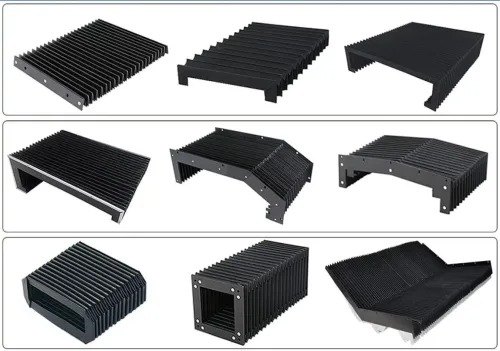
Inside a spring-assisted telescopic cover, nested sheet-metal boxes form the protective barrier. As the machine axis travels, each section slides or rolls over the next, extending to cover the guideway or shaft and retracting into a compact stack. That is the basic telescopic cover working principle.
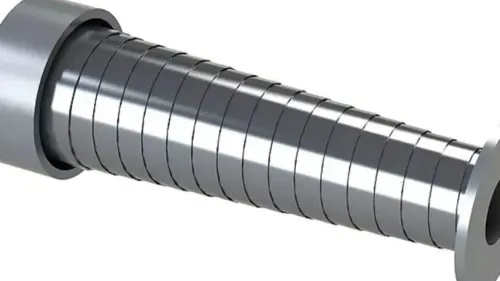
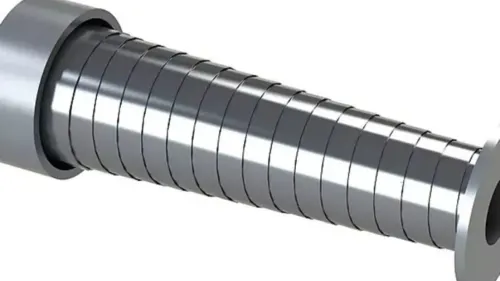
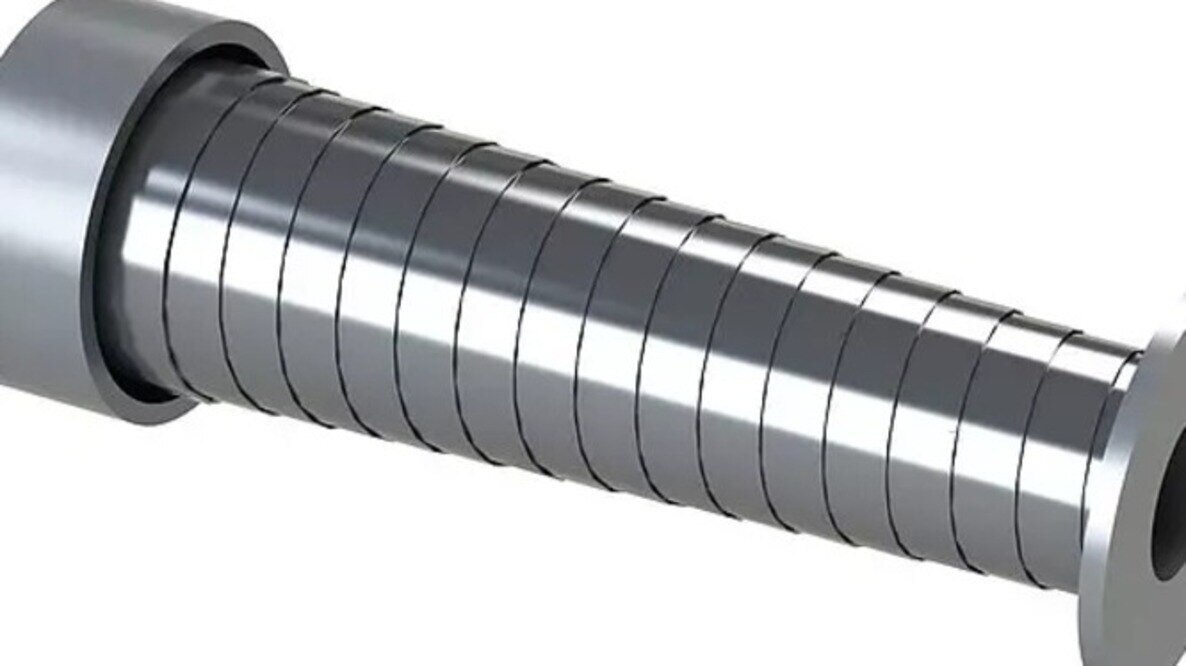
Spiral springs in telescopic machine covers are pre-stressed, strip-type constant-force springs stored as tightly wound coils. The spring sits inside, alongside, or at the end of the cover assembly, captured on an arbor or in a housing.
A spring carrier, strip, cable, or linkage connects it to a moving section, supplying return or tension force as the sections move.
These parts keep the cover aligned and reduce chip entry:
- Guides and rollers support section travel and limit side loading.
- Scrapers or wipers remove chips and coolant from sliding surfaces.
- Seals close gaps around protected machine components.
- Section overlap maintains a continuous barrier through the stroke.
- Fixed and moving end mounts hold the assembly to the machine and axis.
The spring must not buckle, rub against a sharp edge, or unwind without control at the travel limit. The machine axis or linkage determines travel; the spring only assists movement. It does not replace a servo, brake, lock, or mechanical end stop.
How spring torque keeps the sections moving
A tightly wound strip inside a machine cover spiral spring stores energy through pre-stress. As a telescopic cover extends, the strip winds or unwinds over its arbor; during retraction, it returns toward its tightly coiled shape.
The changing coil diameter changes spring torque through the stroke, while the resulting pull keeps nested sections following the machine axis.
Available spring force is not useful cover force. Guides, rollers, wipers, coolant residue, chips, gravity, section weight and misalignment consume part of it. Size the spiral spring telescopic cover for the worst travel direction and highest resistance, including acceleration and rapid reversals.
Check these points before accepting the spring:
- Provide positive travel limits at both ends; normal motion must not fully unwind the strip or mechanically bottom the spring.
- An undersized spring causes incomplete extension, chatter, section separation and bounce during reversals.
- An oversized spring raises closing force, guide and wiper wear, axis loading and the risk of section collision.
- Calculate resistance with acceleration and inertial loads, not cover weight alone.
- Check strip thickness, material, coil diameter, pre-stress, stroke, speed, temperature and cycle count against fatigue life.
A spring that delivers its rated pull once can still fail on a high-cycle axis if repeated bending, heat or near-limit travel damages the strip. Keep the spring captured and inspect it when motion becomes uneven.
Which dimensions and loads belong on the sizing sheet?
Put these values on the sizing sheet before selecting a spring or cover:
- Closed length, maximum extension, usable stroke and available installation space
- Section count, cover width and height, expected overlap and required end-stop positions
- Mounting orientation plus the dimensions of the shaft, ball screw, guideway or other protected component
- Travel speed, acceleration, reversal rate, cycle frequency, payload, external forces and section weight
| Orientation | Main sizing effect | Inspection point |
|---|---|---|
| Horizontal | Section weight loads the guides and spring across the travel path | Confirm drainage and prevent chips settling on the lower guide |
| Vertical | Gravity either assists or opposes spring loading throughout the stroke | Check the worst direction and secure the end positions |
| Inclined | Gravity changes with angle and can shift drainage toward one end | Record the angle, low point and runoff direction |
For machine fit checks, measure the fully closed and fully extended envelope; nominal cover dimensions do not reveal actual interference. Confirm clearance from the moving axis, mounting-face flatness, fastener access, service access and drainage direction. Inspect whether chips can enter the spring cavity or collect at section ends.
Use the measurements to compare spring torque, cover resistance and available stroke, not cover weight alone. A payload or rapid reversal can consume the force margin even when the static mass appears acceptable. Record where the cover stops at both ends, then verify that the spring does not bottom or unwind before those mechanical limits.
These details matter across telescopic cover applications, especially where spiral springs in telescopic machine covers operate near coolant, chips or inclined guideways.
How do conditions and installation errors shorten service life?
Misalignment shortens service life faster than ordinary machine-axis travel. The telescopic cover working principle depends on nested sections moving in line while the machine cover spiral spring stays captured and loads the moving section without side force.
1. Commission the assembly by aligning every section, guide and mounting face. Avoid side loading, protect the spring from impact, set both end attachments correctly, and move the cover through its complete stroke by hand or at controlled speed before enabling the axis.
2. Stop the axis if you find uneven section gaps, rubbing, scraping noise, jerky travel, incomplete extension, cover bounce or a spring reaching its travel limit. These are defects, not normal servo behaviour. Inspect alignment, section overlap, wipers, seals, rollers, guides, spring attachment and mechanical end stops.
3. Match cleaning to the contamination. Remove abrasive chips and fine dust before they enter guides; remove dried coolant or lubricant film when friction rises; inspect for corrosion after moisture exposure; check hot zones for heat damage or lost lubrication; and remove welding spatter before it bonds sections together.
4. Record strip fatigue, cracks, permanent deformation and uncontrolled unwinding at scheduled intervals. Increase inspection frequency on high-cycle axes, where repeated over-bending, excessive speed, heat or operation near the travel limit can fatigue the strip even when it still produces usable force.
A damaged wiper can admit abrasive material, while worn rollers, bent sections or blocked guides create uneven loading and accelerate spring failure. Do not compensate for binding by increasing spring force; find and correct the resistance.
When is a spring-assisted telescopic cover the right choice?
A spring-assisted telescopic cover is the right choice when a linear machine axis needs a rigid barrier against hot chips, impact, coolant, abrasive dust, or lubricants. The steel sections provide that barrier; the spiral spring maintains tension and assists return. The axis or linkage controls position, not the spring.
| Option | What it provides | When it fits |
|---|---|---|
| Rigid overlapping steel sections with a spiral spring | High-impact barrier and assisted extension or return | Linear axes facing hot chips, coolant, abrasive dust, or lubricant |
| Roll-up apron | Compact storage with flexible movement | Restricted packaging space and lower impact exposure |
| Fabric bellows | Flexible enclosure along changing or complex paths | Irregular geometry where chip and impact demands are limited |
A powered cover uses a motor or actuator to position itself; a spring-assisted arrangement does not. For telescopic cover applications, check the specification sheet against exposure, usable stroke, mounting orientation, cycle rate, travel speed, and required barrier performance. Horizontal, vertical, and inclined installations change gravity, drainage, guide loading, and spring demand.
SCUTES INDIA PRIVATE LIMITED can help translate guideway or shaft dimensions, travel data, and contamination conditions into a cover-and-spring specification. Ask for these details before approving the design:
- Rated spring stroke and torque or pull range
- Travel limits and positive end-stop locations
- Fixed and moving mounting details
- Inspection, cleaning, and spring-replacement requirements
Do not select a cover by width alone; an underspecified spring can leave sections short of full extension or impose excessive closing force.
Related products
 | TELESCOPIC SPRING COVER Telescopic Spring Covers provide protection under extreme conditions. View product → |
 | TELESCOPIC COVERS A telescopic cover protects guide-way surfaces and components of moving axis of machines. View product → |
Frequently asked questions
What sits inside a spring-assisted telescopic cover?
Nested sheet-metal cover sections contain spiral springs, spring housings or drums, guides, stops, and mounting hardware. The exact arrangement depends on whether sections slide or roll during travel.
How does spring torque keep the sections moving?
A spiral spring stores torque as the cover extends. That torque helps pull or roll the sections back into the retracted stack while balancing section weight and friction.
Which dimensions and loads belong on the sizing sheet?
Record closed and extended lengths, cover width and height, section count, stroke, section weight, travel speed, acceleration, mounting orientation, available spring space, friction, and required safety margin.
How do conditions and installation errors shorten service life?
Chips, coolant, heat, corrosion, misalignment, excessive speed, overtravel, incorrect preload, and blocked guides increase friction or overstress the springs and cover sections.
When is a spring-assisted telescopic cover the right choice?
Use it when a moving guideway or shaft needs automatic protection, frequent extension and retraction, and a compact retracted stack. Select another arrangement when loads, contamination, or geometry exceed the spring system's limits.