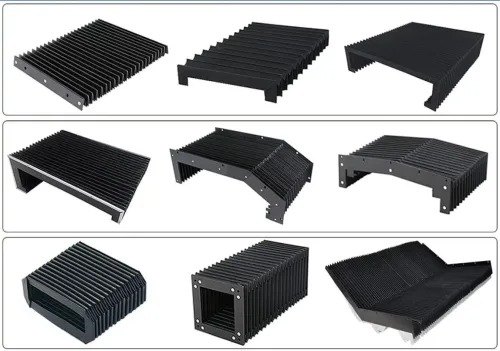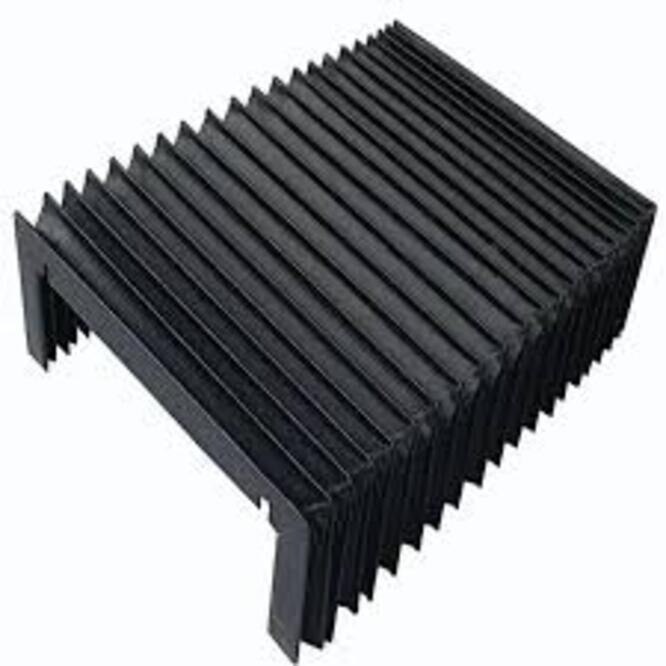
The right replacement depends on the machine’s motion, the hazard reaching the moving part and the space available when the cover is fully compressed—not on the product name or overall length alone. You will be able to identify the required dimensions, compare flap and laser-specific constructions with other cover types, and prepare a replacement specification that a supplier can verify.
Key takeaways
- Choose the cover from the part’s motion, travel and contamination exposure.
- Measure compressed length, extended length, width, height and mounting points.
- Specify laser wavelength, heat, sparks and debris before selecting bellow materials.
- Approve a dimensioned supplier drawing before manufacturing the replacement.
Which cover type matches the damaged moving part?
Choose by the damaged part’s motion and exposure, not by the name on a quotation. “Flap bellow” describes a construction or movement arrangement; “laser machine bellow” describes an application. Neither is a universal engineering category. A search for a flap bellow or laser machine bellow in Coimbatore still requires an application check.
| Option | Best match | Main caution |
|---|---|---|
| Flap bellow | Repeated folding where overlapping reinforced flaps shed chips and coolant | Overlap edges add thickness and friction; face them away from the chip path |
| Laser-specific flexible cover | Cutting-head areas exposed to heat, smoke, assist gas, fine particulate or hot particles | Check wavelength, hot-particle exposure, smoke, assist gas and head clearance before selection |
| Telescopic steel cover | Heavy sharp chips and strong coolant impact | It adds mass and needs suitable straight guideway geometry |
| Roll-up cover | Compact storage and suitable straight travel | It is unsuitable where the path requires repeated accordion folding or irregular movement |
| Brush wiper | Wiping contamination from a surface | It wipes; it does not enclose a moving hazard |
| Simple machine cover | Stationary or low-complexity shielding | It may bind or tear when the part has substantial travel |
Choose a laser-specific cover only after checking the laser wavelength, beam exposure and clearance around the cutting head. Fiber lasers commonly use 1.06–1.08 micrometres; CO₂ lasers use 10.6 micrometres. Bellows do not replace energy chains for cable bend control, strain relief or cable separation.
What must you measure before ordering an industrial bellow replacement?
Before ordering an industrial bellow replacement in Coimbatore, identify the protected guideway, screw, cylinder, optical assembly or other moving axis and create a dimensional record. Measure:
- Linear travel, fully compressed length, fully extended length, folded height and width.
- Bend direction, mounting-face dimensions, and clearance from adjacent components.
- Attachment-hole size, spacing and complete hole pattern.
- Number and pitch of folds, end-frame thickness, and support-ring or slat locations.
- The direction in which the flap overlap faces.
| Stationary fit | Full-stroke risk |
|---|---|
| Fits between the end faces | Binds before reaching the required stroke |
| Looks supported at rest | Sags into the work envelope |
| Clears the machine while stopped | Rubs the guideway during movement |
| Leaves the head unobstructed | Strikes or obstructs a laser head |
Overall length alone is unsafe: a cover can fit while stationary yet fail under motion. Record every dimension at full compression and full extension, then check vertical movement, side movement and bend direction; the replacement must not foul nearby parts.
Send photographs of the guideway, both end attachments, travel direction and failure area. Include the damaged bellow or a dimensional sample with the request. A machine model identifies the equipment, but it cannot establish the required stroke because options and retrofit covers use different dimensions.
How should the replacement follow the machine’s actual motion and laser exposure?
Match the replacement to the machine’s complete motion envelope, not just its straight-line stroke. Check repeated folding, vertical and side movement, rotation, acceleration, vibration, cable and hose motion, and interference with guideways, the laser head or nearby covers.
1. Cycle the proposed geometry through full extension and compression. Record fold direction, minimum bend radius, compressed height and clearance at every position; a cover that fits at rest can rub, snag, sag or obstruct a moving head under acceleration.
2. For a laser machine bellow in Coimbatore, document wavelength, beam diameter, power or energy density, exposure duration and exposure type: direct, reflected, scattered or limited to hot sparks. Fiber systems commonly operate near 1.06–1.08 micrometres; CO₂ systems near 10.6 micrometres.
Also record optical-path clearance, beam-alignment and maintenance access, smoke, fine particulate, assist-gas effects, cutting spatter, dross, heat zones and cleaning chemicals.
3. Do not accept “laser-resistant” as a universal grade. Request test data or a stated application limit for the actual wavelength and exposure. A laser machine cover in Coimbatore is not a beam enclosure because it uses fabric; assess guarding, interlocks, viewing windows and apertures as one safety system.
Include cable-chain bend radius, hose torsion and strain-relief movement in the drawing. If sparks or hot dross reach the folds, specify the heat zone and cleaning method rather than assuming a conventional flap construction will survive.
Which materials, flap details and supports will survive the duty?
Construction, not fabric name or price, determines whether the cover survives. For a flap bellow in Coimbatore, compare the duty against the complete assembly:
| Material | Suitable duty | Main caution |
|---|---|---|
| Coated polyester or polyurethane | Ordinary dust, coolant and light oil | Confirm fold flexibility and chemical compatibility |
| Silicone-containing fabric | Higher heat and hot particles | Heat rating does not prove seam or fold life |
| PTFE-containing fabric | Aggressive chemicals, solvents and low-friction surfaces | Check adhesion and repeated-fold performance |
| Aramid-containing fabric | Abrasion, puncture and hot-particle exposure | It can increase thickness and compressed height |
Ask the supplier to confirm resistance to your exact coolant, cutting oil, solvent, abrasive dust, UV exposure, sparks and welding spatter. Temperature rating alone cannot predict fold fatigue, seam life or coating adhesion. The same applies when comparing a laser machine cover in Coimbatore: request an application limit, not just “laser-resistant.”
Flap overlap sheds chips and coolant, but adds friction, thickness and compressed height. Face the overlap so principal travel drives debris away from the seam. Support strips or frames stiffen folds; mounting plates distribute loads; stitched seams tolerate flexing, while bonded seams reduce exposed thread but can delaminate. Each choice changes drive force and clearance.
For horizontal or long spans, specify internal guide rings, support slats, sliding shoes or external guides when sagging is possible. Thicker fabric alone can increase folded height, inertia and drive force.
- Abrasion tracks indicate rubbing; punctures indicate chips or hot particles.
- Delamination, swollen fabric and open seams indicate coating or chemical failure.
- Detached end frames indicate mounting or adhesion failure.
How do you compare supplier drawings and approve the replacement?
Approve the replacement from a dimensioned drawing, not from the quoted price or a photograph. For industrial bellow replacement in coimbatore, demand these drawing details:
| Item | What to verify |
|---|---|
| Geometry | Extended and compressed length, stroke, folded height, width, fold count and fold pitch |
| Attachment | Mounting-frame dimensions, hole pattern and end-frame material |
| Movement | Travel direction and support method |
| Construction | Fabric and coating, reinforcement and seam type |
| Limits | Stated temperature, speed, acceleration, bend and chemical operating limits |
A laser machine bellow in coimbatore needs head clearance, cable and hose clearance, drainage routes and hot-dross limits shown or stated. SCUTES INDIA PRIVATE LIMITED can be approached in Coimbatore with the damaged part, measurements and photographs, but approve the dimensioned drawing and application limits before fabrication.
A visually identical flap bellow can fail when its overlap faces the wrong way; chips and coolant then drive into the seam.
With the machine stopped, run the installed cover through full compression and full extension before production, checking for sag, rubbing, head obstruction, cable or hose interference, blocked drainage paths and contact with hot dross.
For anyone comparing a flap bellow or laser machine bellow in coimbatore, inspect according to duty, not calendar age. Check exposed folds, shiny abrasion, lifted coating, open seams, distorted supports and contamination reaching the protected way.
Related product
 | TELESCOPIC SPRING COVER Telescopic Spring Covers provide protection under extreme conditions. View product → |
Frequently asked questions
Should you choose a flap bellow or laser machine bellow by name?
No. Match the construction to the moving part’s travel, available space, contamination and laser exposure.
What measurements are needed for an industrial bellow replacement?
Record compressed and extended lengths, cross-section dimensions, travel direction, mounting points, fixing method and nearby clearances.
What must a bellow withstand on a laser machine?
Specify laser wavelength, beam path, reflected radiation, heat, sparks, fumes, metal dust and cleaning chemicals before choosing materials.
How do you approve a replacement bellow from a supplier?
Compare the dimensioned drawing with the machine, checking travel, folded height, mounting holes, supports, flap overlap and interference throughout the stroke.