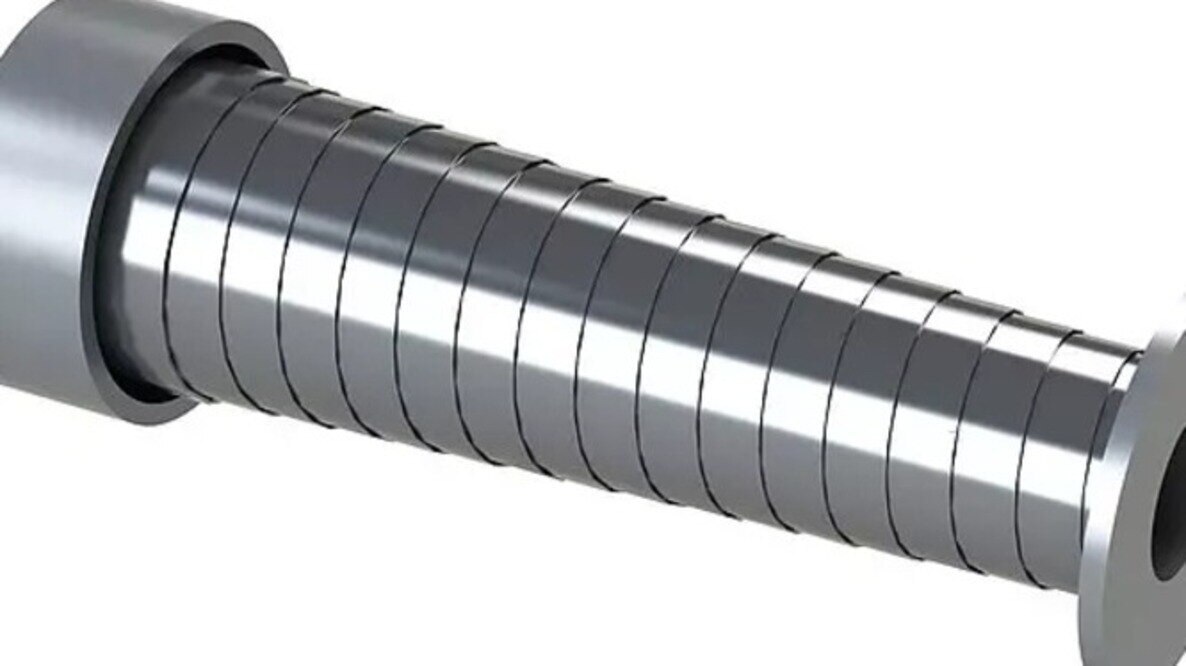
A spiral spring cover suits machine builders that need compact, retractable protection around a shaft, spindle, screw, guide, or cable route without reserving space for a long parked cover. By the end, you will be able to match the cover to your machine type, operating conditions, installation space, and maintenance priorities before requesting a quotation.
Key takeaways
- Use spiral covers where compact, fast-moving protection matters.
- Check travel, speed, temperature, debris, and mounting space before selection.
- Choose bellows or telescopic guards when sealing or heavy impact protection dominates.
- Measure the exposed travel, shaft diameter, coil clearance, and mounting points.
How a spiral spring cover moves and where it fits
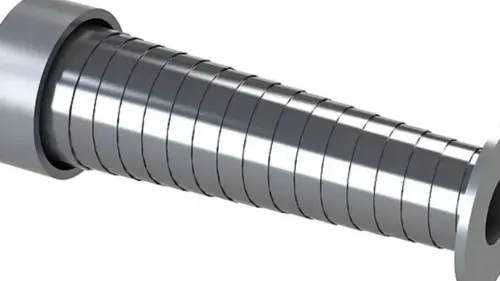
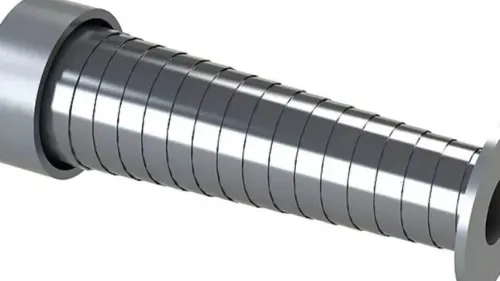
A spiral spring cover is a compact protection assembly made from nested spring-steel strips. As a shaft, spindle, screw, guide, or cable route moves, the strips expand to cover the exposed section and wind into a tight coil when the movement reverses.
That stored coil needs far less parked space than a long bellows or telescopic cover.
This is the value of spiral spring machine protection: it keeps coolant, dust, chips, and oil away from moving components without adding a large enclosure. A spiral spring cover for machine builders suits equipment where the cover will not carry a person, tooling load, or heavy chip pile.
Machine builders in Bengaluru gain the clearest integration benefit when designing:
- CNC lathes and machining centres with compact shaft or screw protection
- Grinding machines with narrow reciprocating or rotary movements
- Automation equipment, transfer units, and cable-routing assemblies
- Special-purpose machines with limited space around moving components
| Option | Motion and space fit | Contamination and load fit |
|---|---|---|
| Spiral spring cover | Compact rotary or linear movement; very small retracted envelope | Light to moderate contamination; not a platform or heavy-chip catcher |
| Telescopic steel cover | Longer linear travel over a broad machine way | Rigid, load-bearing protection for chips and coolant |
| Bellows | Flexible linear movement with wider folded storage space | Good enclosure coverage; material and seal limits need checking |
| Roll-up or apron cover | Long linear travel with a rolled or sliding arrangement | Suits broad ways; exposed surfaces need chip management |
| Exposed shaft | No protection or retraction space required | Acceptable only after risk assessment and separate guarding; contamination reaches the shaft |
Which Bengaluru machines gain the strongest business benefit
CNC lathes and compact machining centres gain the strongest return when a moving spindle, screw, guide, or cable route sits close to chips and coolant. A small parked envelope lets the builder preserve machine width while reducing contamination-related stoppages and cleaning work.
| Machine type | Business benefit | Check before standardising |
|---|---|---|
| CNC lathes | Protects compact spindle, chuck, or tailstock-related moving parts without consuming enclosure space | Confirm chip direction, coolant pressure, and available retracted length |
| Machining centres | Limits ingress around narrow linear drives and guideways where chips collect quickly | Keep the cover away from cutting loads and chip piles |
| Grinding machines | Reduces abrasive dust reaching shafts and sliding components, cutting inspection and cleaning effort | Verify seal and wiper suitability for fine particulate |
| Automation equipment | Fits rotary actuators, linear slides, and cable routes where a bellows or powered roll-up cover is too bulky | Validate cycle count, alignment, and service access |
| Special-purpose machines | Supports repeatable protection across compact, customised assemblies | Freeze mounting faces and replacement dimensions across variants |
These are the best candidates for spiral spring cover benefits machine builders in Bengaluru because a shared interface can reduce redesign between models. Define the mounting faces, travel direction, allowable misalignment, service clearance, and chip-management arrangement; standardising only the cover will not prevent failures caused by poor surrounding geometry.
The cover is less suitable where operators need a rigid load-bearing enclosure or where chips land heavily on the protection surface. For machine protection for manufacturers in Bengaluru, choose it to reduce integration space and routine maintenance—not as a substitute for a safety guard or a telescopic cover built for structural loads.
Choosing between a spiral cover and other protection methods
Choose a spiral spring cover when protection must retract into a very small envelope around a shaft, screw, guide, or cable route, and the cover will not carry a load. Its coiled spring-steel band suits compact cylindrical or narrow linear movement better than a rigid enclosure.
| Option | What it means | When it applies |
|---|---|---|
| Spiral cover | Coils into a compact housing | Limited space, axial motion, moderate chips and coolant |
| Telescopic steel cover | Overlapping rigid boxes | Large machine ways, heavy chips, load-bearing protection |
| Bellows | Folded fabric, coated fabric, or elastomer | Flexible shapes, broad surfaces, heat or chemical selection |
| Roll-up cover | Flexible strip winds onto a roller | Long travel where a flat curtain can be supported |
| Apron cover | Overlapping slats or reinforced strips | Horizontal ways exposed to chips and coolant |
| Exposed shaft | No protective cover | Only after risk assessment confirms no reach, contamination, or damage hazard |
Select telescopic steel if the cover must resist heavy chip piles, lateral force, impact, or a tooling load. Choose bellows for irregular geometry, but check abrasion and coolant compatibility; choose a roll-up or apron cover when the protected surface is broad and travel is long.
The telescopic spring cover benefits in Bengaluru matter when a machine variant has limited installation depth, while spiral spring machine protection avoids the parked length of a bellows or telescopic assembly.
Reject it where alignment is unstable, a pressure-tight seal is required, or an operator could reach the moving part; add a compliant fixed or interlocking guard.
The operating limits that decide whether it will work
A quoted spiral spring cover for machine builders is under-specified if it gives only nominal diameter and stroke. Verify travel speed, acceleration, cycle frequency, reversals, retracted length, outside and inside diameters, and available space at both ends. Compact storage does not prevent fatigue or rubbing caused by poor alignment.
| Input | Verify | Failure if ignored |
|---|---|---|
| Speed and motion | Maximum speed, acceleration, cycle frequency and reversals | Band fatigue or guide friction |
| Stroke and envelope | Usable stroke, retracted length, outside and inside diameter | Coil bottoms out or collides |
| Material | Carbon spring steel, stainless steel, coating and edge finish | Corrosion or cracking |
| Coolant | Type, concentration, pH, additives and temperature | Corrosion or degraded protection |
| Chips | Sharp, hot, heavy or fine chips; impact direction and buildup | Dents, jamming or puncture |
| Temperature | Continuous and peak band, coolant and nearby heat | Loss of spring force |
| Installation | Orientation, alignment, lateral load, mounting faces and service access | Binding or premature wear |
The telescopic spring cover benefits in Bengaluru matter only when the application needs a rigid, load-bearing way enclosure; do not force that design into a compact shaft guard. Reject this cover where lateral loads, heavy chip impact or pressure-tight sealing are unavoidable.
When requesting a quotation from SCUTES INDIA PRIVATE LIMITED, send the complete duty sheet and mounting drawing so the supplier validates actual cycle life rather than applying a generic speed limit.
How to measure and integrate the cover before ordering
1. Measure the protected shaft, screw, guide, or cable route at its smallest and largest outside diameter. Record required travel, extended length, retracted coil length, mounting-face diameter, available axial space, and the cover’s allowable clearance from nearby parts.
2. Map the installation in its actual machine position. Check concentricity between the cover axis and moving member, parallelism of mounting faces, side loads, guide friction, and any offset or tilt. Misalignment can make the spring band rub, telescope unevenly, kink, or deform permanently.
3. Check interference through the complete stroke, not only at the two endpoints. Mark clearances from tooling, chuck jaws, clamps, way covers, cable carriers, lubrication lines, doors, swarf conveyors, and service panels. Confirm that the moving member does not carry radial load from the cover.
4. Give the supplier the duty cycle: strokes or revolutions per minute, cycles per hour, operating hours, travel direction, acceleration, temperature, coolant type, chip size, and cleaning method. State whether chips can strike the band and whether coolant can enter the coil.
5. Include mounting drawings, photographs, material preferences, replacement access, and a defined interface for each machine variant. A standardized interface makes a spiral spring cover for benefits machine builders in Bengaluru easier to repeat, but only if chip management and alignment are standardized too.
Treat it as machine protection for manufacturers in Bengaluru, not as an operator guard; complete the separate risk assessment and provide fixed or interlocking safeguarding where reach is possible.
Frequently asked questions
How does a spiral spring cover move?
Nested spring-steel strips expand over an exposed moving section and wind into a compact coil as movement reverses.
Which Bengaluru machines benefit most from spiral spring covers?
CNC, laser, automation, and other machines with moving shafts, screws, guideways, or cable routes can benefit when compact protection is important.
When should you choose a bellows or telescopic guard instead?
Choose bellows when you need broader enclosed coverage and sealing, or telescopic guards when rigid protection against heavy chips and impact matters more.
What must you measure before ordering a spiral spring cover?
Measure the exposed travel, protected component diameter, retracted and extended lengths, coil clearance, mounting points, and available installation space.