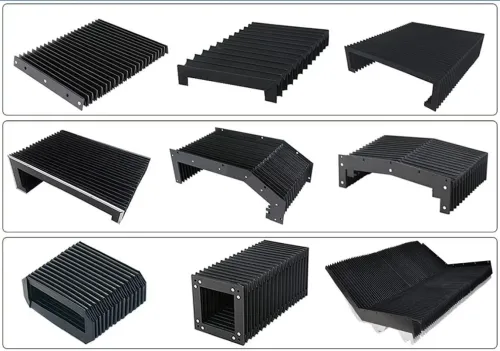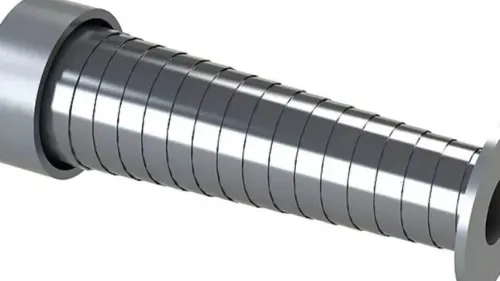
The phrase “spiral spring” can describe either a spring-steel roll-up machine cover or a mechanical constant-force spring, while a telescopic cover is a rigid multi-stage enclosure. You will be able to identify the correct construction, specify its dimensions and duty, compare lifecycle trade-offs, and prepare a quotation request that a supplier can actually engineer.
Key takeaways
- Choose telescopic steel for hot swarf, impact, abrasive dust and high-pressure coolant.
- Choose a spiral spring when compact retraction matters more than heavy chip resistance.
- Give suppliers stroke, closed length, speed, load, mounting and guideway dimensions.
- Require cycle, sealing, temperature and coolant tests before approving the cover.
Choose the cover by hazard, motion and available space
A telescopic steel cover is the safer default for heavy chips, abrasive dust, high-pressure coolant and hot swarf. Its overlapping steel boxes tolerate impact better than a roll-up strip, but need space beside the guideway and a longer retracted package.
| Option | Choose it when | Reject or caution |
|---|---|---|
| Telescopic steel cover | CNC turning, milling, grinding, vertical guideways and exposed linear axes face heavy swarf or coolant | Do not specify it if the retracted length, side clearance or mounting space is unavailable |
| Spring-steel roll-up machine cover | A compact linear axis, threaded rod or auxiliary slide needs low moving mass and minimal retracted length | It is not an impact-resistant enclosure; protect it from large chips and direct high-pressure coolant |
| Bellows or apron cover | The motion is irregular, space is tight, or a flexible seal is more important than rigid chip deflection | Check resistance to heat, oil, abrasion and repeated folding before selecting it |
The phrase “telescopic spring cover or spiral spring for machine builders in Bengaluru” can combine two unrelated product families. For protection, write “spring-steel roll-up machine cover” in the specification; “spiral spring for machine builders” could otherwise produce a constant-force or power spring quotation.
Check the motion before choosing: a rotating spindle usually needs a dedicated bellows, labyrinth or non-contact arrangement, not a linear roll-up cover. A vertical shaft or compact linear slide may suit a roll-up design, while a guideway under aggressive cutting belongs with a telescopic cover.
Neither option replaces guarding, interlocking or pinch-point controls under ISO 12100 and ISO 14120.
Specify the geometry before asking for a price
Give the supplier the complete motion envelope, not just the machine-axis stroke. A cover that reaches the required travel can still fail if its retracted package, mounting face, or side clearance does not fit.
- Identify the product family: telescopic steel guideway cover or spring-steel roll-up cover. They are not interchangeable.
- State the protected guideway or shaft width and height, or shaft diameter, plus the maximum extended length, required stroke, and minimum retracted length.
- Provide mounting-end dimensions, bolt pattern, attachment direction, top and side clearances, and the permitted envelope at full extension and compression.
- Record axis speed, acceleration, cycle frequency, travel direction, vertical or horizontal orientation, reversal behaviour, and the required service life.
- For a spring-steel design, specify roll diameter limits, strip or slat width, overlap, pitch, pre-load or spring force, and end fittings. For a telescopic cover, specify stage count, overlap, guide arrangement, roller or sliding elements, and stop positions.
| Construction | Geometry to verify | Main operating risk |
|---|---|---|
| Telescopic steel cover | Stage lengths, overlap, guide width, retracted package, mounting alignment | Binding or impact when stages misalign |
| Spring-steel roll-up cover | Strip width, roll diameter, spring force, end fittings, winding space | Slamming, buckling, or insufficient return force |
A search for “telescopic spring cover in bengaluru” can therefore produce two different quotations. Ask each supplier to show the closed and extended dimensions, clearance drawing, permissible speed and acceleration, and end-stop behaviour before comparing price.
Match materials, sealing and installation to the machine environment
A catalogue photograph cannot define duty. A quotation for a telescopic spring cover or spiral spring for machine builders in Bengaluru must state the actual hazard and motion envelope, then show how the proposed construction survives it.
Define the environmental duty with these inputs:
- Chip size, impact temperature and chip volume
- Coolant type, pressure and flow direction
- Abrasive dust, oil, humidity and corrosion exposure
- Axis speed, acceleration, stroke and daily cycles
- Required service life and cleaning method
Use “spring-steel roll-up machine cover” in the specification when protection is intended. “Spiral spring” can mean either that cover or a constant-force mechanical spring, so the shorter term invites the wrong quotation. Select panel steel, stainless steel or a coated grade against coolant chemistry and corrosion; select wipers for temperature, abrasion and sealing pressure.
A sealing material that swells in coolant will increase drag and tear at the edges.
State whether the cover is horizontal, vertical or inverted. A horizontal cover needs a chip-shedding surface and drainage path; an inverted installation changes the load on wipers and rollers. Give the supplier the coolant-flow direction and keep drainage away from guideways.
Before acceptance, check the following:
- Confirm the GA drawing shows open and closed lengths, mounting points, clearance and permissible orientation.
- Fit it without forcing the frame or compressing wipers unevenly.
- Move the axis through full travel at slow speed, then rated speed.
- Check for rubbing, buckling, trapped chips, leakage and blocked drains.
- Verify maintenance access, fastener reach and replacement-wiper access.
Control failure risk with maintenance and acceptance tests
Release the machine only after the cover completes its full travel without binding, buckling, rubbing, or exposing the protected guideway. Confirm that the quotation matches the approved drawing: open and closed lengths, mounting points, clearances, wiper contact, panel overlap, orientation, drainage path, and service access.
Use this acceptance sequence:
1. Inspect every panel, spring, roller, guide, wiper, fastener, and end fitting for dents, cracks, loose hardware, uneven overlap, or coolant traps. Check that the cover does not contact the axis, cable carrier, tooling, or adjacent guard at either end of travel.
2. Run at low speed through the complete stroke, then at production speed and acceleration. Listen for scraping, clicking, spring chatter, and impact at reversal. Stop and correct the cause; do not mask it with lubricant.
3. Apply the specified coolant flow and representative chips. Verify that drainage works in the actual mounting orientation and that chips do not lodge beneath wipers or between telescopic sections.
4. Repeat the cycle after thermal stabilisation. Record travel time, abnormal noise, visible deflection, mounting movement, and any loss of sealing. Keep the signed inspection sheet with the machine file.
5. Verify the complete safeguarding system separately. A cover is not automatically a safety guard; confirm access prevention, pinch-point protection, safe distances, and required interlocking under ISO 12100 and ISO 14120.
Write “spring-steel roll-up machine cover” in the purchase record, not only “spiral spring for machine builders.” That wording prevents the wrong product family and replacement parts from entering production.
Build a Bengaluru supplier brief that exposes the real cost
Request a like-for-like quotation, not a catalogue price. “Telescopic spring cover in Bengaluru” can mean a telescopic steel enclosure or a spring-steel roll-up machine cover; state the construction explicitly. The cover is not the complete safety guard: retain responsibility for access prevention, interlocking, pinch points and safe distances under ISO 12100 and ISO 14120.
| Quote item | Standard cover | Custom cover | Cost exposed |
|---|---|---|---|
| Geometry | Catalogue stroke, retracted length and mounts | GA drawing matched to your envelope | Rework if clearance or mounting fails |
| Duty | Published speed, acceleration and orientation | Reviewed chip, coolant, heat and cycle duty | Early wiper, roller or panel failure |
| Parts | Listed wipers, guides and springs | Part numbers created for your build | Downtime while identifying replacements |
| Delivery | Confirmed stock and dispatch date | Drawing approval, fabrication and testing dates | Commissioning delay and freight premium |
Send the supplier one controlled RFQ containing:
- Protected shaft or guideway diameter, stroke, open and closed lengths, retracted envelope, mounting-end dimensions and all top and side clearances.
- Speed, acceleration, cycle count, horizontal, vertical or inverted orientation, coolant-flow direction, chip size and temperature, coolant pressure, abrasive dust and required service life.
- A GA drawing showing panels, overlaps, wipers, rollers, materials, mass, drainage, maintenance access, permissible orientation and inspection records.
- Written lead time for the first unit and replacements, local service response, stocked parts, warranty exclusions and packaging responsibility.
SCUTES INDIA PRIVATE LIMITED is one machine cover manufacturer in Bengaluru to include in that same evidence-based comparison.
Frequently asked questions
When should you choose a telescopic cover instead of a spiral spring?
Choose a telescopic steel cover for heavy chips, abrasive dust, high-pressure coolant, hot swarf and impact. Choose a spiral spring when available space and compact retraction are the main constraints.
What dimensions should machine builders provide for a cover quotation?
Provide guideway width and height, travel or stroke, extended and retracted lengths, mounting points, clearance, operating speed, acceleration, orientation and expected cycle count.
Which materials and sealing details matter in a machine-cover specification?
Specify steel grade or strip material, surface treatment, scraper material, seal design, coolant and oil exposure, temperature, chip size and cleaning method.
How can you reduce machine-cover failure risk before installation?
Check smooth travel, overlap, mounting alignment, seal contact and drainage. Run repeated cycles with representative chips, coolant pressure, temperature and operating speed before acceptance.
What should a Bengaluru supplier brief include to reveal the real cost?
Include drawings, quantities, prototype requirements, installation access, test criteria, spare seals, cleaning instructions, lead time, packaging, commissioning and warranty terms.