Laser cutting puts fine metal dust, hot dross, fumes, moisture and shop contamination directly into the path of guideways, drives and cable routes. You will be able to map those exposure points, distinguish a travelling way cover from a shaft guard, and prepare the dimensions, motion data and acceptance checks needed for a safe selection.
Key takeaways
- Protect guideways, drives, and moving cable routes from chips, coolant, dust, and heat.
- Use spiral springs for compact rotating or linear shaft protection, not broad guideway coverage.
- Compare steel, bellows, apron, and roll-up covers against travel, speed, heat, and access.
- Give suppliers travel, compressed length, speed, clearances, and mounting data before quotation.
Which laser-machine components need a way cover in Bengaluru?
Protect the X, Y and Z guideways first, then shield the drives and cable routes that move with the cutting axes.
Way cover applications for laser machines in Bengaluru must separate clean optical-head zones from the harsher machine-bed area: the head needs low mass and smooth, vibration-free travel; the bed needs resistance to hot dross, abrasive dust and workpiece impact.
- X, Y and Z linear rails and slide surfaces: metal dust and smoke residue enter bearing paths, causing abrasive wear, stick-slip motion and positioning errors.
- Ball screws, rack-and-pinion drives and exposed couplings: slag and fine particles damage tooth flanks, contaminate lubrication and increase backlash or drive load.
- Drag-chain cables and moving cable routes: heat, sharp chips and residue cut insulation, restrict bending and create intermittent electrical faults.
- Openings around the cutting head and lower bed: dross, assist-gas residue and shop dust reach adjacent mechanisms; humid Bengaluru air can combine with residue at joints and spring housings, accelerating corrosion.
| Zone | Protect | Damage if contamination enters |
|---|---|---|
| Optical carriage | Rails, compact slides and cable loops | Vibration, optical-head misalignment and inaccurate cuts |
| Machine bed | Rails, screws, racks and slide surfaces | Abrasion, jamming, backlash and premature replacement |
| Cable route | Cables, connectors and drag-chain bends | Insulation failure, signal faults and unplanned stops |
Laser machine protection in Bengaluru has two separate jobs. A way cover handles mechanical contamination; it does not replace the enclosure, viewing-window specification, access interlocks, beam containment or emergency stop. Treat radiation safety through the documented risk assessment and IEC 60825-1 requirements, not through a roller or spiral cover.
Way cover or spiral spring: which application fits the component?
If the protected part travels along a flat guideway, choose a travelling way cover. It follows the axis, expands and compresses across its stroke, and shields rails, ball screws, racks, cables, or slide surfaces from dross and abrasive dust.
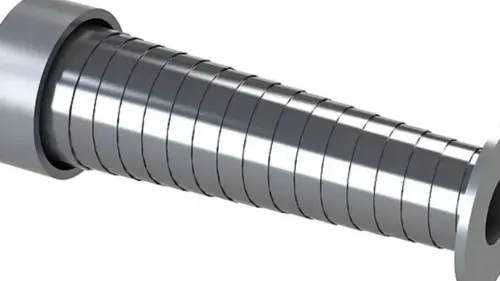
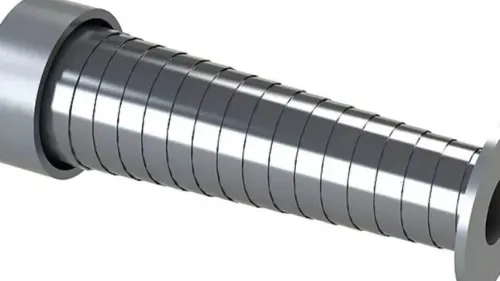
A spiral spring is different: it is a spring-loaded roll-up guard for a rotating shaft, piston rod, narrow rail, or cable route. The coiled spring stores retraction energy inside a housing and keeps a steel strip or curtain tensioned as the component moves.
A search for “spiral spring for way cover in Bengaluru” normally means this roller-shutter arrangement, not a compression spring.
| Check | Travelling guideway cover | Spiral spring or roll-up guard |
|---|---|---|
| Protected geometry | Wide bed, rail, screw, rack, or cable opening | Shaft, rod, narrow guide, or linear strip |
| Movement | Cover folds, telescopes, or slides with the axis | Strip winds into and out of a compact casing |
| Best laser location | Lower bed and drive zones exposed to hot dross and impact | Tight spaces near a carriage or rod where low mass matters |
| Main design concern | Fold clearance, stroke, rubbing, and chip loading | Spring torque, strip overlap, casing alignment, and tension |
For way cover applications laser machines in Bengaluru, do not select a spiral spring merely because the installation space is narrow. Near an optical carriage, low moving mass and controlled motion protect accuracy; near the bed, use a construction that withstands slag and impact.
Neither guard replaces the enclosure, interlocks, beam containment, or IEC 60825-1-based laser risk controls.
How should you choose among steel, bellows, apron and roll-up covers?
Use bellows for the fast, clean optical-head carriage; use steel, apron or roll-up construction where hot dross, abrasive dust and impact dominate. The correct choice for way cover and spiral spring applications for laser machines in Bengaluru depends on the zone, stroke and contamination, not the machine’s outside dimensions.
| Option | Best-fit zone and motion | Exposure and trade-off |
|---|---|---|
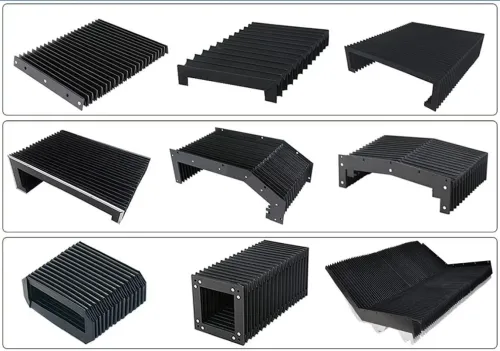
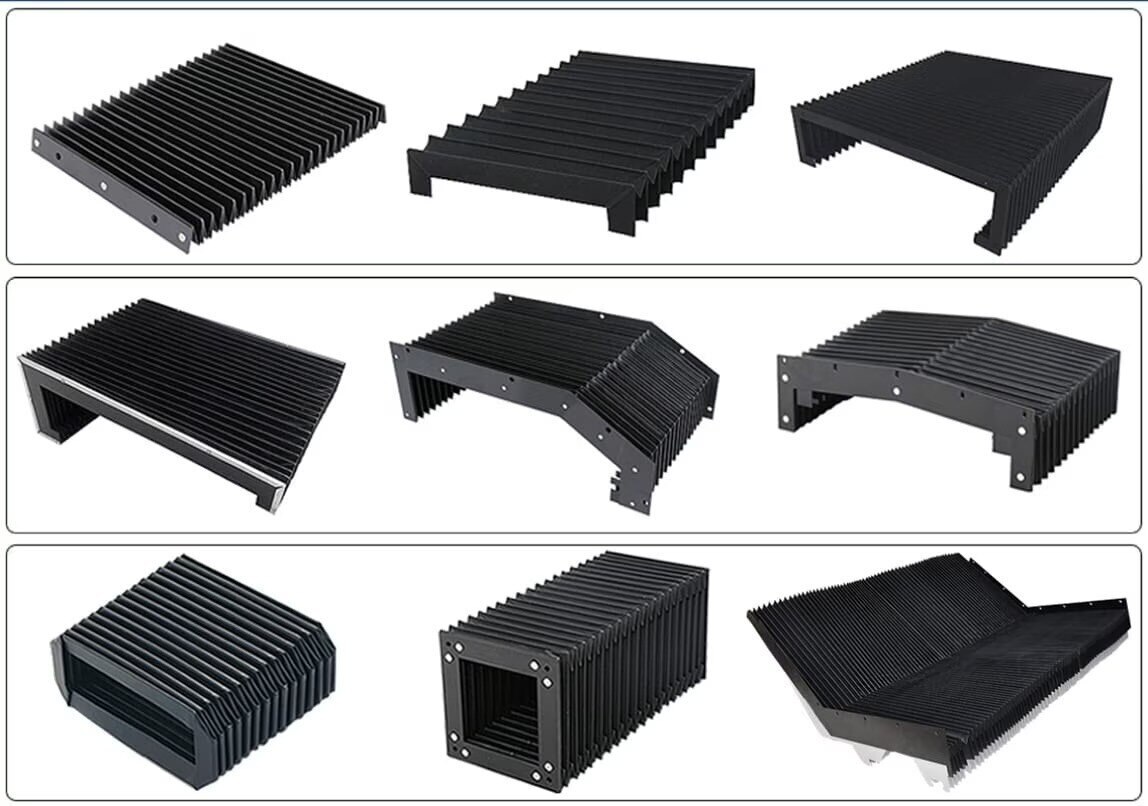
| Fabric or coated bellows | X/Y carriage, Z-axis screw, cable route; rapid reciprocating motion | Low mass and vibration. Choose thermoplastic-coated fabric for oil, coolant and fine dust; protect it from sharp slag and direct heat. |
| Telescopic steel cover | Lower bed guideways, ball screws and rack drives; long straight travel | Handles hot particles, chips and impacts. It adds mass, noise, inertia and folded-height demand. |
| Apron cover | Bed edges and broad horizontal guideways; moderate-speed travel | Interlocking slats resist abrasion and dross better than fabric. Check slat gaps, overlap and debris lodging. |
| Roll-up or spiral-spring cover | Narrow openings, side rails and compact axes; repeated linear travel | The spring stores retraction energy and tensions the strip. It suits limited space, but exposed seams or incomplete overlap can admit dust and heat. |
For laser machine protection in Bengaluru, keep the light optical carriage low-mass and the lower machine-bed cover rugged. A roll-up cover is a contamination barrier, not a laser-radiation enclosure; radiation containment needs a tested enclosure, viewing window, interlocks and documented risk assessment.
What dimensions and motion data must the supplier review?
A cover that fits the machine envelope can still fail if its stroke, folded height, or acceleration is wrong. Give the supplier the protected length and width, usable travel, mounting orientation, fixed and moving-end geometry, guideway position, and the space available for a cassette or folded cover.
- Record maximum speed, acceleration, deceleration, cycle frequency, and the number of cycles required.
- Measure the complete moving cover load, including strips, slats, guides, fasteners, and attached wipers; a spiral spring for way cover in Bengaluru must overcome inertia, not only static weight.
- Mark every nearby obstruction through the full stroke: laser head, cable carrier, rack, motor, hose, guarding, and workpiece clearance.
- Specify hot dross, abrasive dust, fumes, coolant, assist-gas residue, cleaning chemicals, and cleaning frequency.
- Request retraction force or torque across the stroke, minimum winding radius, maximum speed and acceleration, rated cycle life, and the spring replacement method.
| Data to compare | What the supplier checks | Failure if omitted |
|---|---|---|
| Stroke and envelope | Travel, folded height, cassette depth, end clearances | Incomplete retraction or collision |
| Motion profile | Speed, acceleration, reversals, cycle count | Spring fatigue, buckling, vibration |
| Exposure and cleaning | Heat, particles, fluids, wiping access | Sticking, corrosion, lost protection |
| Acceptance test | Actual or representative machine at maximum motion | Faults appear only after installation |
For way cover and spiral spring applications for laser machines in Bengaluru, require a documented full-stroke test. Check over-tension, abnormal noise, adjacent contact, and protection at both stroke ends.
How do you verify installation, maintenance and laser-safety boundaries?
A signed factory-acceptance test must prove the cover works on the machine, not only on a bench. Require a documented cycle at maximum axis speed and acceleration using the actual machine, or a dimensionally representative rig.
- Record full-stroke travel in both directions, including spring over-tension, incomplete retraction, contact with adjacent parts, abnormal noise, vibration, and any exposed guideway at either stroke end.
- Inspect fasteners, seals, overlaps, mounting clearance, cable routing, and access for cleaning and replacement. Require a maintenance schedule stating inspection frequency, cleaning method, wear limits, approved replacement parts, and the person responsible.
- Obtain the cover drawing, material specification, operating limits, FAT report, maintenance instructions, spare-parts list, and photographs showing both end positions.
For laser machine protection in Bengaluru, separate machine-component protection from operator and radiation protection. Way covers protect rails, screws, racks, and cables; they do not replace the enclosure, beam containment, access-door interlocks, warning indicators, or emergency-stop circuit.
Require a documented risk assessment, enclosure and viewing-window specification, interlock validation, and laser-safety file aligned with IEC 60825-1 and applicable machinery-safety requirements.
Do not accept a spiral spring or roller cover as the radiation barrier unless its manufacturer has engineered, tested, and documented that function. Seams, openings, wear, and incomplete overlap can leak radiation. Ask SCUTES INDIA PRIVATE LIMITED for maintenance access and end-of-stroke test evidence when comparing way cover applications laser machines in Bengaluru.
Related products
 | TELESCOPIC SPRING COVER Telescopic Spring Covers provide protection under extreme conditions. View product → |
 | TELESCOPIC COVERS A telescopic cover protects guide-way surfaces and components of moving axis of machines. View product → |
Frequently asked questions
Which laser-machine components need a way cover in Bengaluru?
Protect exposed X, Y and Z guideways first, then review ball screws, racks, linear drives, cable carriers, and moving cable routes for chip, dust, coolant, oil, and heat exposure.
When should you choose a spiral spring instead of a way cover?
Choose a spiral spring for compact protection around a rotating or linear shaft where space is tight. Use a way cover for broad guideways and flat moving surfaces.
How do steel, bellows, apron, and roll-up covers differ?
Steel covers suit severe chip and impact exposure; bellows suit flexible enclosure around complex travel; apron covers suit broad guideways; roll-up covers suit compact access and retraction.
What dimensions and motion data must a supplier review?
Provide axis travel, cover width and height, closed and extended lengths, speed, acceleration, cycle frequency, mounting clearances, obstruction locations, temperature, contaminants, and access requirements.
How do you verify installation, maintenance, and laser-safety boundaries?
Check full travel without binding, confirm mounting alignment and wiper contact, define inspection and cleaning access, and keep the cover separate from the laser enclosure, interlocks, beam shielding, and emergency-stop system.
Related product
 | Laser Machine Bellows Laser Machine Bellows are specialized protective coverings designed to safeguard the vital internal components of laser machines. View product → |