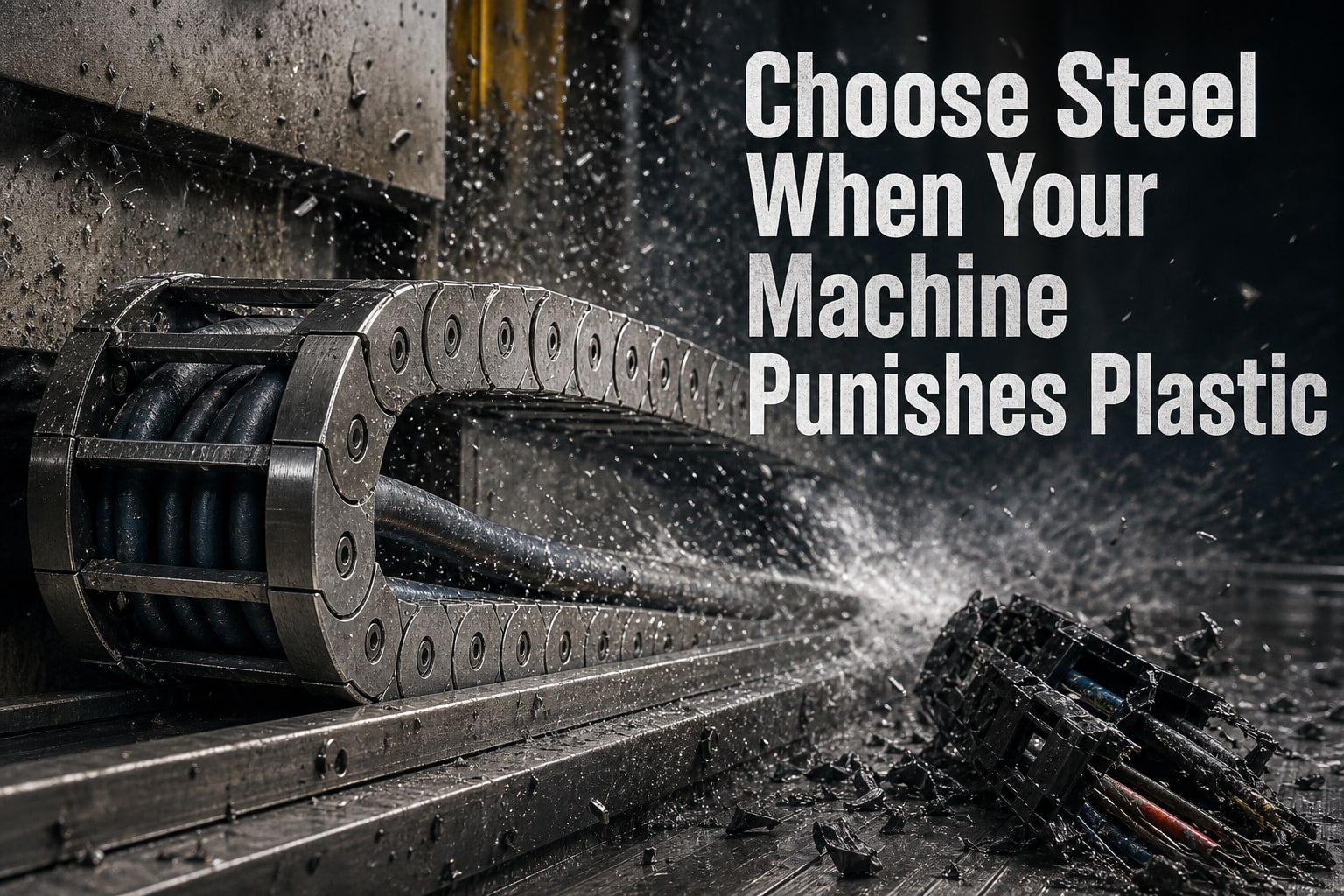
Steel carriers earn their extra weight when machinery exposes moving cables and hoses to hot swarf, weld spatter, impact, heavy bundles or long unsupported runs. By the end, you will be able to match the carrier material, dimensions, bend radius and support arrangement to the machine’s actual duty instead of choosing steel by habit.
Key takeaways
- Choose metal carriers for hot chips, sharp swarf, sparks, impact and abrasive dust.
- Use nylon or polymer carriers when weight, noise and corrosion resistance matter most.
- Size the carrier around cable bend radius, fill space, travel, sag and separation.
- Choose stainless steel for corrosive fluids, washdown or salt exposure—not ordinary dry machining.
Which machinery conditions justify a metal drag chain?
The strongest metal cable drag chain applications are machinery where the carrier faces hot chips, sharp swarf, weld sparks, abrasive dust or impact. This includes CNC machine tools, machining centres, CNC lathes, milling machines, foundry equipment, forging presses, transfer lines, laser and plasma cutting systems, robotic welding cells and presses.
A steel cable drag chain for machinery is justified when:
- Hot particles or radiant heat could soften, embrittle or cut a bare nylon or polymer carrier.
- Heavy cable-and-hose bundles require support across a long unsupported span.
- High acceleration, repeated impact or severe industrial exposure would exceed a polymer carrier’s strength.
- The chain runs near cutting tools, welding arcs, press tooling or abrasive castings.
| Option | Best fit | Main limitation |
|---|---|---|
| Steel carrier | Hot chips, impact, heavy bundles and high acceleration | Higher moving mass, articulation noise and mounting loads |
| Polymer carrier | Clean, low-load automation axes where quiet operation matters | Can soften, embrittle or become cut by heat and sharp debris |
| Steel carrier with chip protection | Debris reaches the cable bundle | Adds components, space and maintenance |
A steel carrier is not automatically a chip shield. Use covered links, steel bands, wipers, or a separate telescopic or chip-protection cover when swarf can reach the cables. A high-temperature chain also does not make standard PVC cable suitable for a furnace zone.
Specify stainless steel for corrosive coolant or washdown exposure, and design any protective-earth or EMC bonding path separately; chain continuity is unreliable.
How does steel compare with nylon and polymer carriers?
Steel cable drag chain applications become defensible when a carrier must carry a heavy cable-and-hose bundle, bridge a long unsupported span, withstand repeated impact, or follow high-acceleration movements. A steel cable drag chain for machines suits machine tools, presses, welding cells and cutting equipment where hot chips or sharp swarf would damage bare polymer.
| Dimension | Steel | Nylon or polymer |
|---|---|---|
| Moving mass | High; increases drive and mounting forces | Low; reduces inertia and motor load |
| Noise | Higher articulation and impact noise | Quieter, especially at high speed |
| Corrosion resistance | Depends on coating or stainless grade; damaged plated steel can rust | Naturally resistant to many coolants and washdown fluids |
| Temperature tolerance | Higher, but limited by coatings, pins, wear surfaces and seals | Lower; heat can soften or embrittle the carrier |
| Impact strength | Better resistance to hot particles, weld spatter and mechanical blows | Better for light debris; sharp or hot impact can cut or deform it |
| Purchase cost | Higher | Lower |
| Maintenance | Inspect articulation, corrosion, guides and lubrication | Usually simpler, with fewer corrosion concerns |
Polymer remains preferable when low acoustic emission, low inertia, lower purchase cost and corrosion resistance matter more than impact or hot-particle resistance. Steel’s temperature advantage stops at the weakest component: check the cable jacket, hose compound, seals and wear surfaces against the surrounding temperature.
A high-temperature carrier does not make standard PVC cable suitable beside a furnace or cutting zone. Miscalculate steel chain span or acceleration and its greater mass produces higher mounting loads, louder operation and more damaging failures; rolling or low-noise designs reduce sound but add parts and maintenance.
How do you size a steel carrier for cables, hoses and travel?
Size a steel cable drag chain for machinery from the bundle inward, not from the chain outward. Measure every cable and hose at its largest working diameter, including connectors, fittings and separation space; compare these measurements with the carrier’s usable internal width and height, never its outside dimensions.
Use about 60% of the usable cross-sectional area as a planning target, then confirm the manufacturer’s fill limit.
- Arrange cables and hoses without crossings or twists, and keep them from pressing against the chain’s inner radius. Add separators or shelves when heavy hoses share the carrier with signal, encoder or fibre-optic cables; otherwise the hoses can crush smaller cables.
- Select the minimum bend radius from the largest cable or hose manufacturer’s dynamic bend-radius requirement. Do not derive it from the chain’s dimensions, because a tight radius causes conductor fatigue, shield damage or hose kinking.
- Calculate length from travel distance, fixed-end and moving-end positions, the required reserve or service loop, and the bend contribution created by the selected radius and return geometry. Check unsupported length, sag and return guidance separately.
- Fit independent strain relief at the fixed end. Add moving-end strain relief when the cable or carrier design specifies it, so tensile loads do not reach connectors, gland plates or terminal blocks.
| Check | Use | Do not use |
|---|---|---|
| Width and height | Usable internal dimensions | Outside dimensions |
| Fill | About 60%, then maker’s limit | Tight visual packing |
| Bend radius | Largest cable or hose specification | Chain size alone |
What installation limits determine service life on a machine axis?
Service life on a machine axis is determined by the complete moving system, not by chain size alone. For a steel cable drag chain for machines, calculate unsupported length, cable-and-hose weight, chain weight, travel speed, acceleration and mounting orientation together; an oversized chain can still sag, buckle or impose excessive side force.
1. Check a horizontal run against the carrier’s rated unsupported span. Long travel may require a guided return run, support table, rollers or a carrier specifically rated for the calculated span. Increasing chain size does not remove the effects of cable weight and acceleration.
2. Treat vertical, inclined and side-mounted axes as separate designs. Continuous cable weight can make the chain fold, twist, climb out of its guide or drop, so use guide channels, reinforced brackets, support rollers or an anti-drop arrangement where the layout demands them.
3. Control impact and wear before commissioning. Steel links striking each other or a support surface create noise; rolling or low-noise designs reduce it but add components and maintenance.
In abrasive chip environments, remove trapped chips, check for seized or loose links, monitor articulation torque and pitch growth, and replace the chain before excessive play develops.
4. Provide a separate, verified bonding path when protective earth, EMC continuity or static control is required. Paint, corrosion, lubricant and moving joints make the metal carrier unreliable as an electrical path.
When should you choose stainless steel instead of coated steel?
Choose stainless steel for steel cable drag chain for machinery when coolant, washdown, chemicals or outdoor moisture could shorten coated steel’s service life. Painted or zinc-plated carbon steel can deteriorate at scratches, joints and crevices, while stainless resists many aqueous environments. Chlorides can still cause pitting and crevice corrosion.
| Construction | Exposure consequence | Decision |
|---|---|---|
| Painted carbon steel | Scratches expose the base metal; joints and crevices retain moisture | Use only where exposure is controlled and coating damage is unlikely |
| Zinc-plated carbon steel | Plating wears at articulation and impact points, then corrosion spreads | Avoid when washdown, coolant or outdoor moisture reaches moving joints |
| Stainless steel | Better resistance to many aqueous environments, but chloride attack remains possible | Specify it when corrosion or contamination would threaten service life |
Compare the complete carrier, not just its side links. Check the material grade, pin and wear-surface construction, joint lubrication, cable-jacket compatibility, shield or fibre-optic abrasion risk, and EMC requirements. Stainless-on-stainless sliding parts can gall. A metal carrier is not automatically a protective-earth or cable-shield path; design and verify bonding separately.
For metal cable drag chain applications, ask SCUTES INDIA PRIVATE LIMITED to document:
- Internal dimensions and minimum dynamic bend radius
- Unsupported-span rating and joint design
- Material grade, temperature limits and wear surfaces
- Cable-jacket compatibility, shield or fibre protection, and EMC provisions
- Cleaning, lubrication and inspection intervals
Related product
 | Cable Drag Chain Cable drag chains are a vital component in modern industrial equipment and automation systems. View product → |
Frequently asked questions
Which machinery conditions justify a metal drag chain?
Choose a metal drag chain when the carrier faces hot chips, sharp swarf, weld sparks, abrasive dust or impact. CNC machine tools, foundry equipment, forging presses, laser cutters and welding cells are common applications.
How does steel compare with nylon and polymer carriers?
Steel handles higher heat, impact and abrasive chip loads. Nylon and polymer carriers reduce weight and noise and resist corrosion, but they suit applications within their temperature, load and chemical limits.
How do you size a steel carrier for cables, hoses and travel?
Base the size on each cable and hose bend-radius requirement, the combined outside diameter, internal separation, usable fill space and the machine axis travel. Keep the bundle below the carrier’s recommended fill capacity.
What installation limits determine service life on a machine axis?
Match the carrier to the required travel, mounting position, unsupported length, bend radius, speed and acceleration. Prevent twisting, side loading, overfilled compartments and cable movement inside the carrier.
When should you choose stainless steel instead of coated steel?
Choose stainless steel for coolant exposure, frequent washdown, salt, moisture or corrosive process chemicals. Coated steel suits dry or controlled environments when corrosion exposure is limited.