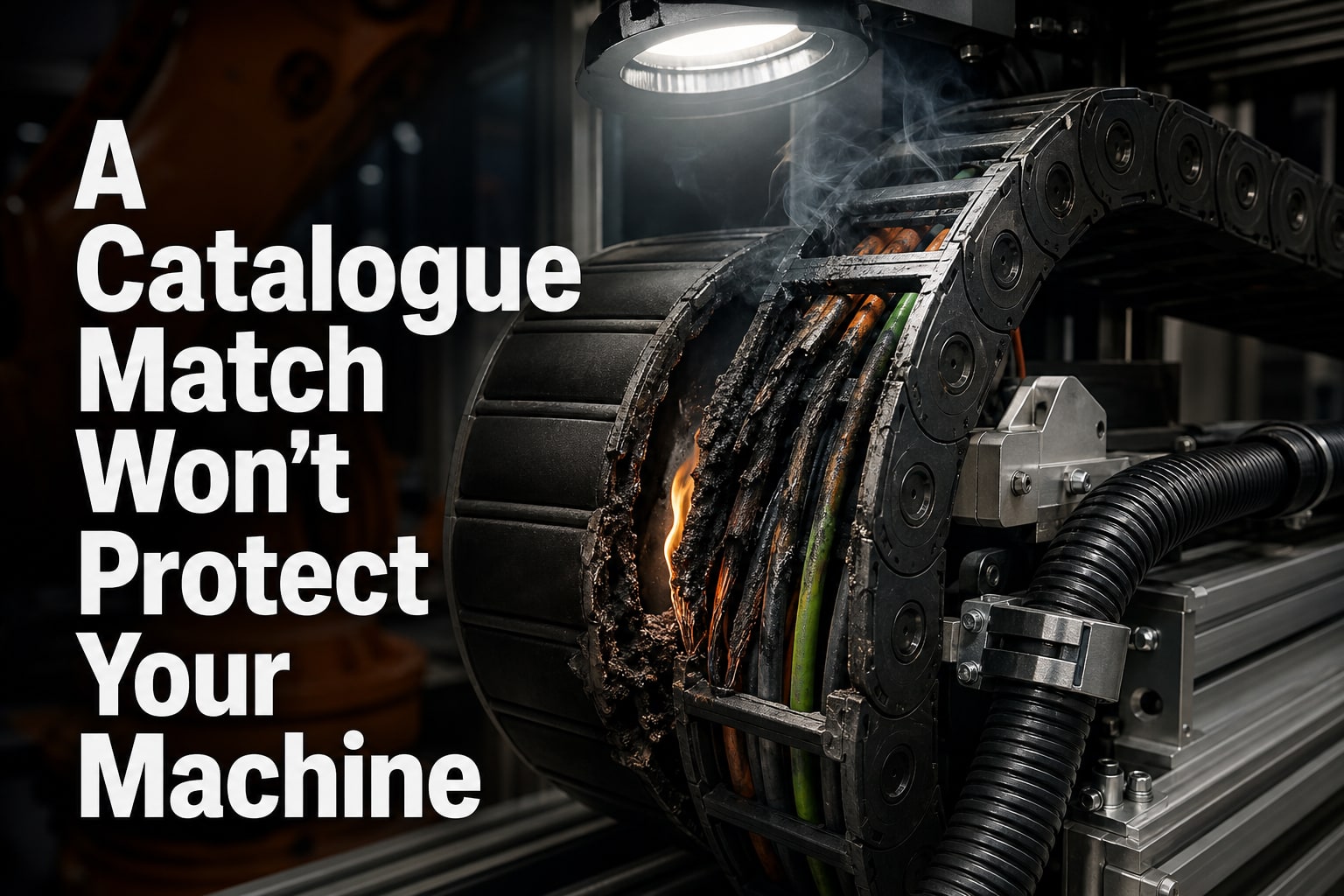
A suitable cover, bellows, spring cover or cable carrier depends on the machine movement, hazard and operating conditions—not the product name alone. By the end, you will have a supplier checklist covering design inputs, material selection, evidence, acceptance testing, lifecycle cost and change control.
Key takeaways
- Ask for a drawing showing mounting points, lengths, clearances and bend radius.
- Match bellows, covers or cable guides to the specific hazard and material exposure.
- Request test records, material details, compatibility evidence and traceable part identification.
- Set acceptance checks and service-life criteria before comparing supplier prices.
Require an engineered design, not a catalogue match
A machine protection components supplier understands your installation when it converts your machine drawing and operating conditions into a design, rather than selecting the nearest catalogue size. Ask for drawings that show mounting points, compressed and extended lengths, clearances, bend radius, materials, fasteners and replacement-part identification.
Send the supplier:
- Machine model, axis travel, guideway dimensions, travel speed, acceleration and cycle frequency.
- Hazard type, operating temperature, coolant or oil type, chip size and photographs of the installation.
- Cable and hose diameters, weights, dynamic-bend requirements, orientation and unsupported length.
- Expected impacts, access points and installation constraints for guards, bellows or covers.
A fixed or movable guard must be designed and documented consistently with ISO 14120, but it does not establish the machine’s Performance Level, Safety Integrity Level or interlocking adequacy. For EU machinery, require technical-file support covering installation limits, risk-reduction assumptions and secure performance under foreseeable impacts.
For switches, interlocks and emergency stops, request B10D or MTTFD, diagnostic data, common-cause-failure assumptions and operating limits for an ISO 13849 calculation.
For cable carriers, compare the largest cable’s dynamic-bend requirement with the carrier radius, then verify speed, acceleration, cable weight and separation. Require packing and restraint instructions; crossed cables and single-end restraint cause abrasion and fatigue.
Treat UL 94 as a resin test rating, not proof of complete-assembly fire performance, and demand the exact resin, grade, thickness and assembly approvals.
Match the protection type and material to the actual hazard
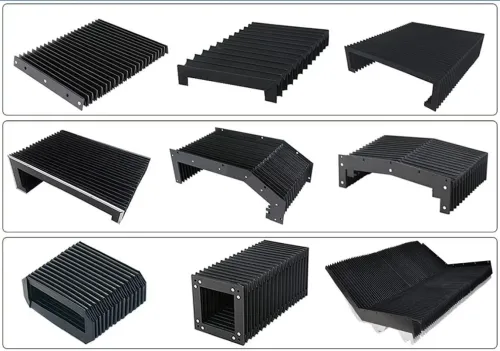
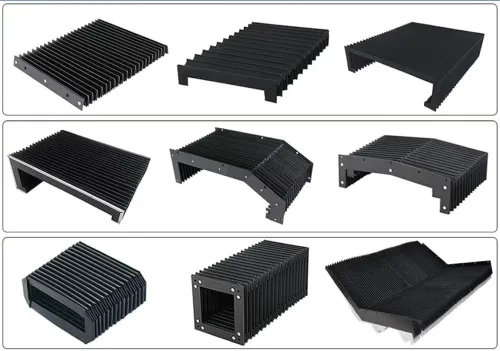
Choose the component and construction by the hazard reaching each moving part, not by the machine’s name: bellows for contaminated guideways, telescopic steel covers for heavy chips and impact, spring covers for rotating shafts, and cable drag chains for continuously moving cable bundles.
| Option | Construction | When it applies |
|---|---|---|
| Bellows | Coated fabric, elastomer, or heat-resistant laminate with guided folds | Protects guideways, optical assemblies, and spindle areas from dust, coolant, oil, or fine chips; specify a low-shedding surface around lenses and sensors. |
| Telescopic steel cover | Overlapping formed steel sections with wipers and scrapers | Suits horizontal guideways exposed to hot, sharp, heavy chips and impact; it is a poor choice where the available retracted length is too short. |
| Apron or roll-up cover | Interlocking slats or flexible curtain winding onto a roller | Fits long travels and broad openings; reject it when chips can lodge between slats or the roll blocks nearby access. |
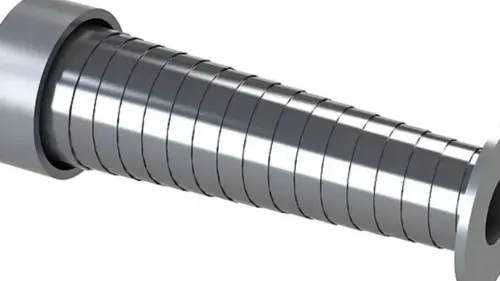
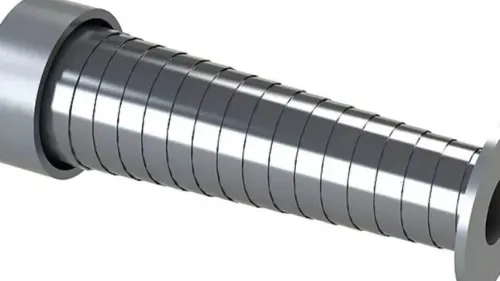
| Spring cover | Spiral-wound metal or coated fabric surrounding a shaft | Shields rotating shafts from dust and incidental contact; it does not replace a fixed guard where an operator can reach the hazard. |
| Cable drag chain | Hinged polymer or steel links sized to the cable bundle | Controls cable bend radius during repeated travel; select it from cable mass, fill, speed, acceleration, travel, orientation, and temperature. |
Ask the machine protection components supplier to match resin, coating, fasteners, and seals to the coolant, oil, chip size, temperature, and cleaning method. A UL 94 rating describes a tested plastic specimen, not the complete assembly’s fire performance.
Treat operator-area guards separately. ISO 14120 covers guard construction, while interlocks and safety circuits require their own ISO 13849 validation; a guard component alone does not establish the machine’s Performance Level.
Ask for testable evidence of quality, safety and compatibility
Ask a machine protection components supplier for drawings, material declarations, test reports and safety data tied to the proposed part number, not generic catalogue claims.
| Evidence | What it supports | What it does not prove |
|---|---|---|
| ISO 14120 design information | Guard construction, access and fastening principles | The guard’s Performance Level or interlock adequacy |
| IEC 60529 IP test report | Resistance to defined dust and water ingress tests | Continuous flexing, coolant chemistry, chips, UV or carrier wear |
| ISO 13849 data, including B10D or MTTFD | Inputs for a complete safety-control calculation | Validation of the complete interlocking or emergency-stop circuit |
| UL 94 report naming resin, grade and thickness | Flammability behaviour of the tested plastic specimen | Fire performance of the installed guard, carrier or assembly |
For flexible cables, hoses and conduits, require test results from repeated-motion exposure at the stated temperature, oil or coolant, speed, bend radius and cycle count. A static immersion result will not reveal jacket cracking or abrasion during travel.
Ask the supplier to identify:
- Material grade, fasteners, operating limits and replacement parts on the drawing.
- Installation limits, mounting loads, compressed and extended dimensions, and clearance requirements.
- Chemical-compatibility evidence for your exact coolant or oil, plus chip, washdown and temperature testing.
- Guard-switch or interlock diagnostic data, common-cause assumptions and operating limits for your ISO 13849 calculation.
For machinery entering the EU market, retain this evidence in the technical file. A CE mark or high IP number cannot substitute for machine-level risk assessment and validation.
Define acceptance checks and the expected service life
Accept a component only after checking it against the machine, its hazards and the supplier’s stated limits. Your acceptance record should capture the measured fit, operating test, documents received and conditions used to establish service life.
1. Verify dimensions, mounting points, compressed and extended lengths, clearances, bend radius, travel, speed, acceleration and cycle frequency against the approved drawing. Operate the machine through its full range; reject any rubbing, binding, exposed gap or loose fastener.
2. For guards, check material and fastener specifications, impact assumptions, installation limits, drawings and replacement-part identification. ISO 14120 supports guard design, but the guard alone does not prove the machine’s required Performance Level or Safety Integrity Level.
3. For switches, interlocks and emergency-stop devices, obtain B10D or MTTFD data, diagnostic information, common-cause-failure assumptions and operating limits for the ISO 13849 calculation. A CE mark does not validate the complete safety-related control system.
4. Confirm service-life evidence under stated conditions. For a cable carrier, record cable mass and fill, travel, speed, acceleration, bend radius, orientation, temperature and failure criterion; “millions of cycles” without these figures is not comparable.
After installation, expect commissioning guidance, inspection criteria, replacement-part identification and a named technical contact. Request a maintenance schedule covering wear, fastener security, cracking, seal damage and cable movement. IP ratings under IEC 60529 do not prove resistance to coolant, chips, flexing or washdown, so agree on separate inspection and replacement triggers.
Ask for updated RoHS and REACH declarations covering coatings, additives, lubricants and supplied subcomponents.
Compare suppliers on communication, traceability and total cost
A dependable machine protection components supplier communicates in drawings, revision-controlled documents and named responses, not vague assurances. Compare the evidence you will receive before placing the order, because a low purchase price disappears when unclear dimensions, late clarifications or unidentified replacements stop a production line.
| Supplier to prefer | Low-price warning | Why it matters |
|---|---|---|
| Clear communication | Quote contains assumptions but no open questions, revision number or responsible contact | Unrecorded changes create fit-up disputes and installation delays |
| Traceable supply | Part number, material grade, batch or serial reference, drawing revision and replacement identification | You can isolate a failed part and reorder the correct version instead of measuring from memory |
| Complete documentation | Installation limits, fastener details and maintenance instructions accompany the shipment | Missing records weaken your technical file and lengthen commissioning |
| Transparent total cost | Price includes expected spares, lead time, installation effort and service terms | A cheaper cover can cost more through downtime, expedited freight and redesign |
Ask each candidate to state:
- What information is included in the quotation, and which assumptions must you confirm?
- How will you identify supplied parts after several design revisions?
- What is the normal replacement route if the original part is discontinued?
- Which failures or fit problems fall under warranty, and what response does that trigger?
Put SCUTES INDIA PRIVATE LIMITED through the same comparison as every other candidate; a supplier earns preference by producing this evidence consistently, not by offering the lowest first invoice.
Related products
 | Machine Covers Machine covers are specially designed shields used to protect industrial equipment and machinery from environmental elements. View product → |
 | Laser Machine Bellows Laser Machine Bellows are specialized protective coverings designed to safeguard the vital internal components of laser machines. View product → |
Frequently asked questions
Why require an engineered design instead of choosing a catalogue size?
An engineered design accounts for mounting points, compressed and extended lengths, clearances, bend radius, materials, fasteners and replacement-part identification.
How do you match machine protection to the actual hazard?
Identify the hazard first, including dust, coolant, oil, chips, heat, abrasion and movement, then select the protection type and material that withstands those conditions.
What quality and compatibility evidence should a supplier provide?
Ask for testable records, material specifications, safety information, compatibility evidence and traceable component or batch identification.
What should acceptance checks and service life include?
Define dimensional checks, mounting fit, movement clearance, sealing or coverage requirements and the expected operating life before ordering.
How should you compare machine protection components suppliers?
Compare technical communication, drawing revisions, traceability, replacement support, lead times, installation effort, maintenance and total cost rather than unit price alone.
Related products
 | TELESCOPIC COVERS A telescopic cover protects guide-way surfaces and components of moving axis of machines. View product → |
 | Roll Up Cover A roll-up cover is a highly durable and flexible protective solution designed to safeguard machinery, equipment, and valuable assets from dust,... View product → |
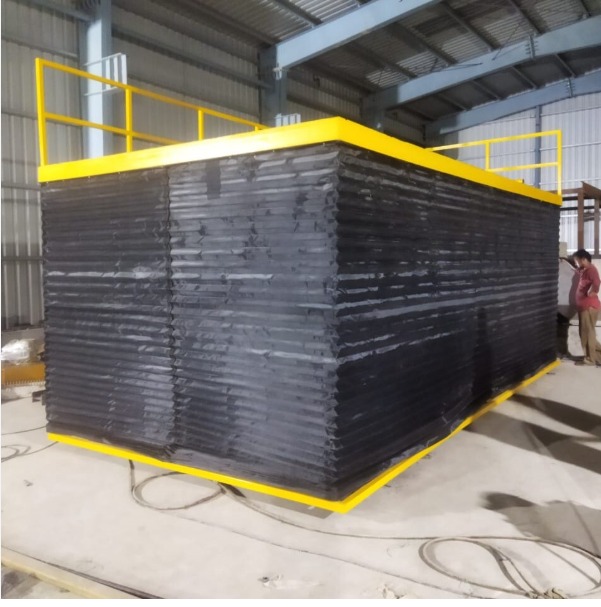 | SCISSOR LIFT BELLOWS Scissor Lift Bellows are one of the broadly demanded stabilizer for which we are considered an acclaimed designed in the market. View product → |
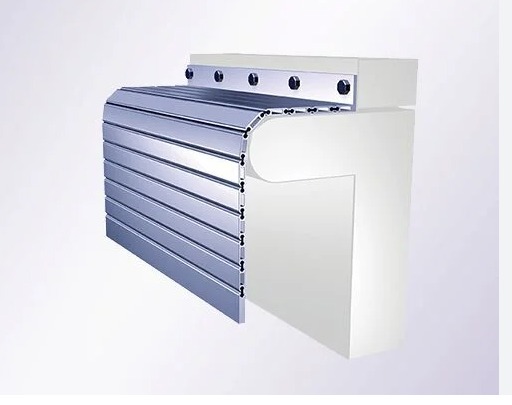 | APRON COVER Effectively engaged in offering a vast collection of outstanding quality products which include Apron Covers. View product → |