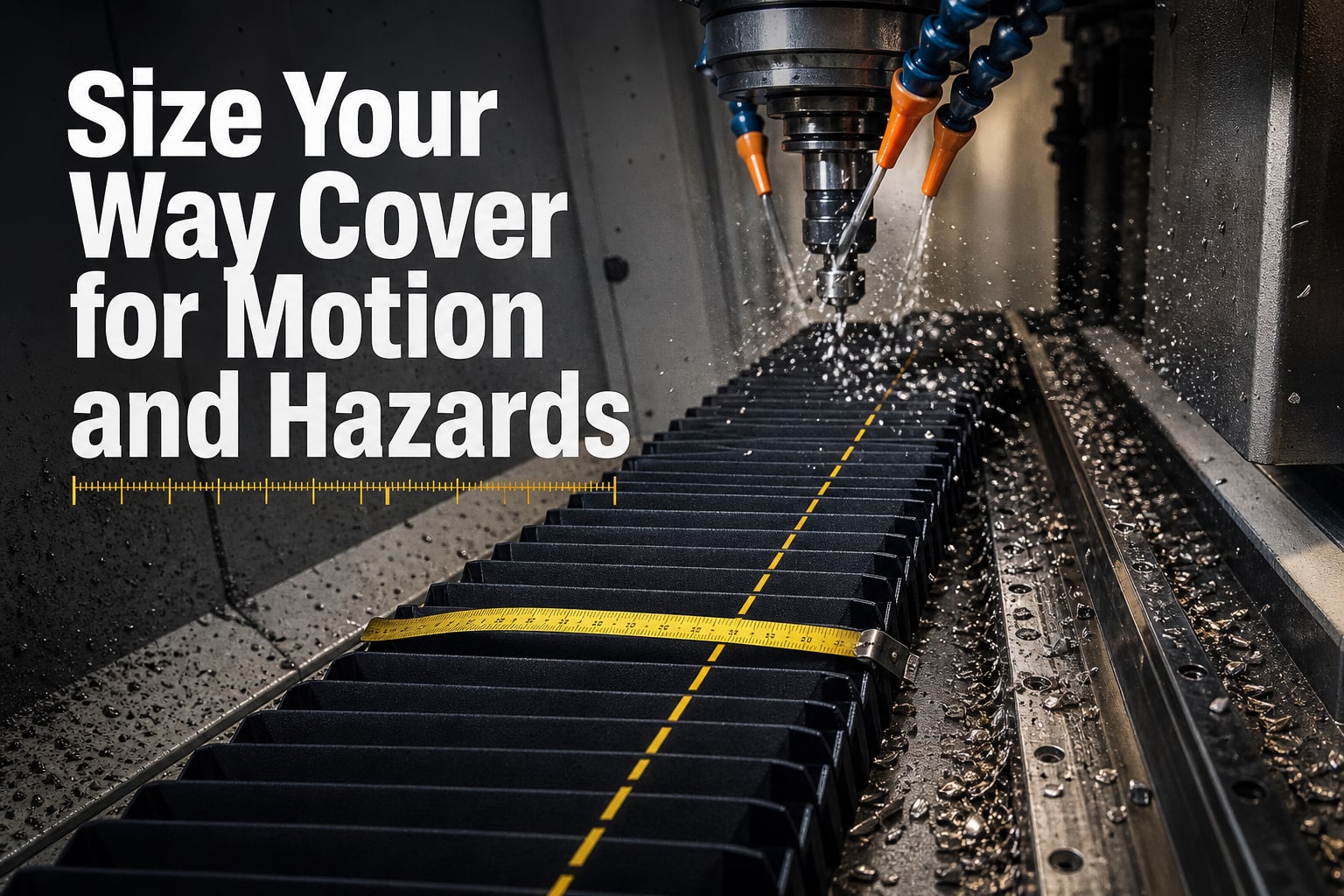
A cover selected by axis travel alone can jam, wear rapidly or block maintenance access. By matching the protection to machine geometry, motion forces, contaminants and installation limits, you can narrow the options and give a manufacturer the information needed for a workable design.
Key takeaways
- Start with each axis’s hazards, motion, travel and available clearance.
- Choose cover types by chip load, coolant exposure, speed and access needs.
- Allow for compression, extension, mounting space and motion forces.
- Validate dimensions, materials, guides and cleaning access before installation.
Start with the machine’s movement and the hazard
Choose machine way protection solutions from the hazard and motion at each axis, not from travel length alone. Record chip shape, coolant type, temperature, speed, acceleration, stroke, mounting space and cleaning method. A single machine may need telescopic steel protection on X, a bellows on Y and a roller-blind cover on Z.
- For hot chips, ask for allowable chip-contact temperature, exposure duration, spark or molten-particle resistance, and sacrificial plates or stainless-steel construction.
- For fast motion, check acceleration, folded-stack volume, unsupported span, permissible deflection and accumulated chip weight; a jam can damage guides and accuracy.
- Match fabric, coating, fold geometry and attachments to abrasive fines, flood coolant, welding spatter, laser debris, vibration and impact.
- Provide inspection access, drain paths, chip-cleaning access and a route to replace wipers or bellows sections before comparing purchase prices.
- Treat way wipers as secondary sealing: match lip material, geometry and preload to the guideway; excessive preload raises friction and heat.
| Option | Main trade-off | Select when |
|---|---|---|
| Telescopic steel cover | Rigid and chip-resistant, but heavier | Sharp swarf, impact and long horizontal ways |
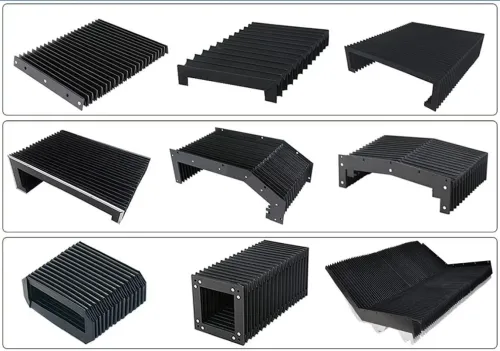
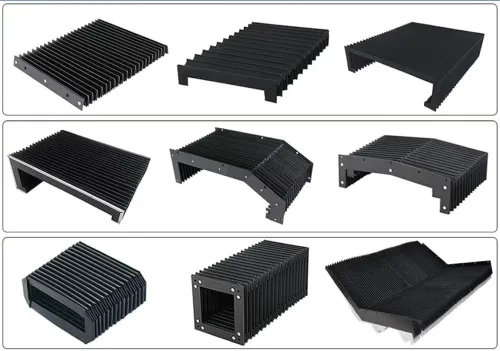
| Bellows cover | Light and compact, but folds can trap hot chips | Low mass, tight space or multi-axis movement |
| Roller-blind cover | Low profile and fast, but not automatically chip-tight | High-speed travel with protected roller, slats, seals and guides |
| Apron or spring cover | Handles broad travel, but needs clearance and tension control | Large exposed ways where folded height is limited |
| Uncovered or integrated guarding | Simplest access, but leaves contamination risk | The machine enclosure itself blocks chips, coolant and dust directly. |
Compare machine way protection cover types by their limits
Compare machine way protection cover types against the failure you cannot tolerate, not axis travel alone. Chip shape, coolant volume, temperature, speed, acceleration, stroke, mounting space and cleaning method change the answer; one machine can need steel on X and bellows on Z.
| Option | Main advantage | Practical limit |
|---|---|---|
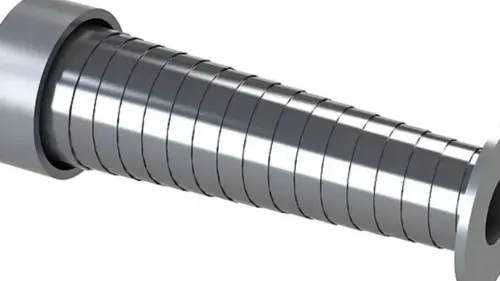
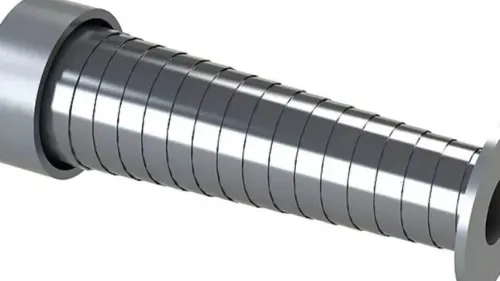
| Telescopic steel covers | Strong barrier against hot, sharp chips, heavy impact and flood coolant | Mass, moving inertia, stack height and inter-box chip packing demand space and reliable drainage |
| Bellows | Light, flexible protection for complex geometries and restricted spaces | Fabric, coatings and seams can fail under sharp swarf, heat, welding spatter or abrasive dust |
| Roll-up covers | Low folded volume and suitability for fast movement | Roller, seals and side guides need chip protection; unsupported spans can sag and admit debris |
| Apron covers | Long horizontal beds with repeated chip impact | Overlapping slats need correct guidance, orientation and sealing; joints are not fully enclosed |
| Spring covers | Compact wound-steel protection where installation space is tight | Limited stiffness and exposed edges make severe impact or large chip loads a poor match |
| Brush wipers | Secondary sealing and debris removal at a sliding interface | Excessive lip preload raises friction and wear; wipers cannot replace a cover |
| Guarding | Keeps people and large debris away through a fixed or integrated enclosure | It does not seal the way; openings, access doors and internal chip accumulation still need control |
Before selecting, confirm inspection access, wiper or bellows-section replacement, chip-cleaning routes, drain paths and permissible accumulated chip weight. A jam can bend mounts, stop an axis and destroy accuracy, turning a low purchase price into downtime.
Size the cover around travel, clearance and motion forces
Machine way protection cover selection starts with the complete envelope and motion profile, not axis travel alone. Measure exposed guideway length, width and height; required stroke; maximum extension; folded height; mounting points; tooling clearance; and the installation space available around the axis. Check guideway parallelism and permissible cover deflection.
Poor alignment or insufficient overlap can cause box collision, seal wear and jamming.
Give the supplier these motion and operating figures:
- Usable travel, approach distance and any overtravel
- Maximum speed, acceleration and deceleration
- Reversal frequency, vibration and cycle count
- Chip type, accumulated chip weight, coolant volume, operating temperature and cleaning method
- Inspection access, drain routes and the space needed to replace wipers, bellows sections or other wear parts
| Check | Record | What goes wrong if missed |
|---|---|---|
| Travel and extension | Stroke, maximum extension, minimum overlap | The cover bottoms out, separates or overloads its guides |
| Installation envelope | Folded height, mounting points, tooling and adjacent-axis clearance | The cover collides with the machine or restricts access |
| Motion forces | Peak acceleration, reversals, vibration and cycle frequency | Steady speed looks acceptable, but repeated shock causes fatigue and jamming |
| Service limits | Chip load, drain path, cleaning route and replacement access | Debris adds weight, blocks movement and turns a cheap cover into downtime |
| Cable routing | Carrier bend radius and service space | A correctly sized cover still allows cable fatigue if the carrier is cramped |
Match materials and construction to chips, coolant and heat
Choose machine way protection solutions by the loads the construction must survive, not by axis travel alone. Match the cover to chip shape and heat, coolant concentration and additives, axis speed and acceleration, cleaning method, and available mounting space.
The same machine may need different machine way protection cover types on its X, Y and Z axes.
For sharp or heavy swarf, use a construction that resists puncture and impact, with overlapping sections, sacrificial plates, or stainless-steel surfaces where specified. Ask for allowable chip-contact temperature, exposure duration, spark resistance, and molten-particle resistance; an ambient-temperature rating does not answer whether hot chips will burn through the cover.
Check coolant compatibility using the actual fluid concentration, operating temperature, additives, and washdown chemicals. Synthetic coolant or chlorine-containing cleaner can attack coatings, adhesives, sealants, bellows fabric, and wiper lips that tolerate mineral-oil coolant.
- Select wiper lip material, geometry, and preload for the guideway surface and chip environment; excessive preload raises friction and can heat or damage the way.
- Provide drain paths and a practical route for chip removal, inspection, and wiper or bellows-section replacement.
- Confirm permissible accumulated chip weight and the result of a jam before approval.
- Keep cable carriers separate in the design: the cover excludes contamination, while the carrier controls cable and hose bend radius. Leave service access, or cable fatigue can follow even when the cover is correctly sized.
A low purchase price becomes expensive when cleaning requires dismantling the machine or a jam destroys accuracy. Include those failure-mode limits in the selection record.
Validate the design before ordering or installing it
Send a supplier a dimensioned drawing and operating profile, not just the axis travel. A reliable machine way protection cover selection depends on the space available, the actual forces and the planned maintenance route.
- Mark guideway width, length, mounting faces, tooling clearance, folded height, maximum extension, installation envelope and axis travel. Show guideway parallelism and any obstructions.
- Give maximum speed, acceleration, deceleration, reversing frequency, vibration and cycle frequency. Include chip type, chip load, coolant or oil exposure, temperature range and cleaning method.
- State the cover’s permissible deflection, minimum box overlap, accumulated chip-weight limit and the consequence of a jam. Ask the supplier to identify the failure mode if those limits are exceeded.
- Require a service drawing showing inspection access, drain paths, chip-cleaning access and the replacement route for wipers, seals, bellows sections or damaged boxes.
- Check that the proposal leaves cable carriers separate from the cover and preserves the carrier’s minimum bend radius. A cover that fits can still fatigue cables if service access or routing is cramped.
Before ordering, review the drawing at full extension and compression, then confirm clearances through the complete motion cycle. Check wiper lip material, preload and geometry against the guideway; excessive preload adds friction and heat.
A quotation from SCUTES INDIA PRIVATE LIMITED is comparable only when it uses this complete design information, rather than axis travel alone.
Related products
 | Machine Covers Machine covers are specially designed shields used to protect industrial equipment and machinery from environmental elements. View product → |
 | TELESCOPIC COVERS A telescopic cover protects guide-way surfaces and components of moving axis of machines. View product → |
Frequently asked questions
What should you assess before choosing machine way protection?
Record each axis’s movement, stroke, speed, acceleration, chip shape, coolant type, temperature, mounting space and cleaning method.
How do machine way protection cover types differ?
Telescopic steel covers suit heavy chip and coolant exposure, bellows suit flexible enclosed protection, and roller-blind covers suit restricted spaces and selected travel conditions.
How do you size a machine way protection cover?
Calculate travel, compressed and extended lengths, mounting clearances, guideway geometry, folding or telescoping space, and forces created during acceleration.
What should you validate before ordering or installing a cover?
Check the dimensional drawing, mounting points, material compatibility, travel limits, interference risks, cleaning access and performance under the machine’s actual operating conditions.
Related products
 | Roll Up Cover A roll-up cover is a highly durable and flexible protective solution designed to safeguard machinery, equipment, and valuable assets from dust,... View product → |
 | Laser Machine Bellows Laser Machine Bellows are specialized protective coverings designed to safeguard the vital internal components of laser machines. View product → |
 | Cable Drag Chain Cable drag chains are a vital component in modern industrial equipment and automation systems. View product → |
 | TELESCOPIC SPRING COVER Telescopic Spring Covers provide protection under extreme conditions. View product → |