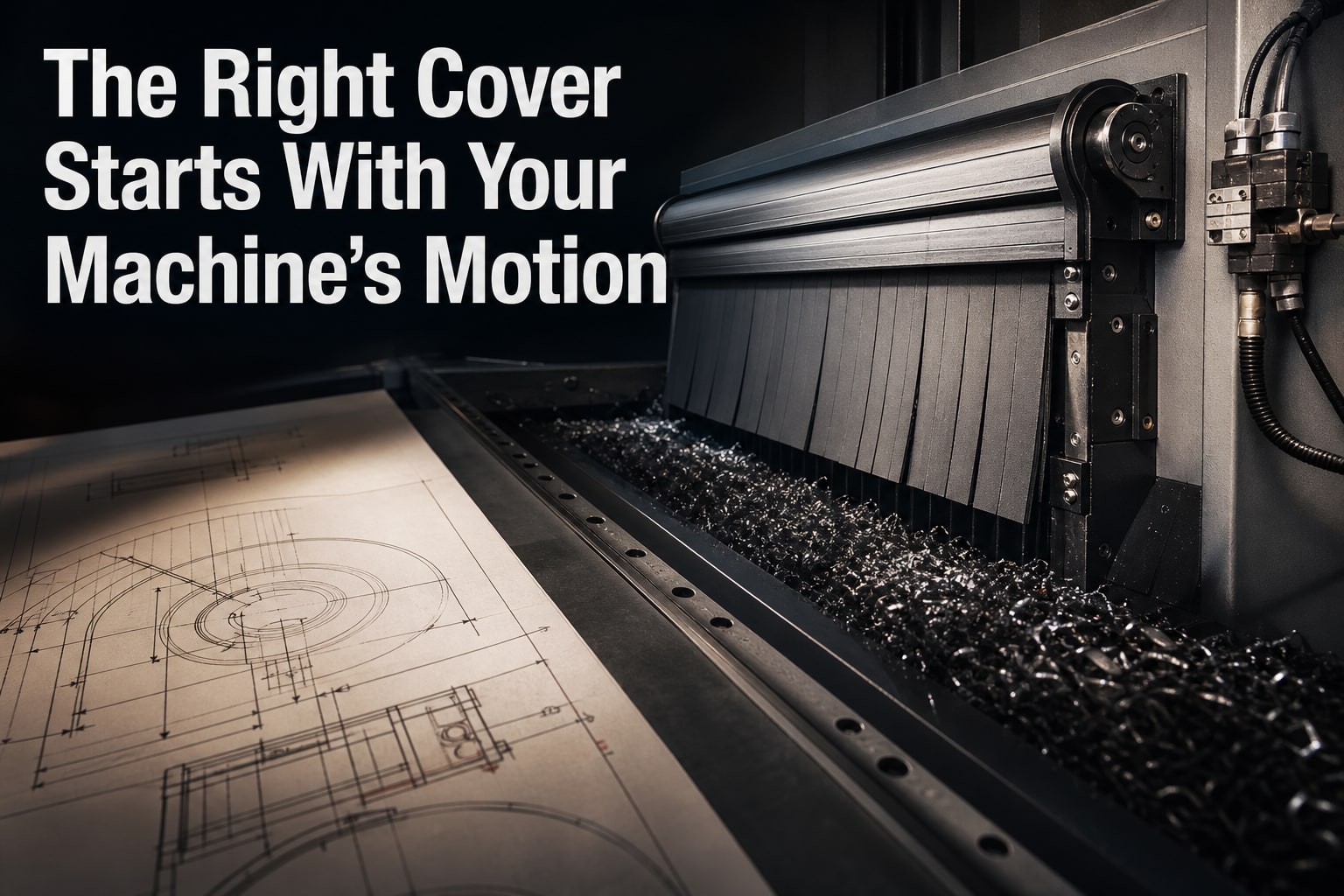
The right manufacturer must match the cover to the machine’s movement, contamination pattern, mounting envelope and control system—not just quote a width and stroke. By the end, you will have a practical way to compare cover designs, prepare a complete quotation request and test whether a supplier can deliver a reliable installation.
Key takeaways
- Choose roll-up covers when frequent access and compact retraction matter.
- Send the manufacturer machine envelope, motion data and interface drawing.
- Compare curtain coatings, seams and chip handling—not material names alone.
- Require drawings, testing evidence and a replacement-support plan before approval.
Choose a roll-up cover only when its movement and access advantages fit the machine
Choose a roll-up cover when the opening needs frequent access, the cover must retract into a compact drum, or folded material would exceed the machine’s side clearance.
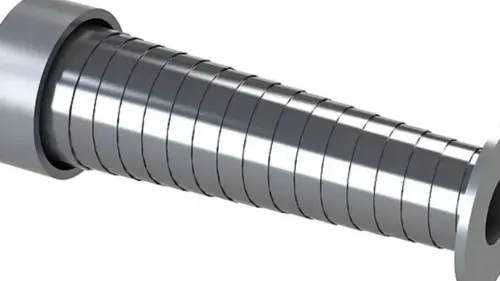
A fabric roll up cover for machine tools suits lighter contamination and flexible, low-profile installations; slatted or armoured versions withstand more impact and chips but need extra winding space and accurate guidance.
| Option | Travel direction and access | Rolled or folded size and clearance | Rigidity, sealing and chip load |
|---|---|---|---|
| Roll-up cover | Frequent opening; suits horizontal, vertical or angled travel | Compact drum; check drum diameter and side clearance | Fabric suits light contamination; slats handle greater impact but seal less tightly |
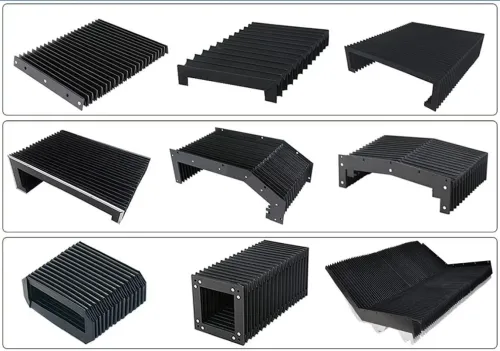
| Bellows | Guided movement with repeated travel | Large folded pack behind the opening | Good sealing; suitable for coolant and chips within its material limits |
| Apron cover | Simple horizontal protection with occasional access | Rolls or folds along one edge | Moderate rigidity and sealing; suits lighter chip loads |
| Telescopic steel cover | Guided axis travel with limited access | Large rigid box envelope | Strongest chip and impact protection; excellent guideway shielding |
| Fixed enclosure or sliding guard | Permanent access control or infrequent entry | Fixed envelope or side-sliding panels | Most rigid and sealable; consumes access space and does not follow moving travel |
A roll up machine cover manufacturer should state winding diameter, guidance, drainage, cleaning access and jam response. A motorized version also needs rated torque, duty cycle, limit switches, overload response and manual recovery.
Treat a roll up cover for machine protection as contamination control, not automatically as a safety guard. If it blocks hazardous movement, require risk-assessment evidence covering safety distances, interlocking, emergency-stop and restart behavior.
Give the manufacturer the machine envelope, motion data and interface drawing
For an accurate quotation, give the manufacturer the machine envelope, motion data and a dimensioned interface drawing. For a custom roll up machine cover, state the protected opening width and height separately from the total mounting envelope. Do not substitute the machine door opening unless it is the actual opening requiring contamination protection.
Provide these quotation details:
- Axis travel, movement direction and mounting orientation
- Attachment points, available side clearance and end limits
- Cable or hose routes, service-access space and maximum permitted rolled-cover diameter
- Axis speed, acceleration and cycle frequency
- Unsupported span and minimum winding or bending radius
- Expected drum speed and available clearance around the drum, guides, bottom bar and fasteners
On a CNC machine, measure the opening where chips, coolant or oil must be blocked. Then measure the surrounding structure that the roll up cover for CNC machines will occupy. A nominal width-and-stroke figure cannot reveal a collision with a door, tool changer or travelling axis.
Ask for a drawing showing the fully extended and fully retracted envelopes, guide alignment, collision clearances, attachment points and mounting tolerances. Require the supplier to check buckling, edge tracking, telescoping and drum torque against the real motion profile.
A small drum saves space but increases bending stress and drive torque. A large drum reduces stress but can obstruct doors, tooling or travel. Compare custom roll up machine covers against both constraints before approving the design.
Compare the curtain, coating, seams and chip-handling details—not just the material name
Evaluate a roll up cover for machines by its complete construction, not by a material name such as polyurethane, PVC or rubber. Ask the industrial roll up cover manufacturer for the following details and evidence:
- Exact fabric construction, coating chemistry, thickness, mass per area, seam method, edge reinforcement and attachment method.
- Resistance to your actual coolant or cutting-fluid formulation, tramp oil and alkaline cleaning chemicals; mineral-oil compatibility does not prove resistance to synthetic or semi-synthetic coolant.
- Operating temperature, intermittent hot-chip exposure, UV exposure, abrasion, swelling, tensile performance and minimum winding or bending radius.
- Chip size, impact direction, coolant pressure, drainage path and cleaning method.
| Construction detail | What to compare | Why it matters |
|---|---|---|
| Curtain and coating | Woven or laminated structure, chemistry, thickness and mass per area | High-speed chips can puncture or abrade a thin curtain |
| Seams and edges | Welded, stitched or bonded seams; reinforced edges | Weak seams fail before the fabric does |
| Attachment | Clamps, bolted strips, slats or bonded retainers | Poor retention causes tracking loss and drum misalignment |
| Guidance and sealing | Brushes, wipers, side guides, bottom bar, overlaps or labyrinth seal | These control leakage and debris entry |
Choose guided edges when chip exposure demands predictable tracking, but require guide-clearance assumptions and cleaning access: guides add friction and trap debris. Check whether packed chips can stop slats or overlapping elements from winding.
Compare edge wear, seam failure, slat fatigue, tension loss, coolant swelling and debris scoring. Request cycle-test data from a construction equivalent to the proposed roll up cover for machine protection, including the stated chip and coolant conditions.
Select the right roll-up architecture and specify controls for powered versions
Choose fabric for the lowest mass and greatest flexibility, armoured slats for impact resistance and rigidity, and a motorized roll up machine cover when repeatable positioning or automatic-cycle integration matters.
| Architecture | Main advantage | Main limitation |
|---|---|---|
| Fabric | Light, flexible, compact when rolled | Needs support where chips strike or the unsupported span is long |
| Slatted or armoured | Resists impact and holds its shape | Adds weight, drum diameter, friction and maintenance |
| Motorized | Positions consistently and connects to machine cycles | Requires mechanical, electrical and safety integration |
For a roll up cover for CNC machines, match the architecture to chip impact, coolant exposure and access frequency. Packed chips can stop slats winding; a fabric curtain can abrade or puncture. Ask the supplier to state the minimum winding radius, unsupported-span limit, allowable travel speed and acceleration in writing.
Specify a motorized roll up machine cover with these controls and responses:
- Rated torque, winding speed, duty or cycle frequency and speed control
- Limit-switch arrangement, overload or jam response and brake behaviour
- Manual recovery after a drive or control failure
- Power-loss behaviour, including whether the cover stops, holds position or moves
- Cover-open permissive, cover-closed confirmation and fault output
- Emergency-stop response and restart behaviour
Treat the machine-control interface as a separate specification. If the roll up cover for machines forms part of safeguarding, derive the required performance level or safety integrity level from the risk assessment; an ordinary limit switch is not a safety-rated system. Confirm what happens when chips block the curtain, the drum misaligns or power fails.
Qualify the manufacturer through drawings, testing, service and replacement support
A capable roll up machine cover supplier owns the mechanical calculations, interface design, controls integration and final acceptance test. A vendor that quotes only curtain width and stroke can leave you coordinating drum torque, guide alignment, interference checks and field modifications.
Request these documents before comparing prices:
- A drawing approval process and dimensioned interface drawing showing attachment points, drum clearance, mounting orientation, end limits, cable routing, service access, and fully extended and retracted envelopes.
- Identified fabric or strip construction, coating specification, temperature range and chemical-resistance data.
- Documented cycle-test criteria, acceptance limits and the method for recording test results.
- A replacement-cover identification method using a drawing number, revision, material and dimensions.
| Supplier scope | Evidence to request | Risk if absent |
|---|---|---|
| Matched assembly | Curtain, slats, guides, shaft, motor and controls specified together | Misalignment, overload or incompatible controls |
| Curtain-only supply | Separate responsibilities named in writing | You coordinate several vendors and own integration failures |
| Acceptance ownership | Signed functional and cycle-test record | Disputes after installation |
For custom roll up machine covers, require service access, removable guides at chip-collection points and separate replacement of wear components. Confirm spare-part availability for the curtain, slats, guides, shaft, motor and controls.
The maintenance plan must cover chip removal, edge and fastener inspection, guide cleaning, tension or alignment checks and limit-switch verification. SCUTES INDIA PRIVATE LIMITED belongs in the comparison when it can demonstrate these records and after-sales arrangements for your machine, not merely offer a nominal width-and-stroke price.
Frequently asked questions
When should you choose a roll-up cover for a machine?
Choose one when the opening needs frequent access, the cover must retract into a compact drum, or folded material would exceed available side clearance.
What information should you give a roll-up machine cover manufacturer?
Provide the machine envelope, opening dimensions, travel and speed data, cycle frequency, operating environment, attachment points and an interface drawing.
What should you compare between roll-up covers for machine tools?
Compare the curtain construction, coating, seams, edge retention, drum design, chip-handling performance and resistance to coolant, oil, heat and abrasion.
What must you specify for a motorized roll-up machine cover?
Specify the retraction architecture, motor and gearbox, operating speed, control signals, limit detection, interlocks, emergency-stop behaviour and access requirements.
How do you qualify a roll-up machine cover supplier?
Request approval drawings, application-specific test evidence, installation instructions, maintenance details, response commitments and a plan for replacement curtains or parts.