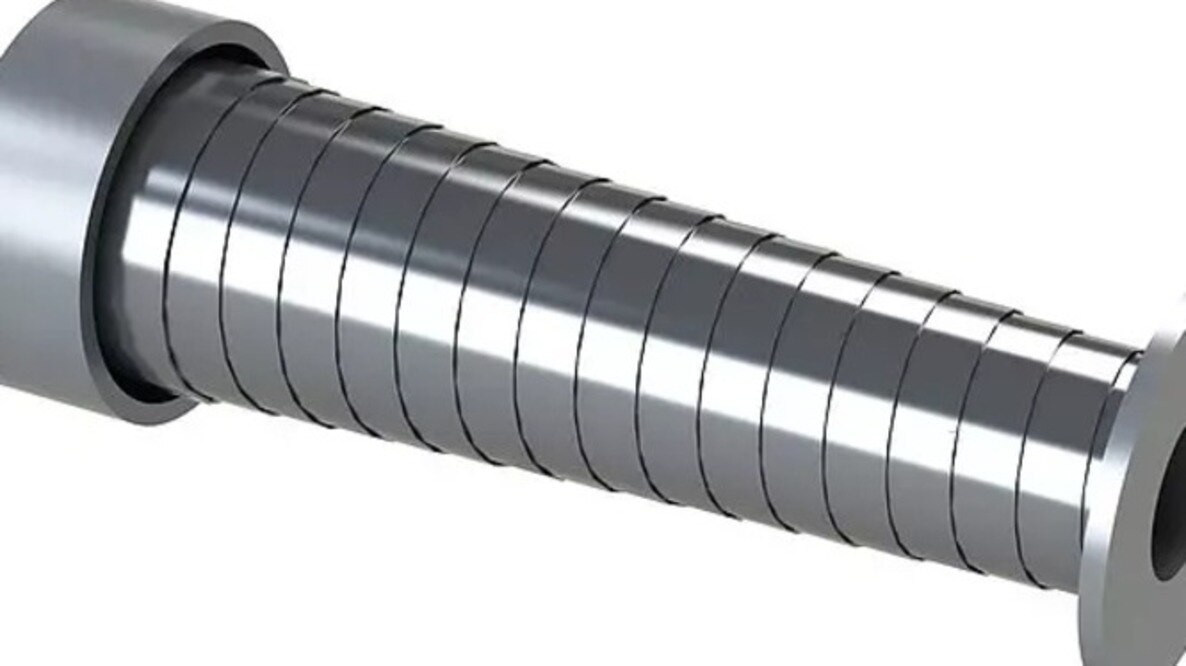
A lead screw is exposed to chips, coolant, oil and abrasive dust precisely where contamination can damage the thread, nut and drive system. By the end, you will know how the cover moves, which dimensions and operating limits to check, how it differs from other covers, and when its design is unsuitable.
Key takeaways
- Match the cover to axial travel, rotation, speed and acceleration.
- Keep overlapping turns intact across the lead screw’s full working stroke.
- Provide clearance for compression, extension and nearby moving components.
- Inspect for damaged turns, gaps, rubbing and contamination after operation.
How the spring barrier follows lead-screw movement
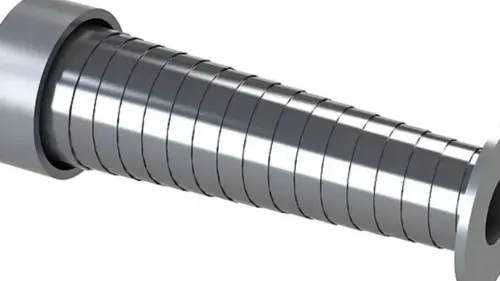
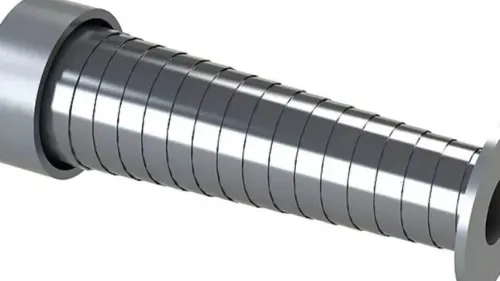
A spring cover keeps contamination away by expanding and contracting with the lead screw’s axial movement, leaving overlapping turns between the thread and the machine environment. As the nut travels, the helical spring cover compresses; as the exposed length increases, it extends again. This movement creates practical lead screw protection without restricting the screw’s travel.
- It deflects large chips and swarf from the thread.
- It sheds much of the coolant and oil reaching its outer surface.
- It reduces direct contact with abrasive dust.
This barrier is not a hermetic seal. Fine particles, washdown fluid and small chips can enter between adjacent turns or through the end interfaces, so the nut still needs its own wiper, seal or protected housing. Arrange the cover so debris and liquid drain away; a low-facing installation can trap contamination between coils.
A rotating spring cover for lead screw applications must have suitable balance, attachment and peripheral clearance. A stationary cover must accommodate sliding relative to the moving screw or nut. Neither design supports the screw or corrects whip, bending or misalignment; use proper bearings and support.
Do not assume a safe rpm: diameter, strip thickness, extension length and the manufacturer’s dynamic rating determine the limit.
Choose the cover around rotation, translation and travel
Choose the cover by matching the screw’s motion and dimensions: use a rotating lead screw cover when the cover turns with the screw, and a translating lead screw cover when the cover remains stationary while the screw or nut moves axially.
| Motion | Cover choice | What to check |
|---|---|---|
| Rotating screw and cover | Rotating lead screw cover | Balance, attachment, peripheral clearance and rated rotational speed |
| Stationary cover with axial screw or nut movement | Translating lead screw cover | Relative sliding, concentric mounting and clearance through the full travel |
| Rotation combined with translation | Design rated for both motions | Resultant speed, axial speed, mounting constraints and interference at both limits |
Measure the lead-screw diameter, mounting-point dimensions, available radial clearance and lead screw stroke. Specify the cover’s fully compressed length and fully extended length, not the screw’s overall length alone. The usable stroke must fit between those limits with clearance; forcing coils into solid compression or stretching them past the rated extension causes deformation and fatigue.
Keep the cover concentric. An off-axis installation can rub, develop uneven coil gaps and impose side loads on the screw or nut. A spring cover for lead screw protection is a barrier, not a support, so provide suitable bearings, alignment and intermediate screw support where required. Keep the nut’s own wiper or seal as well.
Check speed, acceleration and contamination before specifying it
A spring cover for lead screw service survives only when its dynamic rating matches the machine’s actual motion. Check maximum rotation, axial speed, acceleration, deceleration, exposed length, extension ratio and available clearance; lead screw cover rpm alone is not enough.
| Operating condition | What to verify | Failure if ignored |
|---|---|---|
| Rotating cover | Rated rpm, balance, attachment, peripheral clearance and vibration | Coils can open, rub, or resonate |
| Stationary cover | Relative sliding between the cover, screw and nut | Side loads can wear the nut or distort the cover |
| Rapid indexing | Acceleration, stopping frequency and reversal rate | Repeated shock can cause fatigue or loosen the mounting |
| Contamination | Chip size, abrasive dust, coolant pressure and washdown direction | Fine debris and fluid can enter overlapping turns |
Select a coolant-resistant spring cover against the actual fluid and cleaning chemistry, not the label alone. Stainless spring steel resists humidity better than carbon steel, but chloride attack, galling and abrasive wear remain possible. A spring steel cover also needs clearance from nearby parts throughout its full extension.
The cover does not correct lead-screw whip, bending or misalignment. Provide suitable end bearings and intermediate support where required, and keep the cover from transferring side load into the screw or nut. It deflects contamination; it is not a hermetic seal or a load-bearing support.
Plan the mounting, clearance and neighbouring component protection
A spring cover for lead screw protection must attach to the machine structure and screw arrangement it was designed for: a rotating cover needs balanced, secure end attachment to rotate with the screw, while a stationary cover needs a fixed bracket that allows the screw or nut to slide relative to it.
Do not clamp a stationary cover to the rotating screw.
Before finalising lead screw cover mounting, check the cover at both extremes of travel. Leave radial and axial clearance from:
- the lead screw nut and its housing
- bearing blocks, couplings and machine guards
- the cover’s own coils when fully compressed
The compressed position is the critical check. A cover that clears the nut when extended can buckle into it during return travel. For a rotating design, verify peripheral clearance, attachment concentricity and the manufacturer’s maximum rotational speed; imbalance creates vibration and drag.
Keep the cover out of the load path. It will not correct lead-screw whip, bending or misalignment, and side loads can transfer into the screw or nut. Align the screw with proper end bearings and intermediate support where required.
Treat spring cover clearance as protection against contact, not as a seal. At the nut, add a wiper or secondary bellows for lead screw nut protection, especially where grinding dust or high-pressure coolant is present.
Compare a spring cover with telescopic, bellows, roll-up and apron covers
A spring cover for lead screw is the better choice when you need a compact cylindrical barrier around a rotating or translating screw, with little room for a large housing.
Its overlapping steel turns tolerate hot chips and oil better than fabric, but they do not form a hermetic seal; keep a nut wiper or secondary seal.
| Option | Main advantage | Choose it when |
|---|---|---|
| Spring cover for lead screw | Compact, metal, and axially flexible | Space is tight and the screw needs protection from chips, dust, oil, or cutting fluid |
| Telescopic steel cover | Rigid protection against heavy chips and impact | You have room for nested sections and need a stronger barrier against large swarf |
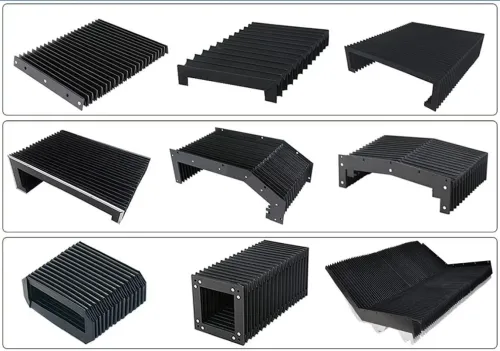
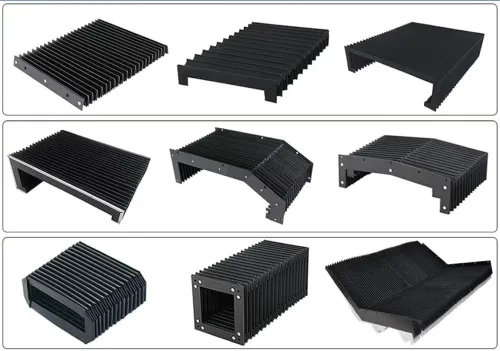
| Bellows cover | Broad coverage with good exclusion at folded joints | You need greater sealing around a stationary or translating screw and can accept a larger folded envelope |
| Roll-up cover for lead screw | Long travel with compact retraction | Travel is extensive and a drum-based cover fits the machine layout |
| Apron cover | Tough overlapping strips for exposed machine ways | The protected area is broad, flat, and exposed to heavy chip loads |
Choose a spring cover over bellows when rotation, heat, or sharp swarf would shorten fabric life. Choose another format when high-pressure coolant, grinding dust, or impact demands a more complete secondary enclosure.
Use inspection findings to confirm the cover is doing its job
Approve a spring cover only when inspection shows that it moves freely, stays concentric and leaves the lead screw and nut properly supported throughout the stroke.
1. Check the attachment, coil alignment and clearance at full compression and extension. A rotating cover must run without eccentricity, rubbing, loose fasteners or exposed edges; a stationary cover must slide relative to the screw or nut without lateral restraint.
2. Run the machine through its complete working cycle and inspect coil gaps, vibration, rubbing marks and unusual noise. Confirm the cover’s dynamic rating against actual rotational speed, extension length and attachment arrangement; never approve it on rpm alone.
3. Inspect the lead screw separately for whip, bending, misalignment and vibration. The cover is not a bearing: verify end bearings, intermediate supports and nut alignment, because side loads from an off-axis mount can accelerate wear.
4. Look inside the cover and around the nut for chips, abrasive dust, coolant or oil. Overlapping turns are a barrier, not a hermetic seal, so retain the nut’s wiper, seal or protected housing.
5. Record spring cover maintenance findings: damaged strip, uneven gaps, corrosion, packed debris and loose mounts. Ask SCUTES INDIA PRIVATE LIMITED for the rated speed, allowable stroke, mounting drawing and inspection interval before sign-off.
A lead screw cover failure often begins as rubbing, vibration or contamination, not a sudden break. Reject the installation until its cause is corrected.
Related products
 | TELESCOPIC SPRING COVER Telescopic Spring Covers provide protection under extreme conditions. View product → |
 | TELESCOPIC COVERS A telescopic cover protects guide-way surfaces and components of moving axis of machines. View product → |
Frequently asked questions
How does a spring cover follow lead-screw movement?
Overlapping helical turns compress as the nut travels toward the cover and extend as more lead screw becomes exposed.
What must you check before specifying a spring cover for a lead screw?
Check axial travel, rotation, speed, acceleration, contamination type and the cover’s required compressed and extended lengths.
How should you plan spring-cover mounting and clearance?
Provide rigid mounting points, allow space for the cover’s compressed diameter and extended length, and prevent contact with neighbouring components.
When is another lead-screw cover better than a spring cover?
Use telescopic covers for rigid high-duty protection, bellows for flexible sealing, roll-up covers for compact storage, or apron covers for broad chip protection when those designs suit the machine geometry.