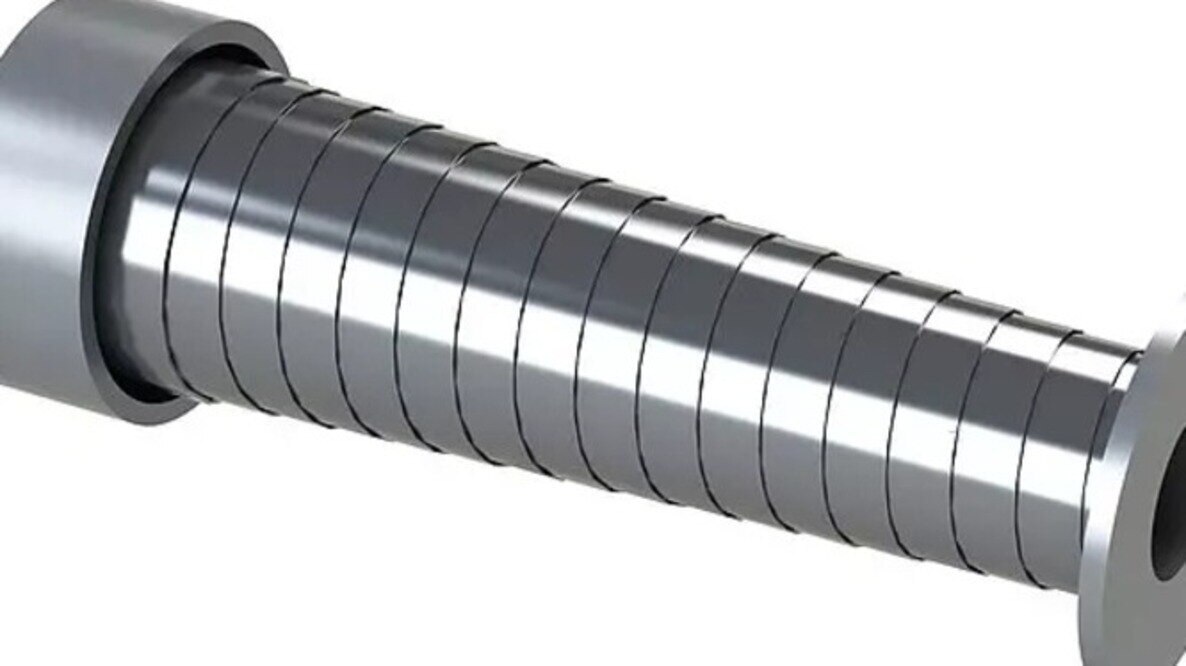
A spiral spring cover can appear slack even when the spring steel is intact: friction, chip packing, misalignment, overextension and lost preload can all prevent stored force from retracting the cover. By the end, you will be able to separate normal force variation from a genuine fault, test the cover safely, identify the likely cause and decide whether cleaning, alignment work, rebuilding or replacement is appropriate.
Key takeaways
- Measure force across the full stroke before calling normal variation a failure.
- Inspect alignment, travel limits, coil overlap, chips, coolant and damaged turns.
- Do not dismantle a loaded spring cover without the manufacturer’s repair procedure.
- Match replacement spring force, stroke, mounting geometry and contamination conditions.
Normal force variation versus genuine tension loss
A spiral spring’s force is not constant across the cover’s stroke. Winding geometry changes as the cover extends: coil diameter, leverage and the number of active turns all shift, so a modest change in pull or push force is normal. Judge the pattern, not one position.
| Condition | What you observe | Likely meaning |
|---|---|---|
| Normal variation | Force changes through the stroke, but the cover retracts fully and smoothly | Expected change in coil geometry and leverage |
| Genuine spring weakness | Slow retraction, slack, incomplete closure or reduced force across most of the travel | Fatigue, permanent set, overheating, excessive deflection or loss of preload |
| End-of-stroke weakness | Force disappears mainly near full extension | Overextension, insufficient reserve stroke or a damaged end attachment |
| Resistance throughout | Drag or stalling from retracted position onward | Contamination, corrosion, rubbing, interference or guide misalignment |
A spiral spring tension problem can also come from incorrect winding direction or a distorted spring strip. A spiral spring cover losing tension on CNC equipment is not automatically a failed spring: packed chips, coolant residue or a rubbing guide can consume the stored energy before it reaches the cover.
Check whether the cover feels weak or merely obstructed. If it retracts freely after the interference is removed, the spring may still store adequate energy; inspect guide alignment, coil contact and debris before replacing it. Persistent weakness after those checks points to damaged spring material or preload loss.
A safe diagnostic sequence for a weak or slow cover
Stop and isolate the CNC machine before diagnosing a weak or slow cover. Lock out electrical and hydraulic energy, prevent axis movement, and mechanically restrain the cover so stored spring energy cannot release it unexpectedly.
Follow this sequence:
- Remove chips, coolant residue and retained oil from the cover, guides and winding area.
- Inspect for gaps between coils, uneven winding, spring slap, scraping, buckling, cracked metal, oil retention and incomplete closure.
- Confirm that the axis does not overrun the cover’s positive end stop. A programmed limit does not protect a cover that reaches its mechanical limit first.
- Check mounting faces, guide paths and clearance for rubbing or side loading.
- Disconnect the cover from the moving axis only after those checks.
- Test free retraction at low speed, then compare extension force at several positions through the stroke.
- Reconnect it only after confirming that the cover does not rub, bind or twist.
| Isolation result | Likely meaning | Next action |
|---|---|---|
| Free retraction disconnected | Spring force remains available | Check alignment, guides and interference |
| Stalling only when connected | Side loading, guide friction or alignment error | Correct the machine interface before replacing the spring |
| Weakness while disconnected | Spring damage, lost preload or permanent set | Stop use and obtain a specified repair assessment |
Free movement when disconnected but stalling when connected points to transmission problems, not automatically to lost spring force. Do not hand-wind the cover or improvise clamps for retensioning: the spring stores rotational energy, and a slipping arbor or end attachment can release it violently.
How travel, alignment and contamination remove usable tension
Chip packing can stop a spiral spring machine protection cover from retracting even when the spring still stores adequate energy. Abrasive swarf, mixed coolant, tramp oil and corrosion enter between nested sections and winding layers, increasing drag, removing lubrication and damaging contact surfaces.
High reciprocation rates, vibration, excessive stroke, high acceleration and side loading multiply that drag; temperatures outside the spring material’s working range cause softening, brittleness or permanent set.
- Inspect mounting-face alignment and confirm shaft concentricity with the cover path.
- Measure clearance around the complete travel path, including the tightest point.
- Verify that the positive end stop leaves reserve travel beyond the programmed stroke.
- Match spring diameter, compressed length, extended length, stroke, number of turns, strip thickness, mounting orientation and required retraction force to the machine.
| Machine condition | What happens | What to check |
|---|---|---|
| Chip packing or abrasive contamination | Drag between sections prevents full retraction and accelerates wear | Clean trapped material, not only the outer surface |
| Excessive stroke or acceleration | The spring reaches its limit, loses preload or deforms | Compare axis limits with cover travel and reserve stroke |
| Misalignment, side loading or eccentric shaft | Sections rub, increasing force demand and distorting turns | Check mounting faces, shaft concentricity and full-path clearance |
A cover that reaches its stop before the CNC axis reaches its programmed limit is mechanically overrun, even without a control alarm. Mixed coolant, tramp oil and corrosion make the problem worse.
Mounting orientation and the required force must also suit the spring’s working direction; a wrong winding direction can prevent force from reaching the cover.
When cleaning works and when telescopic spiral spring repair is unsafe
Cleaning can restore normal movement when loose chips, coolant residue or surface deposits are creating drag. Isolate the CNC machine, mechanically restrain the cover, and clean the accessible winding path before testing it; cleaning cannot restore lost spring force or correct structural damage.
Inspect the spring and cover for these conditions:
- Fatigue cracks, permanent set, corrosion pitting or kinks in the strip
- Distorted turns, gaps between coils or a spring that has left its winding path
- Fractured rivets, damaged end fittings or guide rings
- Worn sliding interfaces, buckled sections or persistent scraping after cleaning
Any of these signs makes telescopic spiral spring repair a controlled engineering job, not a cleaning task. Reforming the strip, cutting it, retempering it or forcing distorted turns back into shape can change its torque and release stored energy unexpectedly.
Field retensioning is safe only with the specified arbor, retaining fixture, winding direction and number of turns. Never hand-wind the spring or substitute improvised clamps; a slipping fixture or end attachment can release rotational energy and cause serious injury.
Replace the spring cassette, end fitting or guide component when that part is damaged. Replace the complete assembly when several parts are worn, the strip has permanent deformation, or the cause of the spiral spring cover failure remains unresolved.
A replacement is often more reliable than rebuilding an original that suffered contamination, misalignment, excessive acceleration or an incorrect travel limit.
How to choose a replacement that will not lose tension again
Do not order a replacement by cover width and travel alone. That repeats the failure when the spring is under-torqued, overextended, misaligned, or exposed to conditions outside its design range.
| Selection basis | What width and travel miss | What to confirm |
|---|---|---|
| Narrow match | Physical size only | Retracted length, extended length, stroke, strip dimensions |
| Operating match | Spring behaviour | Torque or tension range, winding direction, number of turns, maximum speed and acceleration |
| Machine match | Installation stress | Mounting orientation, horizontal or vertical use, temperature, coolant exposure, and guide requirements |
Request this specification checklist:
- Confirm the axis limits, positive mechanical stop, full-path clearance, and mounting-face alignment. Leave reserve travel so the cover does not reach its stop before the CNC axis reaches its programmed limit.
- Match the spring torque or tension range to the required retraction force, not merely to the cover’s dimensions.
- State the winding direction and number of turns; reversing either can destroy preload.
- Provide maximum speed, acceleration, strip width, thickness, and material, plus the coolant type, concentration, temperature, and chip load.
- Identify guide rings, rollers, supports, and any required guide clearance.
SCUTES INDIA PRIVATE LIMITED can assess the machine interface and operating data rather than a photograph alone; ask for a documented fit and operating specification, not simply a larger spring. This is the practical way to select spiral spring machine protection when dealing with a spiral spring cover losing tension cnc equipment.
Correcting chips, alignment, acceleration, or travel limits matters as much as replacing the spring.
Related products
 | TELESCOPIC SPRING COVER Telescopic Spring Covers provide protection under extreme conditions. View product → |
 | TELESCOPIC COVERS A telescopic cover protects guide-way surfaces and components of moving axis of machines. View product → |
Frequently asked questions
How can you tell normal force variation from genuine spiral spring tension loss?
Measure the cover at several positions and compare the pattern with the manufacturer’s force range. A single weak point does not prove failure because winding geometry changes across the stroke.
What should you check first when a CNC spiral spring cover moves slowly?
Stop the machine, isolate stored energy, and inspect for chips, hardened coolant, rubbing, misalignment, restricted travel and damaged coils before testing spring force.
Can cleaning restore a spiral spring cover that has lost tension?
Cleaning can restore movement when contamination causes drag. It cannot restore bent coils, cracked spring material, permanent deformation or incorrect alignment.
When is telescopic spiral spring repair unsafe?
Repair is unsafe when the spring remains loaded, coils are distorted or cracked, the cover cannot be restrained, or you lack the manufacturer’s disassembly and tension-setting procedure.
How do you choose a replacement spiral spring cover that will not lose tension again?
Match the required stroke, closed and extended lengths, force curve, mounting points, alignment, material and protection against the machine’s chips, coolant, oil and heat.