Fluid inside a bellows does not automatically prove that the cover itself has failed: the source may be a torn fold, a hose, a seal, or a nearby enclosure component. You will be able to identify the likely failure path, stop the machine safely, assess the operating risk, and specify a replacement without creating a second failure.
Key takeaways
- Trace coolant and oil before blaming the bellows fabric.
- Stop operation when contamination reaches the guideway or moving axis.
- Match replacement dimensions, travel, mounting, folds, and material resistance.
- Record photographs, measurements, machine data, and acceptance checks before ordering.
What counts as a laser machine bellows cover leak?
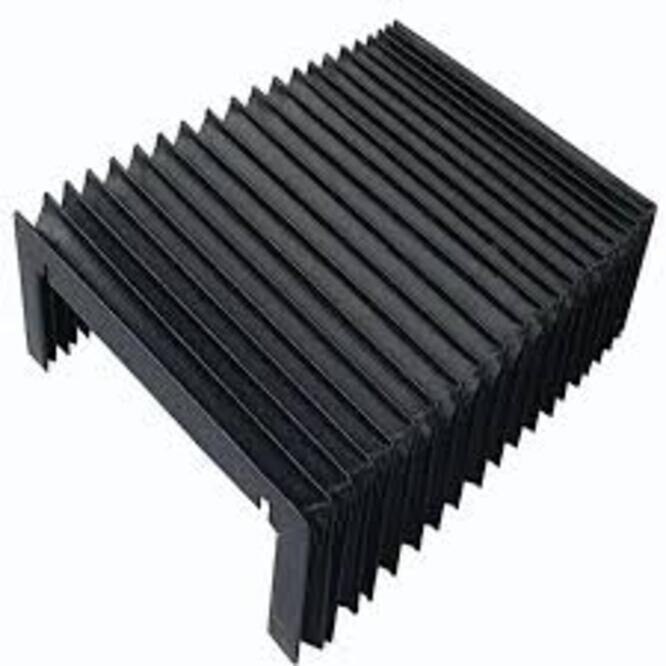
A laser machine bellows cover leak means contamination can cross the flexible guard and reach the protected guideway, axis, or machine components. The source has two possibilities: the cover has lost fabric integrity, or coolant, oil, hydraulic fluid, compressed air, or another service is leaking from equipment behind or beside it.
A search for a laser machine bellows cover for leaking in Vienna should begin with this distinction.
Check for these signs:
- Wetness inside the bellows, coolant trails, or repeat contamination after cleaning.
- Coolant, dust, chips, or smoke on guideways, bearings, seals, or nearby components.
- A torn or punctured fold, exposed fold, open stitched or bonded seam, or failed corner.
- A detached frame, pulled fastener, damaged wiper edge, or gap at the mounting flange.
- Abnormal axis resistance, jerky travel, scraping, or rubbing sounds.
- Contamination that returns after the machine has been wiped clean, especially during axis movement or air blow-off.
A bellows is a flexible guard, not a pressure vessel. Ordinary tape or sealant cannot restore its movement, fabric strength, or mounting geometry; where chips, fluid, sparks, or heat are present, patching is temporary containment only. Stop and identify the source before continued operation drives contamination deeper into the machine.
How to prove whether the bellows is the source
After isolating the machine under lockout/tagout, prove the source before removing the cover. A dry wipe test separates fresh fluid from condensation and shows whether contamination starts inside the bellows or arrives from adjacent equipment.
1. Wipe the bellows underside, protected guideway, end frames, and surrounding enclosure with clean, dry lint-free cloths. Mark each wet or dirty area, then check coolant hoses, fittings, seals, the cable carrier, telescopic cover, and enclosure surfaces for separate trails or droplets.
2. Inspect the bellows from the underside. Check every folded section, seam, corner, mounting flange, end frame, wiper edge, sliding surface, attachment fastener, and area exposed to chips or axis overtravel. Look for punctures, open stitching, separated bonding, abrasion, skew, pulled edges, and embedded debris.
3. With the machine still locked out, inspect the cover fully retracted, at mid-stroke, and fully extended. A parked-position check can miss fold fatigue, pleat-to-pleat abrasion, lateral rubbing, over-compression, or a mounting edge pulled sideways; one fold may open only during travel.
4. Trace any fluid to its highest wet point. A hose leak, failed seal, leaking cable carrier, damaged telescopic cover, or condensation around the laser enclosure will leave a trail outside the bellows or recur without a damaged fold.
5. Record photographs and wipe results at each position. Treat this as a laser machine bellow failure when contamination passes through the cover. Air blow-off can force fine dust through a small tear or make a lightweight cover flutter, revealing weak seams and mounts; do not energise the axis to test it.
What to do before the next machine cycle
Treat laser bellow damage in vienna as an unsafe machine condition, not a housekeeping issue. Stop the affected axis, keep people clear, and do not reach behind the cover until every energy source is isolated.
- Apply the site lockout/tagout procedure. Isolate electrical power, laser emission, pneumatic pressure, hydraulic pressure, gravity, spring force, vacuum, and other stored energy; verify zero energy before access.
- Photograph the damage in the parked and accessible positions. Record the axis position, machine state, active program, coolant condition, pressure settings, and any alarm or unusual noise.
- Inspect for fluid at the cover, guideway, hose connections, seals, and fittings. Place a temporary external barrier over the leak to stop further coolant entry, but keep it out of the entire travel path.
- Do not restart because someone wiped away visible fluid. Test and repair the source before authorising another cycle.
Continued operation can carry contamination into linear guides, bearings, ballscrews, seals, optical components, sensors, and cable assemblies. Rubbing can increase axis resistance, while chips can embed in folds or wipers and enlarge the failure.
Escalate to the machine builder or a qualified service team when laser guarding, interlocks, optical paths, pressure systems, or stored energy are involved. Stop work if you cannot prove isolation or if the temporary barrier could touch the moving axis.
Why laser bellows fail and what the replacement must match
Laser bellow damage in vienna often starts with geometry, not a visible hole. Incorrect folded-pack compression, over-extension, excessive speed or acceleration, high cycle frequency, or an obstruction can fatigue pleats and seams. Nonparallel guideways, a shifted frame, unsupported sag, and collisions with fixtures add skew, lateral rubbing, and impact.
For a bellows cover replacement in vienna, match the machine’s motion and exposure rather than relying on the word “coolant.” Provide:
- Actual fluid formulation and concentration, operating temperature, cleaning agent, fabric, coating, adhesive, and thread system.
- Axis stroke, folded and extended lengths, fold pitch, cross-section, mounting pattern, guide orientation, speed, acceleration, and cycle frequency.
- Locations of chip packing, abrasion, heat, smoke condensate, spark, and molten-spatter exposure.
- Documented temperature, flame-resistance, spark, abrasion, and chemical-resistance data where direct exposure is expected.
Polyurethane-coated, silicone-coated, or flame-retardant fabric alone does not prove suitability for laser radiation or molten spatter. Require a defined spark shield, laminated foil, stainless-steel slat, or separate beam guard when the risk assessment calls for one.
SCUTES INDIA PRIVATE LIMITED can help a Vienna service team convert these operating details into a documented bellows specification, but the purchaser must verify fluid compatibility, folded clearance, safety performance, and the machine builder’s requirements before approval.
Related product
 | Laser Machine Bellows Laser Machine Bellows are specialized protective coverings designed to safeguard the vital internal components of laser machines. View product → |
How to order, validate, and accept a bellows cover replacement in Vienna
Request a bellows cover replacement in Vienna only after recording the machine geometry and operating load. Stroke alone is insufficient: the folded package and end clearances determine whether the cover buckles, over-compresses, or obstructs the carriage.
1. Provide axis stroke; fully retracted and extended lengths; open and closed cross-section; fold count and pitch; mounting-hole pattern; end-frame dimensions; guide orientation; maximum speed; acceleration; cycle frequency; coolant or chip exposure; and nearby air, oil, vacuum, or hose connections.
2. Identify the actual coolant or cleaning formulation, concentration, temperature, fabric, coating, adhesive, and thread system. A heavier or stiffer substitute increases moving mass, can overload screws and guide elements, collide with the carriage, or create a larger folded package. Check the replacement against allowable moving mass, acceleration, and clearance.
3. Treat laser safety separately. IEC 60825-1 covers laser-product classification and safety requirements; an untested bellows is not automatically a certified laser enclosure. Reassess access prevention, interlocks, visibility, fire behaviour, travel limits, and emergency-stop risk. Document the applicable conformity route before the transition to Regulation (EU) 2023/1230 on 20 January 2027.
4. Put acceptance criteria in the purchase order. Run the cover through its full stroke at operating speed, inspect every fold and seam, apply controlled fluid or washdown exposure where relevant, and confirm that no fluid reaches the protected guideway. Reject a generic “waterproof” claim without defined test conditions and pass/fail limits.
Frequently asked questions
What counts as a laser machine bellows cover leak?
A leak exists when contamination passes through damaged bellows fabric or when coolant, oil, hydraulic fluid, or compressed air leaks from equipment beside or behind the cover.
How can you prove whether the bellows is the leak source?
Clean and inspect the cover, trace the fluid path, check nearby hoses and fittings, and run a controlled test while observing the guideway and bellows seams.
What should you do before the next machine cycle?
Stop the machine if contamination reaches protected components, isolate the leaking service, remove unsafe debris, document the damage, and complete a controlled inspection before restarting.
What must a replacement bellows cover match?
Match the installed length, compressed length, extension, width, height, mounting method, fold geometry, travel speed, temperature, coolant exposure, and clearance.