
A way cover and a machine cover solve different problems: one follows the machine’s moving precision elements, while the other defines and protects the machining zone. By the end, you will know which system your milling machine needs, what measurements to send for a quote, and how to compare suppliers beyond the cover price.
Key takeaways
- Use way covers for guideways and moving interfaces; use machine covers for the machining-zone boundary.
- Measure travel, retraction space, mounting points and cable movement before requesting a quote.
- Specify chip load, coolant type, temperature, drainage and cleaning access as design inputs.
- Compare Pune suppliers using approved drawings, test evidence, installation scope and after-sales service.
Way cover versus machine cover: which boundary are you protecting?
The decision in way cover versus machine cover in Pune is about responsibility, not two names for the same component. A milling machine way cover protects guideways, ballscrews, racks and other motion components at the sliding interface. A machine cover or enclosure controls the larger machining-zone boundary.
Way cover | Machine cover or enclosure Protected boundary | Guideways, ballscrews, racks and sliding interfaces | The machining zone and operator access points Primary job | Keep chips, coolant and mechanical damage away from motion components | Contain chips and coolant; separate people from hazardous movement Design features | Telescoping sections, bellows, wipers, mounting faces and drainage | Doors, windows, chip evacuation, coolant containment and maintenance access Safety role | Component protection, not automatic personnel guarding | Guarding that requires separate access and interlock assessment
An enclosure cannot replace a correctly fitted milling machine way cover. Chips and coolant can still reach an exposed guideway or ballscrew through door gaps, table movement or drainage paths. A way cover is not automatically a personnel guard because it may leave hazardous motion accessible and may not resist operator impact.
Assess the enclosure under ISO 14120 for general guard requirements and use ISO 13857 for safety distances that prevent access to danger zones. Check impact resistance, access to hazardous motion and door interlocks separately.
The practical answer is often both systems: the way cover protects the machine’s motion boundary, while the enclosure protects the operator and contains the process.
Match the cover construction to the milling machine and axis
A knee mill usually needs a simple apron or bellows cover for exposed guideways, while a bed mill often benefits from telescopic steel sections where the table throws chips directly at the cover. A CNC milling machine needs a choice based on travel, axis speed, retracted length and chip impact—not the machine label.
| Construction | Best fit | Main checks |
|---|---|---|
| Telescopic steel | Hot, sharp, heavy or abrasive chips; long travels and strong coolant exposure | Provide alignment, support, correctly loaded wipers and space to prevent chip packing between sections |
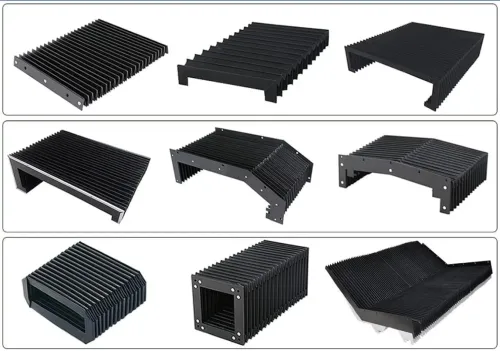
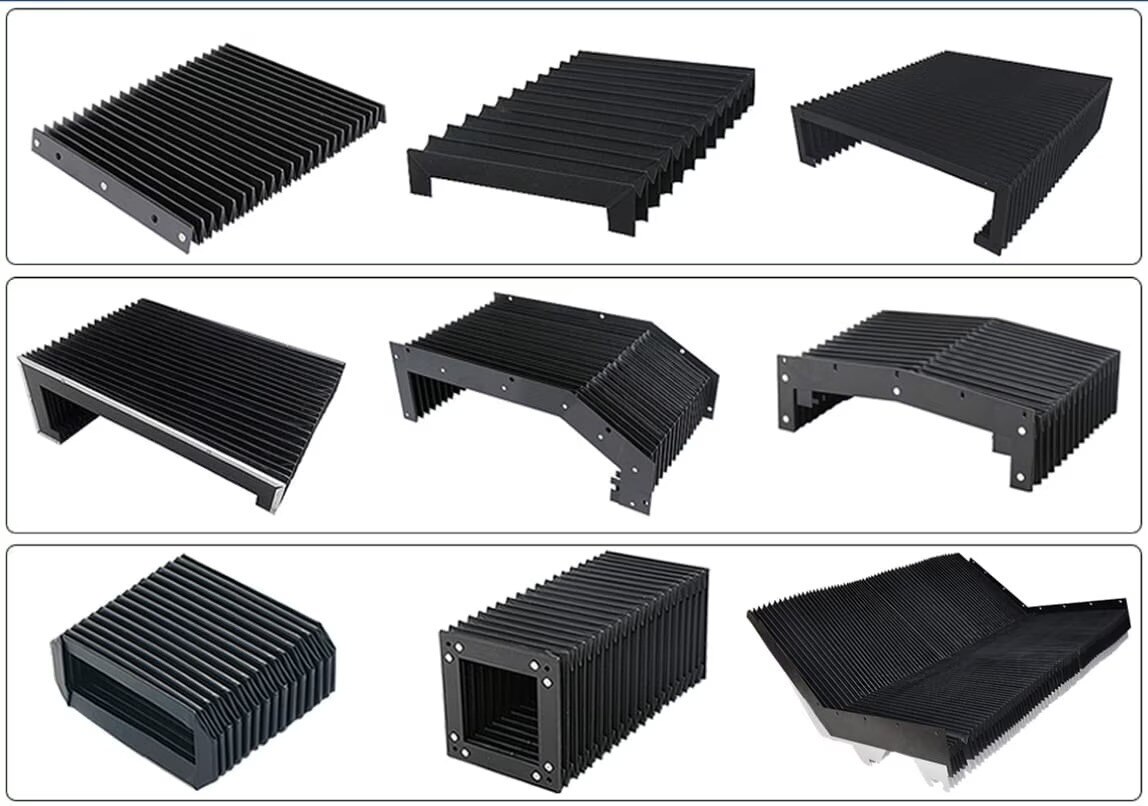
| Bellows | Low moving mass, compact retraction or unusual geometry | Match fabric and coating to the actual coolant, temperature and wash-down method |
| Roll-up | An axis with suitable winding direction and clear storage space | Confirm winding radius, retracted envelope, travel speed and resistance to chips |
| Apron | A simple flexible strip arrangement on a relatively open axis | Check strip overlap, support and coolant drainage; it offers less impact protection |
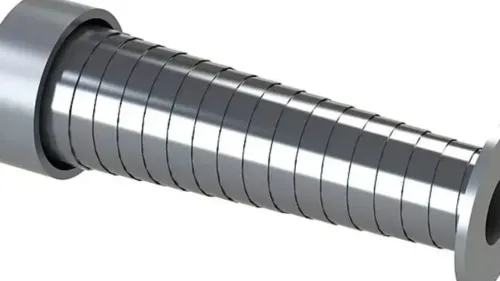
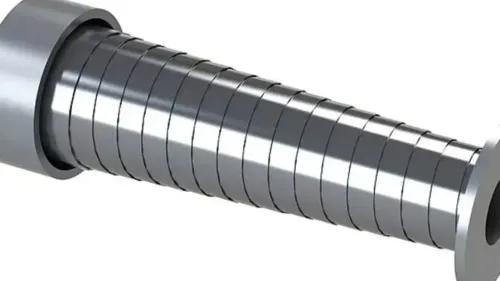
| Spring | Narrow shafts, spindles or rods needing local protection | Confirm spring clearance, extension length and resistance to snagging or fouling |
A machining center machine cover must work with the enclosure, not merely cover a guideway. Reserve clearance for sliding or lifting doors, tool-change motion, pallet changers, rotary tables, coolant hoses and chip conveyors; otherwise the cover can complete axis travel yet block production or maintenance access.
For steel, specify mounting support, section alignment and wiper contact. For bellows, specify the actual coolant chemistry and operating temperature; an incompatible coating can swell, crack or admit coolant and fines.
Measure the axis envelope before requesting a cover quote
Use the machine’s physical envelope, not nominal table travel, to size a milling machine way cover. A repeatable survey must show what moves, where it retracts, and what it can strike throughout the complete axis stroke.
1. Record guideway length and width, axis travel stroke, cover height, section height, guideway or screw position, moving mass, acceleration, maximum extended length and minimum closed or compressed length.
2. Measure the cover fully open and fully closed. Record clearance from the tool, table, saddle, column and spindle, including side and top clearance.
3. Locate every mounting point and identify each mounting face as fixed or moving. Note whether the cover follows the table, saddle, column or spindle by tracing the protected guideway through the entire stroke.
4. Specify the folding or telescoping direction and confirm that brackets, sections and the retracted cover fit inside the available envelope. Mark interference zones around doors, tool changers, chip conveyors, rotary tables, coolant pipes and service openings.
5. Check the extended position for collisions and the closed position for crushing, rubbing or trapped chips. Include cable and hose paths in the drawing.
The quoted cover must retract without reducing programmed travel or increasing drive load. Moving mass and wiper resistance affect acceleration, so provide those figures rather than describing the axis as “fast.” On a CNC machining center, check the complete enclosure movement with tool-change and pallet-change positions, not only the way-cover stroke.
Specify chips, coolant, drainage and cable movement as design loads
A milling machine way cover must be designed for the actual swarf and fluid load, not the machine name. Ask the buyer or manufacturer to record:
- Chip size and shape, hot or sharp swarf, abrasive cast-iron or aluminium fines, and heavy-chip impact
- Coolant type and concentration, flood coolant, mist, high-pressure coolant, tramp oil, and dry-machining periods
- Wash-down practice, cleaning chemicals, storage humidity and operating temperature
- Axis speed, acceleration, nozzle direction and whether coolant can be driven beneath a section
Hot, sharp or heavy chips favour telescopic steel sections with adequate thickness, slide support and chip-packing clearance. Bellows require fabric and coating compatibility with the coolant, tramp oil, fines, temperature and wash-down method. A machining center machine cover also needs drainage that does not send fluid toward guideways or cable spaces.
Specify wiper profile, material, contact force and sliding speed. Wipers are wear parts: excessive contact raises axis load, while weak contact lets coolant and fines pass. Define overlap direction, gasket or wiper joints, drain holes or channels, drain direction and mounting flatness; leakage often begins at these details rather than the cover material.
Keep cable carriers separate from way-cover duties. Specify the largest cable or hose, dynamic bend radius, mass per metre, unsupported length, allowable fill, media separation and connector strain relief. The cable maker’s dynamic bend-radius requirement governs, not the smallest available carrier space.
Compare Pune suppliers through drawings, testing and service scope
A way cover manufacturer in Pune should be compared on documented fit and commissioning support, not the quoted cover price. The phrase way cover versus machine cover in Pune should not hide differences in installation hardware, drainage, wipers or service parts.
| Supplier evidence | What to request | Why it matters |
|---|---|---|
| General arrangement | Dimensioned drawing, section, mounting faces, fixed and moving points, compressed and extended lengths, section heights and rated speed | Confirms the cover fits the real axis envelope |
| Construction | Material, surface finish, wiper profile and material, folding or minimum bend radius where relevant | Exposes coolant, chip and wear limitations |
| Water management | Drain holes or channels, drain direction, overlap, joints, mounting-flatness limits and nozzle-clearance guidance | Prevents coolant bypass and pooling |
| Service scope | Service-part prices, replacement-wiper availability, commissioning support and written exclusions | Reveals the cost and work hidden after delivery |
Require a written compatibility explanation covering your coolant concentration, operating temperature, chip load and cleaning method. Pune location proves neither material compatibility nor resistance to your wash-down chemicals.
Before acceptance, run the complete axis travel at intended rapid and feed speeds using production coolant and representative chips where possible. Inspect both fully extended and retracted positions for:
- Section collision, vibration, wiper lift and coolant bypass
- Chip trapping, abnormal drive load and interference with doors, tool changers, chip conveyors or coolant hoses
SCUTES INDIA PRIVATE LIMITED belongs on the comparison sheet when its quotation supplies these measurable design and commissioning details rather than a generic cover label.
Related products
 | Machine Covers Machine covers are specially designed shields used to protect industrial equipment and machinery from environmental elements. View product → |
 | TELESCOPIC COVERS A telescopic cover protects guide-way surfaces and components of moving axis of machines. View product → |
Frequently asked questions
What is the difference between a way cover and a machine cover?
A milling machine way cover protects guideways, ballscrews, racks and other motion components at the sliding interface. A machine cover or enclosure controls the larger machining-zone boundary.
How do I measure an axis envelope before ordering a way cover?
Record axis travel, fully extended and compressed lengths, width, height, mounting points, nearby obstructions, access requirements and cable movement.
What design loads should I give a way cover manufacturer?
Specify chip size and volume, coolant type and pressure, oil exposure, operating temperature, drainage direction, cleaning method and the required movement cycle.
How should I compare way cover manufacturers in Pune?
Request a dimensioned drawing, material and construction details, movement or cycle-test evidence, drainage provisions, installation scope, warranty terms and service response.
Related products
 | Roll Up Cover A roll-up cover is a highly durable and flexible protective solution designed to safeguard machinery, equipment, and valuable assets from dust,... View product → |
 | TELESCOPIC SPRING COVER Telescopic Spring Covers provide protection under extreme conditions. View product → |
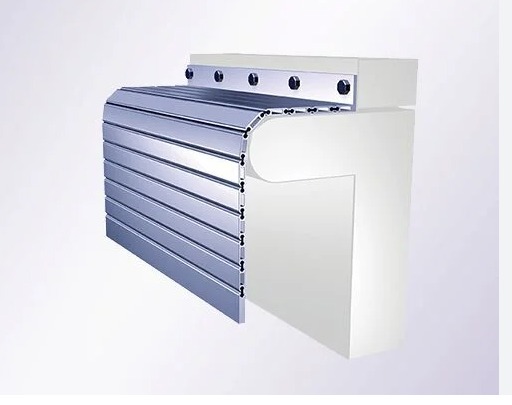 | APRON COVER Effectively engaged in offering a vast collection of outstanding quality products which include Apron Covers. View product → |
 | Laser Machine Bellows Laser Machine Bellows are specialized protective coverings designed to safeguard the vital internal components of laser machines. View product → |