
A telescopic cover earns its cost when chips, coolant, abrasive dust or washdown threaten an exposed milling-machine axis and the resulting cleaning, repair or downtime is expensive. You will be able to judge the payback, compare cover types, prepare a usable request for quotation and define the tests a supplier must pass before installation.
Key takeaways
- Compare annualised cover cost with downtime, cleaning, rework and guideway replacement.
- Choose steel covers for chips and coolant; use bellows when flexibility or access matters.
- Specify stroke, closed length, height, width, mounting points and travel speed before requesting quotes.
- Require travel, sealing, noise and interference checks before accepting a machining center cover.
When the avoided downtime justifies a telescopic cover
Buy an industrial telescopic cover when the annual cost of exposed guideway damage exceeds the cover’s annualised ownership cost. Calculate the exposure using downtime hours multiplied by your machine-hour cost, then add cleaning labour, lost accuracy, rework and expected rail, ballscrew or guideway replacement.
Annualise the cover’s purchase, installation and commissioning cost over its expected service life. Add planned wiper and scraper replacement, corrosion maintenance, and the production penalty from extra moving mass.
A heavy cover can reduce axis acceleration, extend cycle time and increase drive demand; obtain the supplier’s moving-mass figure and check the effect with the machine builder.
The business case is strongest when:
- Hot chips, abrasive cast-iron dust, coolant or washdown reach the guideway on every shift.
- One contamination-related failure would stop production for several hours or require regrinding, alignment or component replacement.
- Operators currently spend enough time cleaning the axis that the labour and interruption are visible in maintenance records.
- The existing enclosure leaves a gap that repeatedly admits contamination.
It is weak for a lightly used, enclosed machine whose existing guarding already keeps the guideway clean. A cover also does not replace fixed guards, doors or safety interlocks around the cutting zone, and it does not replace an energy chain for moving cables.
Ask for a payback calculation using your recorded failure history, not a generic service-life claim. Include inspection access and replacement lead time: local supply can shorten recovery, but it does not prove that a replacement cover will fit.
Steel cover, bellows or another option: which protection fits the hazard?
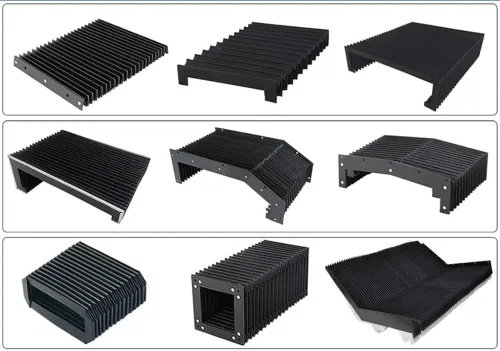
A steel telescopic cover is the strongest choice for sharp chips, hot swarf, abrasive cast-iron dust and high-pressure coolant, but its moving mass needs space, guides and a drive that can handle acceleration. Compare the options against the actual hazard, not the product name “industrial telescopic cover.”
| Option | Chips and coolant | Speed and space | Sealing and maintenance |
|---|---|---|---|
| Steel telescopic cover | Best resistance to heavy, hot chips and coolant | Moderate moving mass; needs stacking space at full compression | Good with correctly compressed wipers; inspect leaves, guides and replaceable wipers |
| Fabric bellows | Suits light chips and splash; sharp chips can puncture folds | Light and fast; short folded length and tolerates irregular motion | Seams and folds need cleaning; coolant compatibility limits fabric choice |
| Apron cover | Handles moderate chips; overlapping slats give weaker coolant sealing | Compact and relatively light | Slats, hinges and end seals need inspection; gaps admit fine debris |
| Roll-up cover | Protects against dust and splash, not heavy chip impact | Very compact and quick | Roller, curtain and edge seals wear; poor choice for chip-packed milling |
| Brush wipers | Sweeps fine chips and dust from an edge, not a primary enclosure | Minimal space and friction when correctly selected | Fast wear; bristles do not seal against coolant or coarse chips |
| Uncovered guideway | Exposes rails to every chip and fluid | No cover space or moving mass | Cleaning and guideway damage become the maintenance burden |
Check acceleration and vibration, not only rapid speed: unsupported steel leaves can chatter or strike. Keep cables in a separate energy chain, and integrate any cover with fixed guards, doors and safety interlocks.
The measurements that turn a generic quotation into a working design
A supplier needs more than axis travel to design a cover that works. A cover can match the stroke yet collide with the spindle head when folded, restrict fixture access, or add enough resistance to overload the axis drive.
Send a dimensioned drawing and these figures:
- Axis travel, orientation and direction of movement, including the closed and extended cover lengths required.
- Guideway profile, exposed width, rail height, nearby steps, lubrication points and chip channels.
- Maximum available cover height and width, stacking space, and the distance to the spindle, tools, fixtures, enclosure and operator access.
- Mounting-point coordinates, datum surfaces, bolt sizes, allowable parallelism and whether one mount needs a floating or slotted connection.
- Rapid-traverse speed, maximum acceleration, cycle frequency, motor force or torque limit, and the permitted added moving mass.
- Chip type and size, coolant type and pressure, operating temperature, and the requested leaf material, scraper and wiper arrangement.
- Required replacement parts, inspection access and acceptance-test conditions.
Include tool-holder and fixture models for the worst-case positions, not only the machine’s nominal table dimensions. A search for machining center cover in Pune identifies a supplier category; these measurements identify the actual design.
Require a drawing showing every interference clearance and the cover’s extension ratio. During acceptance, run the axis through its full stroke at production speed and acceleration, then inspect for rubbing, buckling, chip packing, pooling and rising drive load after thermal stabilisation.
How the cover behaves during milling and what you must inspect
Overlapping leaves deflect chips and coolant away from the guideway while guides keep each section aligned through the stroke. Scrapers remove packed chips before they reach the gaps; flexible wipers improve coolant exclusion but wear against the leaves.
Excessive wiper compression creates friction, heat and extra drive load, so specify the material, replaceability and compatibility with your cutting-fluid concentration.
Do not treat splash resistance as protection against high-pressure coolant. Confirm spray direction, pressure, flow, drain paths, leaf overlap and the cleaning method, then inspect the cover in production motion:
- Run the axis across its full stroke at production speed and acceleration; stop if you hear scraping, clicking, knocking or cyclic drive-load changes.
- Check every leaf for binding, buckling, dents, corrosion and chip packing, especially after cast-iron machining or washdown.
- Confirm that coolant drains away instead of pooling on horizontal leaves or entering between sections.
- Inspect scrapers and wipers for cuts, hardening, gaps and uneven compression; replace damaged parts before they expose the guideway.
- Check bolts, brackets and stops for looseness, cracked welds and fretting marks.
- Verify clearance from tools, fixtures, doors and nearby moving parts at both stroke ends.
- Lubricate guides, rollers or sliding points only with the specified lubricant; excess oil attracts abrasive chips.
For a telescopic cover for milling machines in Pune, request a service schedule and replacement-part list, not just a catalogue photograph. A cover that runs quietly but leaves coolant trapped inside is already failing.
How to compare suppliers, quotations and acceptance tests in Pune
Approve a cover only when the quotation, drawing and acceptance test describe your machine’s motion, not merely “industrial telescopic cover.” For a telescopic cover for milling machines in pune, request a priced design against the actual axis and guideway.
- Quotation: state axis travel, closed and extended lengths, folded height, leaf material and thickness, wiper type and replacement cost, coolant pressure, chip type, rapid-traverse speed, acceleration, moving mass, mounting orientation and drain arrangement.
- Drawing: show every mounting hole, datum, guideway clearance, stacking envelope, leaf overlap, wiper contact line and end-stop. Specify allowable parallelism, floating or slotted mounts, and clearance at both ends of travel after thermal stabilisation.
- Installation test: run the axis through its full stroke at production acceleration. Accept it only if every leaf moves without rubbing, binding, buckling or abnormal noise, while wipers clear chips and coolant does not pool or pack inside.
A local telescopic cover manufacturer in pune can shorten inspection and replacement lead time, but location proves nothing about interchangeability. SCUTES INDIA PRIVATE LIMITED should be compared on the same drawing, test conditions and spare-parts schedule as every other bidder.
| Supplier type | What to compare | Disqualifying gap |
|---|---|---|
| Local manufacturer | Site measurement, drawing revision, trial fitting, replacement wipers and response time | No accountable dimensional drawing |
| Generic listing | Published material and size only | No mounting pattern, acceleration rating or acceptance test |
| Machining center cover in pune | Machine-specific quote and service access | “Standard size” without axis data |
Related product
 | TELESCOPIC COVERS A telescopic cover protects guide-way surfaces and components of moving axis of machines. View product → |
Frequently asked questions
When is a telescopic cover worth buying for a milling machine?
Buy one when the annual cost of exposed guideway damage exceeds the cover’s annualised ownership cost. Include downtime, cleaning, lost accuracy, rework and rail, ballscrew or guideway replacement.
Should you choose a steel cover or bellows for milling-machine protection?
Choose a steel telescopic cover for repeated chip and coolant exposure with rigid guideway protection. Choose bellows when the design needs flexibility, compact folding or coverage around irregular machine geometry.
What measurements do suppliers need for a telescopic cover quotation?
Provide the guideway width and height, required travel, closed length, maximum extension, mounting points, available clearance, machine speeds and the chip, coolant and temperature hazards.
What should you inspect before accepting a machining-center cover?
Run the cover through its full travel and check smooth movement, section alignment, sealing, noise, interference, mounting security and protection against chips and coolant.