
A duct bellow can use spiral spring support, but only when the spring, fabric, connections, and movement conditions are designed as one assembly. You will be able to distinguish the three common spring arrangements, check compatibility, identify unsuitable applications, and prepare a specification that produces comparable quotations from suppliers in Pune.
Key takeaways
- Match spring support to pressure, movement, temperature, and contamination.
- Calculate bellow dimensions, spring rate, compression limit, and supported mass.
- Specify fabric, seams, reinforcement, and spring material for the environment.
- Reject spiral support when friction, heat, corrosion, or access makes it unsuitable.
When does spiral spring support make a duct bellow mechanically suitable?
Yes, a spiral spring duct bellow is mechanically suitable when the spring is specified for the bellow’s pressure, movement, temperature, and contamination conditions. It must perform a defined job: resist collapse, prevent fabric sag, preserve a circular or rectangular flow path, limit compression, or carry part of the bellow mass.
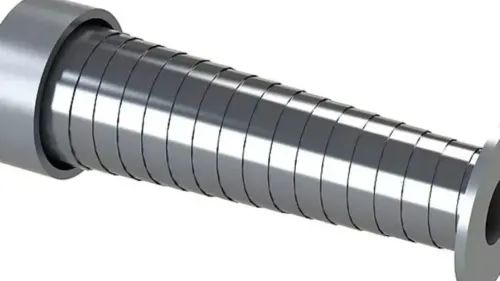
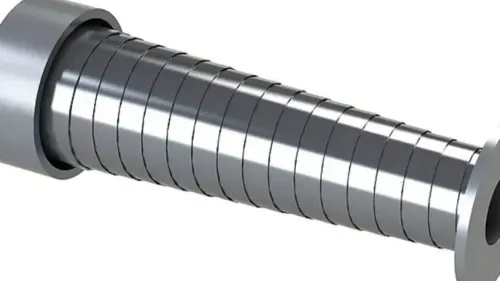
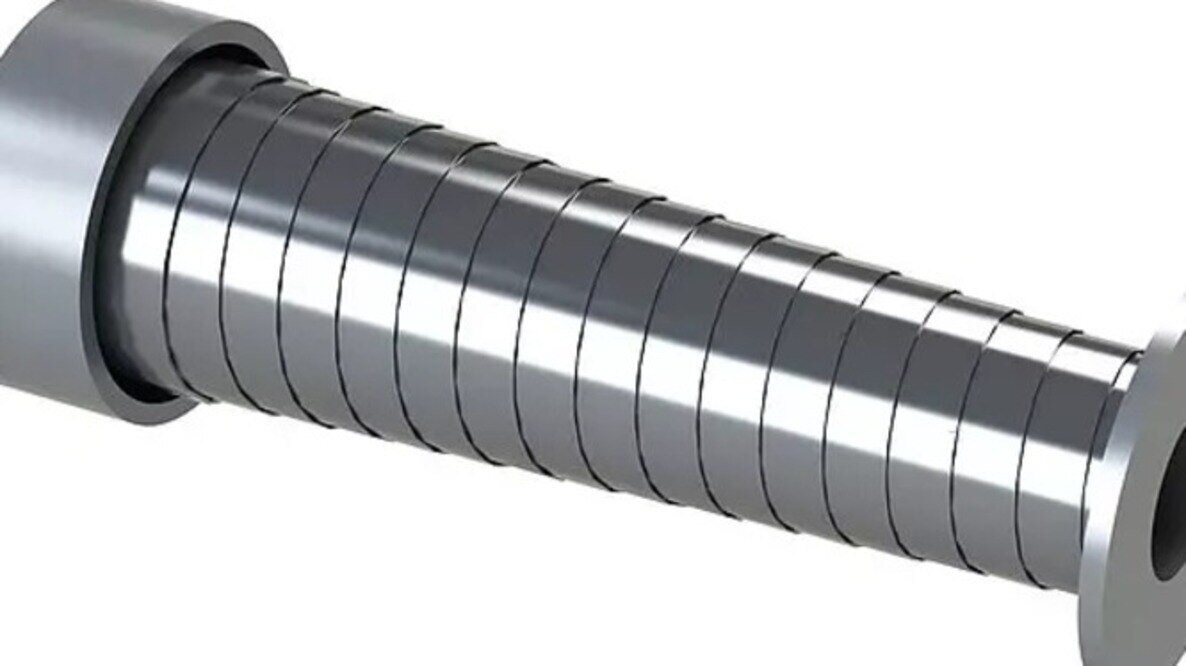
- A helical wire sewn into the bellow wall supports each fold and stays integrated with the fabric. Identify whether it is internal, external, or encapsulated, because an external coil can trap chips while an internal coil can obstruct cleaning or airflow.
- Separate internal or external spring rings support selected sections rather than forming one continuous helix. They suit designs that need local anti-collapse support or a controlled profile.
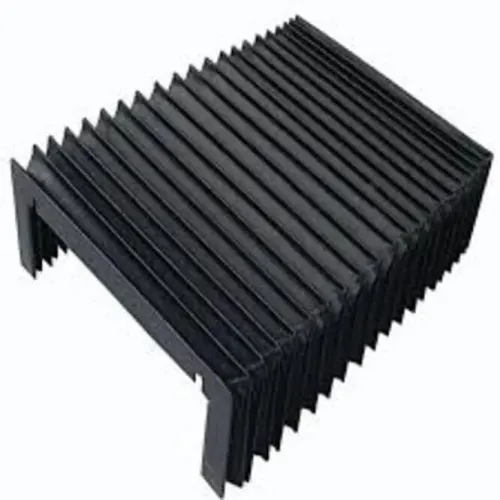
- A spring in a telescopic machine cover is not automatically suitable for a process-air duct bellow. It may guide motion or limit compression without carrying pressure or maintaining an airtight flow path.
For negative pressure, estimate the first-order compressive load as F = ΔP × A, where A is the projected unsupported area. Local fold buckling and spring-wire instability still require engineering review, especially under airflow pulsation or repeated cycling.
For positive pressure, spring support does not replace pressure-rated fabric, reinforced seams, or secure clamps; pressure pushes the bellow outward and loads its joints. A shield that carries no process pressure needs contamination and movement checks instead. Compare these duct bellow options by support function, not by the word “spiral” alone.
What dimensions and spring loads must you calculate before choosing the support?
Calculate the spring against the bellow’s full movement, not its nominal diameter. Record:
- Bellow cross-section, free length, compressed length, extension length, and working stroke
- Lateral offset, angular movement, and minimum bend radius
- Spring outside diameter, wire diameter, coil spacing, spring rate, and preload
- Supported mass, mounting points, and available installation space
An unsupported long spring can buckle, migrate from its pocket, cut the cover, or rub the machine. Restrain it at both the fixed end and moving end; a loose insert is less predictable.
Spring choice also changes the folded geometry:
| Option | Benefit | Cost or risk |
|---|---|---|
| Tighter coil spacing | Greater collapse resistance | Higher contact pressure and fold damage |
| Larger wire diameter | Higher load capacity | More mass, folded height, bend radius, and friction |
| Lower spring rate | Easier compression | Greater sag or collapse under vacuum |
For a duct bellow in Pune, check resonance at the machine’s cycle rate, spring fatigue over the required cycles, and coating fatigue where the wire flexes. Test the actual movement route, including compression, extension, offset, angular travel, and mounting orientation; a bench-straight test can miss binding.
Compare duct bellow options using these measured values, because a spring that supports static mass can still fail through dynamic instability. For negative pressure, compare spring capacity with F = ΔP × A, then review local fold buckling and wire instability.
How should fabric, seams, reinforcement, and spring material match the environment?
Match the fabric and spring to the contaminants and movement, not to nominal duct size. Temperature, coolant mist, cutting oil, moisture, abrasive chips, dust, outdoor exposure, fire requirements, chemical contact, antistatic needs, and cleanability determine the construction. Pune monsoon humidity and washdown conditions belong in the specification.
A spiral spring duct bellow may use a helical wire sewn into the wall, separate internal or external rings, or an encapsulated support; these duct bellow options differ in access, airflow, and failure risk.
| Material | Strength | Limitation or best use |
|---|---|---|
| PVC-coated | Economical, flexible, cleanable | Check oil and solvent compatibility before selection |
| Silicone | Handles elevated temperature and flexibility | Lower abrasion resistance and higher cost |
| Polyurethane | Strong abrasion and oil resistance | Confirm temperature limit and chemical compatibility |
| Rubber-coated | Good resilience and coolant resistance | Compound-specific ageing, odour, and fire limits |
| PTFE-laminated | Strong chemical resistance and clean surface | Expensive, less forgiving in repeated folding |
| Multilayer | Combines barrier, reinforcement, and wear layers | Heavier, thicker, and harder to repair |
Use stitched seams for flexible, repairable construction; use welded seams when the coating permits and leakage control matters. Add reinforcement rings, secure clamps, and a protective spring pocket or encapsulation so wire cannot chafe the fabric.
Carbon-steel spring wire needs corrosion review in humid or washdown service; stainless wire raises cost and changes fatigue strength and magnetic behaviour. An external coil can collect swarf, while an internal coil can obstruct cleaning or airflow.
Check coating, seam, pocket, and spring fatigue over the expected CNC cycle count, not through a static fit alone.
When is spiral support the wrong choice for a duct bellow?
Spiral support is the wrong choice when the bellow must carry pressure, span a wide unsupported distance, withstand impact, or operate beyond the fabric or spring temperature rating. It also fails as a substitute for a rigid expansion joint or formed metal bellows.
| Situation | Why spiral-supported fabric is unsuitable | Better construction |
|---|---|---|
| High-pressure ducting | Spring support does not prove pressure rating, seam strength, or leakage control | Pressure-rated flexible connector with verified clamps and reinforcement |
| Large unsupported span | The spring can sag, buckle, migrate, or fatigue under the bellow’s mass | Guided reinforcement layout or rigid intermediate support |
| Severe chip or impact exposure | An external coil can snag swarf; impact can deform the wire and tear the fabric | Protected reinforcement, rigid cover, or encapsulated support |
| High-temperature zone | Fabric, coating, spring wire, or seam can exceed its rated temperature | High-temperature fabric assembly or formed metal bellows |
| Rigid movement control | A flexible wall cannot provide a fixed expansion-joint geometry | Rigid expansion joint or formed metal bellows |
A protective machine bellows cover prioritizes guided motion and contamination exclusion. A process-air flexible duct must demonstrate flow resistance, leakage control, pressure rating, temperature performance, and any required fire or electrical properties.
A generic HVAC flexible-duct specification cannot validate a moving CNC cover because it does not establish stroke life, routing, fold behaviour, or machine-speed cycling.
For duct bellow options, choose rigid support for fixed routing, guided reinforcement for repeated motion, formed metal bellows for heat and rigidity, or a pressure-rated flexible connector for air service. These distinctions matter when specifying a duct bellow in Pune.
What should you include in a Pune supplier specification and acceptance test?
Order a duct bellow with spiral spring support in Pune from operating data, not nominal duct diameter. Give every industrial duct bellow supplier in Pune the same drawing and limits, or visibly similar quotations may describe assemblies with different movement, leakage, and service life.
- Dimensional drawing showing connection dimensions, cross-section, centreline length, compressed and extended lengths, stroke, lateral offset, bend radius, end connections, and installation clearance.
- Maximum positive pressure or vacuum, airflow temperature, cycle rate, mounting orientation, supported mass, contaminants, and routing condition.
- Fabric material, coating identification, spring material, spring outside diameter, wire diameter, coil spacing, and any fire, chemical, antistatic, or cleanability requirement.
- Required cycle rating, dimensional tolerances, visual inspection points, seam inspection, spring restraint, and leakage-test method.
- Check the supplied assembly at full compression and full extension. Measure stroke, folded height, connection alignment, and interference with nearby machine parts.
- Apply the specified lateral offset and minimum bend radius, then inspect folds, seams, spring migration, and contact damage.
- Cycle the bellow at machine speed through the actual routing condition, including guides, clamps, cable carriers, and mounting orientation. Record binding, sag, excessive noise, and loss of flow path.
- Add pressure or vacuum leakage testing when it carries air, fumes, or coolant extraction; record test pressure, duration, and permitted leakage.
Compare SCUTES INDIA PRIVATE LIMITED with other suppliers only after each quotation answers these points and the acceptance records match the approved drawing.
Related product
 | Duct Bellows HVAC systems and industrial ducting rely on high-quality duct bellows for durability and performance. View product → |
Frequently asked questions
When is a spiral spring support mechanically suitable for a duct bellow?
Use it when the spring must resist collapse, prevent fabric sag, preserve the flow path, limit compression, or support part of the bellow mass. Check pressure, movement, temperature, and contamination before selection.
What must you calculate before choosing a spiral spring support?
Calculate the bellow’s expanded and compressed dimensions, movement direction and stroke, internal pressure, fabric mass, supported mass, spring rate, working load, compression limit, and available installation space.
How should the duct bellow materials match its environment?
Select fabric, coating, seam construction, reinforcement, and spring material against the actual temperature, coolant or chemical exposure, dust, abrasion, moisture, and pressure conditions.
When is spiral spring support the wrong choice for a duct bellow?
Choose another support when the spring creates excessive friction, cannot tolerate the temperature or corrosion environment, restricts movement, interferes with cleaning, or cannot provide the required collapse resistance.
What belongs in a Pune supplier specification and acceptance test?
State dimensions, movement, pressure, temperature, materials, spring load and rate, attachment details, inspection points, and test criteria. Check fit, stroke, flow-path shape, seams, spring return, and leakage before approval.