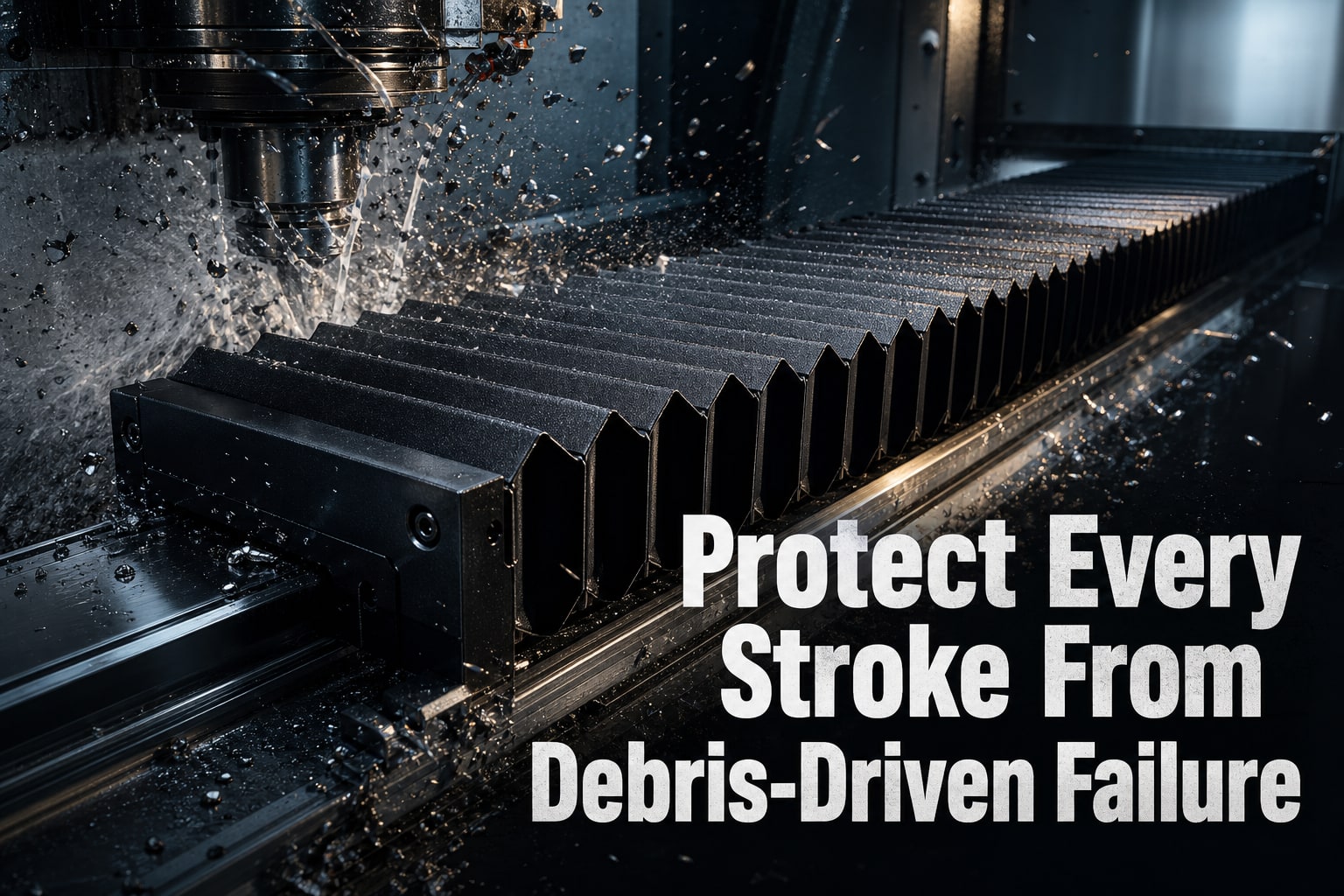
Chips, coolant, oil and abrasive dust reach guideways through gaps that open and close as an axis moves. By the end, you will be able to map those debris paths, measure the full motion envelope, compare cover types and specify a bellows that survives the machine’s actual environment.
Key takeaways
- Measure the full retracted-to-extended stroke before specifying bellows.
- Use telescopic covers for rigid guideways and bellows for flexible, enclosed protection.
- Match fabric and coatings to chips, coolant, oil, heat and abrasion.
- Leave clearance for folds to expand without rubbing, sagging or trapping debris.
How a bellows blocks debris through a machine’s full stroke
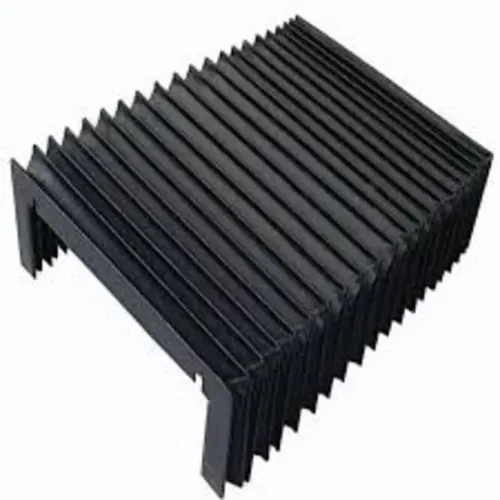
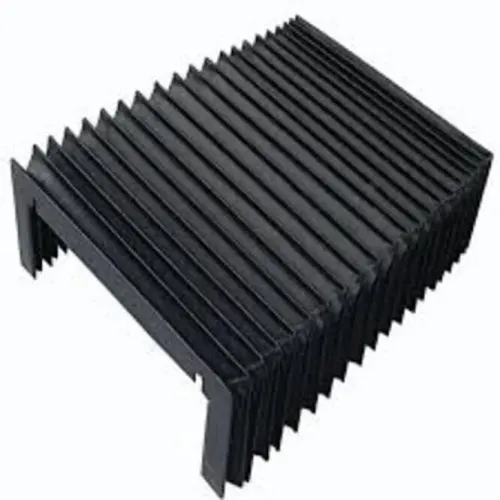
An industrial bellows for moving equipment forms a flexible barrier around a guideway while the axis travels from its retracted to its extended position. Its folds compress and expand with the stroke, keeping chips, coolant, oil and abrasive dust away from rails, screws, shafts, cylinders or cable carriers.
The bellows must move with the machine, not carry its side load; the guideway or a separate support system carries that force.
Protection fails when debris enters through an end-frame gap, mounting interface, stitched corner or fold that lifts during motion. Inspect and clean the folds, prevent pockets from draining toward the guideway, and stop accumulated chips from being dragged through the stroke.
Horizontal installations often need internal supports, sliding strips or shaped folds to prevent sagging and fold-to-fold rubbing.
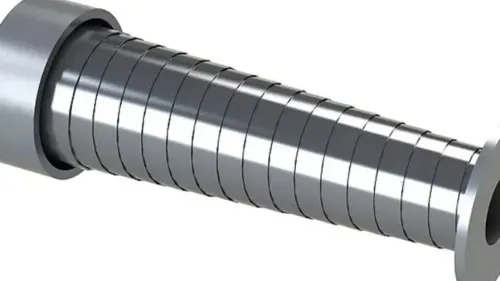
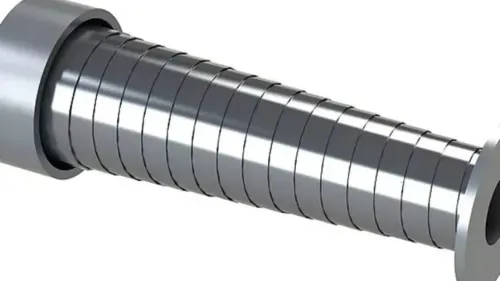
- Telescopic steel covers protect guideways with rigid overlapping sections and resist hot chips better, but they need space and cannot follow every geometry.
- Roll-up covers seal a moving opening with a flexible curtain; they suit broad travel but do not manage cables.
- Brush wipers remove particles from a surface as it moves; they wipe rather than enclose the guideway.
- Cable drag chains route and bend cables; they are not debris seals unless a separate cover encloses them.
Before selecting a bellows, record the compressed length, extended length and usable stroke. Also measure folded height, internal and external dimensions, mounting-hole pattern, bend radius and clearance at every position. Verify the end transition, not just the fabric.
Which protective component matches the moving hazard?
Match the component to the hazard: an industrial bellows forms a flexible environmental barrier around a guideway, screw, shaft, cylinder or linkage as it travels. It seals the moving gap against chips, coolant, oil and abrasive dust, but it is not a structural guard, load-bearing member or axis guide.
| Component | Primary job | Choose it when |
|---|---|---|
| Industrial bellows | Seal a moving gap | The protected assembly needs coverage through a stroke |
| Telescopic steel cover | Protect a guideway | Heavy chips, impact or hot cutting debris demand rigid protection |
| Roll-up cover | Cover a broad opening | Space or stroke makes folding bellows impractical |
| Machine guard | Block personnel access | The hazard is contact with moving machinery, not contamination alone |
| Brush wiper | Wipe a surface | Loose debris must be swept from a rail or cover edge |
| Cable drag chain | Manage cables and hoses | Power, signal or fluid lines must follow an axis |
| Duct bellows for industrial ventilation | Isolate vibration or absorb movement | A fan or air-handling unit connects to rigid ductwork |
Do not force a bellows to carry side loads or guide an axis; it can buckle, rub through its folds or tear its end frames. Provide clearance and a cleaning route, because trapped chips or coolant can be dragged onto the guideway.
Inspect duct-bellows fabric, clamps and seams: leakage can reduce source capture and spread dust, while fire and smoke requirements still apply to the specified connector.
Measure the motion envelope before choosing a bellows
Measure the axis at both ends of its stroke before selecting industrial bellows for moving equipment. Record the motion envelope, not just the guideway’s nominal length. A cover that bottoms out, stretches at full extension or rubs against nearby parts will tear quickly.
Industrial bellows for moving equipment are flexible barriers, not structural guides. Let the machine’s linear guides or a separate support carry side loads; forcing the bellows to guide motion can buckle folds, pull on mounting frames and tear the ends.
Record these dimensions:
- Usable stroke, measured between the actual retracted and extended positions
- Compressed length and extended length
- Folded height or fold depth at compression
- Internal height and width around the protected screw, shaft, guideway or cylinder
- External height and width, including fold movement
- Mounting-hole pattern, flange size and attachment orientation
- Minimum bend radius and the clearance to guards, tooling and adjacent folds
| Operating input | Record | Why it matters |
|---|---|---|
| Speed and cycle rate | Maximum velocity, acceleration and cycles per hour | High cycling increases fold fatigue and heat |
| Temperature | Minimum and maximum operating temperature | Material and coating performance change across the range |
| Contamination | Chip size, abrasive dust, coolant, oil and chemical exposure | Debris type determines fabric, coating and fold protection |
| Pressure or airflow | Internal pressure, vacuum, airflow and leakage target | Pressure can inflate, collapse or distort the bellows |
| Installation | Orientation, cleaning method and required service life | Access and washdown forces affect construction and maintenance |
Match fabric, construction and fold geometry to the debris
Industrial bellows for moving equipment need a material and construction matched to the debris, not just the machine’s temperature. Choose a flexible barrier that tolerates the actual chip impact, coolant chemistry, cleaning agent, speed and number of cycles. The bellows must not carry machine loads, rub against guides or trap debris in folds.
| Hazard | Material and construction | Fold geometry and reinforcement |
|---|---|---|
| Sharp metal chips | Abrasion-resistant coated fabric with heat-resistant outer protection; add stitched or bonded wear layers where chips strike | Use deep, supported folds that do not collapse onto the guideway; reinforce corners and end attachments |
| Coolant, oil and spray | Select a coating tested against the specific fluid; seal stitched seams or use welded construction where compatible | Slope folds and transitions so liquid drains away; close end-frame gaps and mounting interfaces |
| Hot chips | Use heat-resistant fabric with metal lamellae or mesh where impact energy demands it | Keep hot debris from sitting in horizontal pockets; add sacrificial shields at the impact zone |
| Abrasive dust | Tightly finished fabric with protected seams and low-friction fold surfaces | Use compact folds that stay closed through motion; prevent fold lift at maximum extension |
| Repeated flexing | Choose a fatigue-resistant fabric and flexible seam construction; avoid stiff layers that crack at low temperature | Match fold pitch and compressed height to the cycle; reinforce only where added mass will not accelerate fatigue |
Inspect folds, corners, rails and transition plates, not only the outer face. A temperature rating for fabric alone does not prove hot-chip resistance, and one coolant can swell a coating that survives another. Provide access for cleaning so retained chips or oil cannot be dragged into the moving joint.
Prevent gaps, sagging and premature failure during service
Installation, cleaning and inspection determine whether a bellows keeps its seal through the full stroke. Mount it square to the guideway, leave the specified compressed and extended clearance, and prevent clamps or fasteners from pinching the fabric. Misalignment creates gaps; excessive compression creates rubbing and early cracks.
Check these points during installation and service:
- Confirm every fold opens and closes without fold-to-fold contact, snagging or twisting.
- Support horizontal runs with the specified internal supports, sliding strips or support table; gravity can make a vertically successful design sag.
- Keep coolant drains, chip trays and nearby surfaces from directing contamination into the folds or toward the guideway.
- Remove chips and dried coolant with the approved cleaning method, rather than forcing debris deeper into the folds with compressed air.
- Inspect seams, mounting edges, rivets, clamps and end transitions for loose sections, cuts, abrasion, oil swelling and hardened fabric.
- Run the axis slowly after cleaning and watch for a fold that drags, collapses or pulls away from its frame.
Record the inspection against travel, speed, cycle rate, temperature and cleaning chemicals. Replace the bellows when a tear opens a path to the protected parts, even if the machine still moves.
Duct bellows for industrial ventilation require the same attention to seams, clamps and end transitions, but their job is flexible duct connection and vibration or thermal movement—not automatic debris protection for a machine axis. SCUTES INDIA PRIVATE LIMITED can help clarify this distinction in a specification that states orientation, motion, environment and required service life.
Related products
 | Laser Machine Bellows Laser Machine Bellows are specialized protective coverings designed to safeguard the vital internal components of laser machines. View product → |
 | Duct Bellows HVAC systems and industrial ducting rely on high-quality duct bellows for durability and performance. View product → |
Frequently asked questions
How does an industrial bellows block debris during a machine’s full stroke?
Its folds compress and expand as the axis moves, maintaining a flexible barrier over rails, screws, shafts, cylinders or cable carriers.
Which protective component matches a moving machine hazard?
Choose bellows for flexible enclosure around moving axes, telescopic covers for rigid guideways, cable carriers for supported cables and duct bellows for industrial ventilation connections.
What should you measure before choosing a bellows?
Record the total stroke, closed and extended lengths, width and height of the protected area, mounting points, travel speed, acceleration and nearby interference.
How do fabric, construction and fold geometry affect bellows life?
Select the fabric, coating, reinforcement and fold depth for the chips, coolant, oil, heat and abrasion present at the machine.
How can you prevent gaps, sagging and premature failure?
Check mounting alignment, allow fold clearance, support long spans, prevent sharp-edge contact and inspect the bellows for tears, distortion and trapped debris.