Laser cutting and welding machines expose guideways, ball screws, cable carriers, linear bearings, and laser-head mechanisms to fine dust, metallic particles, coolant mist, sparks, and repeated motion. By the end, you will be able to identify the zones that need protection, compare cover types, specify the right fabric construction, and verify that a bellow will not restrict machine access or travel.
Key takeaways
- Protect guideways, ball screws, bearings and cable carriers from laser-cutting debris.
- Compare fabric bellows with telescopic covers, spiral spring covers and segmented guards.
- Specify travel, compressed length, expansion, mounting, temperature and chemical exposure.
- Request drawings, fit checks and service access details before approving production.
Which laser-machine zones gain the most from a fabric bellow?
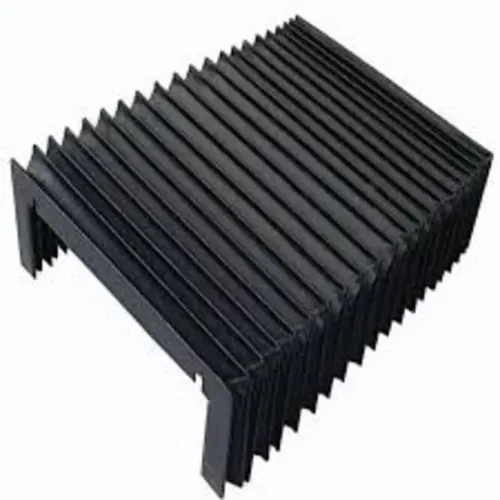
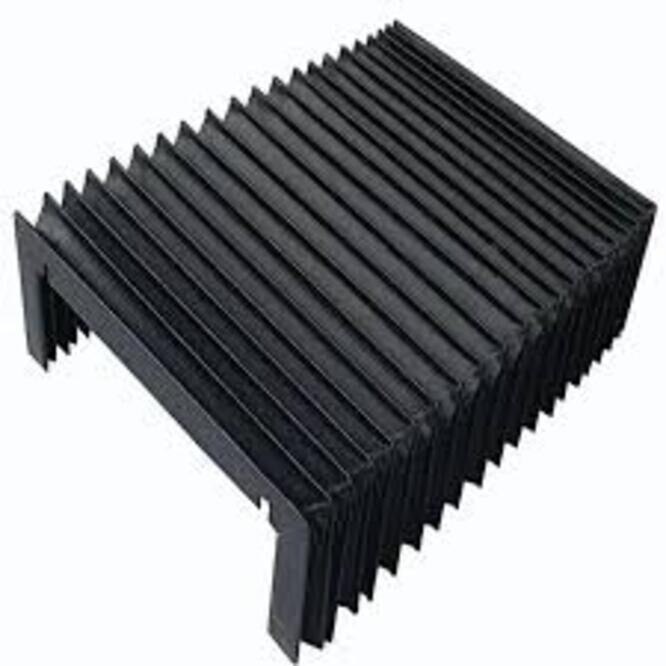
A fabric bellow creates its clearest measurable benefit where moving components repeatedly face dust, metallic particles, abrasive debris or coolant mist. The fabric bellow benefits laser machine manufacturers in Kolhapur by reducing contamination on guideways, ball screws, linear bearings and cable carriers, which helps prevent rough motion, scale-reading errors and premature wear.
The highest-value zones are:
- X- and Y-axis guideways, where long travel exposes rails and drives to cutting debris.
- Z-axis assemblies, where compact folds protect the laser-head lift mechanism without blocking vertical movement.
- Cutting-head cable routes, where a shaped bellow shields power, sensor and assist-gas lines from abrasion and snagging.
- Moving tables and exposed drive components, where the cover follows travel while preserving maintenance access.
| Zone | Protection benefit | Important limit |
|---|---|---|
| X/Y axes | Restricts debris reaching guides, screws and scales | Seal the ends and verify folded clearance |
| Z axis | Protects the head mechanism in limited space | A tight fold can rub during rapid travel |
| Cable route | Prevents abrasion and particle buildup on cables | Do not compress cables below their bend radius |
| Table or drive | Reduces contamination around exposed moving parts | Add a spark shield near hot particles |
These are the practical laser machine bellow benefits, not a claim of complete sealing. A bellow does not replace enclosure ventilation, positive air purge or sealed way covers. Hot sparks can burn ordinary PVC-coated fabric, while a fabric bellow is not automatically a laser-radiation barrier; direct or reflected beam exposure requires a documented safety assessment.
How should fabric bellows be compared with other machine covers?
A fabric bellow is the strongest choice when an axis needs continuous coverage through changing travel, tight bends, or irregular geometry.
Its laser machine bellow benefits include shielding guides, ball screws, linear scales, cable carriers, and head mechanisms from dust, metal particles, abrasive debris, and coolant mist without consuming the full retracted length of a steel enclosure.
| Option | Movement and clearance | Contamination and heat | Choose it when |
|---|---|---|---|
| Fabric bellow | Follows long travel, bends, and compact spaces | Seals well against fine debris; requires heat-resistant layers near sparks | The axis has complex motion or limited surrounding clearance |
| Telescopic steel cover | Rigid, straight axial travel; needs mounting space | Strong against chips and contact; poor for tight bends and fine mist gaps | The guideway is straight and faces heavy mechanical impact |
| Apron or roll-up cover | Suits broad surfaces and moderate travel | Handles chips; sealing depends on overlaps and guides | A table or large horizontal opening needs broad coverage |
| Spiral spring cover | Compact radial clearance and simple axial movement | Resists light contact but leaves coil gaps; hot spatter can damage it | Space is severely restricted and contamination is coarse |
For spiral spring cover laser manufacturers, high speed alone is not a reason to select a spring cover. Check spring fatigue, strip cracking, snagging, and ingress between coils. Use sacrificial spark shields, stand-off distance, or overlapping layers where hot particles occur.
No fabric or spring cover replaces an enclosure, positive air purge, or ventilation system, and none proves laser safety against direct beam exposure.
What dimensions and materials belong in the bellow specification?
Specify travel before fabric: record X, Y or Z stroke, extended length, collapsed length, folded height, width, minimum fold radius, maximum speed, acceleration and duty cycle. If collapsed length is missing, folds can rub, interfere with the laser head or split seams during compression.
A specification for fabric bellow laser machines in Kolhapur should also state:
- Mounting-frame dimensions, hole pattern, allowable misalignment and clearance from the workpiece, nozzle and cable chain.
- The motion path, including lateral offset, twisting, repeated reversals and the required free movement at full stroke.
- Exposure type: dust, chips, coolant, sparks, radiant heat, direct beam exposure or reflected radiation. Mechanical protection does not equal laser safety.
- Seam construction, thread type, edge reinforcement, inspection access and replacement method.
Material choice must match the actual hazard.
| Construction | Best fit | Main limitation |
|---|---|---|
| Coated polyester or polyurethane | Dust, light coolant and general enclosure protection | Hot particles can burn pinholes |
| Aramid or silicone-coated fabric | Sparks, hot scale and intermittent radiant heat | Higher cost and tighter fabrication controls |
| PTFE-coated fabric | Chemical resistance and elevated-temperature exposure | Check flex-fatigue and coating adhesion |
Treat the fabric, coating, thread, seams and mounting frame as one thermal system. A headline fabric temperature rating does not rate the finished bellow. Add stand-off spacing, overlapping layers or a sacrificial spark shield near frequent spatter; never claim direct laser-beam protection from a standard cover.
For export builds, link the design to ISO 12100 risk assessment and ISO 11553-1, then cycle the bellow through full travel while checking fold cracking, delamination, seam opening, loose fasteners and interference.
How can you prove that the bellow will fit and remain serviceable?
Prove fit with a released drawing, a full-motion clearance check and a documented endurance test—not a folded sample held beside the machine. Treat the bellow as part of the machine risk assessment under ISO 12100 and ISO 11553-1, especially where the enclosure, access doors, interlocks or laser head affect exposure risk.
- Draw the extended and collapsed bellow envelopes, including fold height, minimum fold radius, mounting frames and fasteners. Check both positions against the laser head, workpiece, clamps and fixtures.
- Cycle every axis through its complete travel at maximum speed and acceleration. Confirm that no fold rubs a guideway, ball screw, linear scale, cable carrier or cutting-head hose.
- Open doors, remove covers, change the nozzle and access lubrication points with the bellow installed. Record the tools and clearance needed for each maintenance task.
- Verify the routing of cables, purge lines and cooling hoses at full extension and compression. Secure them so they cannot snag a fold or transmit force to the laser head.
- Define the protection claim separately: dust, chips, coolant mist, sparks, radiant heat, direct beam exposure or reflected radiation. A mechanically sound cover is not automatically a laser-safety enclosure.
Run repeated full-stroke cycles with representative dust, debris or coolant exposure, then inspect for seam opening, coating delamination, cracked folds, loose fasteners, abrasion and restricted movement. Record travel, cycle count and photographs before release.
This evidence gives buyers of industrial laser covers in Kolhapur a serviceability decision based on the actual machine, not a headline fabric temperature rating.
What should Kolhapur manufacturers include in a supplier brief?
Put the protection boundary on paper before requesting a price. State whether the bellow must stop cutting dust, metallic particles, coolant mist, sparks, radiant heat, direct laser exposure, or only reflected radiation; these requirements are not interchangeable. The fabric bellow benefits laser machine manufacturers in Kolhapur only when the cover matches the actual hazard.
Include these items in the supplier brief:
- Protected zone and attachment points: X, Y, or Z axis, guideway, ball screw, linear scale, cable carrier, or laser-head route.
- Motion data: travel, collapsed and extended lengths, folded height, minimum fold radius, speed, acceleration, cycle frequency, and duty cycle.
- Drawing requirements: mounting-hole pattern, flange dimensions, clearances, cable-entry positions, service access, and an interference check at full compression and extension.
- Construction: fabric and coating, thread, seam method, frame material, spark shield, stand-off distance, overlapping layers, and the specified heat exposure.
- Deliverables: quotation, dimensioned approval drawing, material declaration, inspection points, replacement method, and acceptance-test criteria.
- Release controls: revision number, batch identification, approved deviations, and confirmation that the bellow is not the machine’s laser-safety enclosure or purge system.
For fabric bellow laser machines in Kolhapur, ask SCUTES INDIA PRIVATE LIMITED or another supplier to mark every assumption on the drawing rather than burying it in a quotation note. Specify ISO 12100 risk-assessment inputs and ISO 11553-1 review points for industrial laser covers in Kolhapur before production release.
Related product
 | Laser Machine Bellows Laser Machine Bellows are specialized protective coverings designed to safeguard the vital internal components of laser machines. View product → |
Frequently asked questions
Which laser-machine zones gain the most from a fabric bellow?
Guideways, ball screws, linear bearings and cable carriers benefit most when they repeatedly encounter dust, metallic particles, abrasive debris or coolant mist.
How should fabric bellows be compared with other machine covers?
Compare the cover type against the zone’s travel, available space, debris load, heat, coolant exposure, access needs and required flexibility. Include telescopic covers, spiral spring covers and segmented guards where their construction suits the motion.
What dimensions and materials belong in the bellow specification?
Record the protected component, travel, extended and compressed lengths, height, width, folds, mounting points, clearances, fabric construction, coating, seams, temperature range and chemical exposure.
How can you prove that the bellow will fit and remain serviceable?
Use a dimensioned drawing or sample envelope, check travel at both stroke limits, inspect mounting and clearance during motion, and confirm that cleaning, inspection and replacement are possible without obstructing machine maintenance.
What should Kolhapur manufacturers include in a supplier brief?
Include machine-zone photographs, drawings, travel data, mounting details, debris and coolant conditions, heat exposure, cleaning method, duty cycle, access constraints, required documents and acceptance-test criteria.