A carrier that fits the hose diameter can still fail if its bend radius, load capacity, mounting direction or environmental resistance is wrong. By the end, you will have a practical method for measuring the installation, sizing the carrier, checking support and deciding which construction suits your machine.
Key takeaways
- Match the carrier bend radius to the hose’s minimum dynamic bend radius.
- Measure full stroke, hose length, mounting points and movement before ordering.
- Leave clearance for hose expansion and separate hydraulic lines from cables.
- Confirm the carrier suits coolant, oil, chips, heat and the machine’s speed.
Start with the hose’s dynamic bend radius
Confirm the hose’s minimum dynamic bend radius before comparing carrier sizes: a cable chain for hydraulic hoses is suitable only when its nominal bend radius meets or exceeds that value throughout the full stroke.
1. Read the hose manufacturer’s datasheet and record the minimum dynamic bend radius, not the static storage radius. Dynamic radius governs a hose that bends repeatedly while the machine moves.
2. Compare the hose value with the carrier drawing. Ask both manufacturers how they define the radius—such as to the hose centreline, inside edge, or another datum—because identical numbers can describe different geometries.
3. Check the complete movement, including the chain’s tightest bend at both stroke limits. A radius that works at the neutral position can still pull the hose tight at one end or compress it at the other.
4. Inspect the proposed routing. Keep the hose free of torsion, axial tension, and compression; keep fittings outside the bending section; and prevent contact with crossbars or end brackets. A fitting forced into the bend concentrates stiffness near the crimp.
5. If the radius is too small, reject the arrangement before sizing the carrier. Repeated over-bending, rubbing, or clamping can damage the cover and reinforcement before an external leak appears. When several hoses share the chain, plan separators so they cannot cross or crush one another.
Measure the complete moving installation before ordering
Measure the complete moving installation before ordering a cable carrier for hydraulic hoses. Record the fixed-end position, moving-end position at both stroke limits, total travel, unsupported span, mounting orientation, travel speed and acceleration. Carrier length depends on this geometry, not on stroke alone; use the carrier maker’s length formula and add the specified end allowance.
Collect these hose and layout details:
- Actual outside diameter of every hose, including sleeves, abrasion guards and insulation
- Hose weight per metre, minimum dynamic bend radius and maximum permitted compression
- Fitting dimensions and locations; keep fittings outside the bending section unless the carrier maker approves otherwise
- Required clearance around each hose for movement, heat expansion and diameter variation
- Separation requirements between pressure, return and pilot hoses
- Any electrical cables sharing the route, with their diameter, weight and required segregation
Compare the installation with these carrier choices:
| Option | What it provides | Ordering check |
|---|---|---|
| Cable-only drag chain | Space intended for electrical cables | Reject it if hose weight, bend radius or pressure-hose containment is not rated |
| Hose-rated carrier | Structure and load capacity for hydraulic hoses | Confirm usable internal width, height, permissible load and orientation |
| Carrier with separators | Individual compartments that prevent crossing and rubbing | Specify separator positions and reserve space for the largest hose |
Size the internal opening from the installed outside diameters, not bare hose dimensions. Add the manufacturer’s clearance and fill limits; nominal internal dimensions are not fully usable. Confirm that the chain’s bend-radius datum matches the hose manufacturer’s datum, then select a nominal radius at least equal to the stated hose requirement.
A tight fit can crush a smaller return hose or force a fitting into the bend.
Size the carrier for clearance, separation and load
Calculate usable internal space from the carrier manufacturer’s fill envelope, not its nominal width and height. For each hose, use the actual outside diameter after adding sleeves, abrasion guards, insulation and deliberate movement clearance. Packing to the nominal dimensions turns diameter variation into contact and abrasion.
For a cable chain for hydraulic hoses, check the internal arrangement as well as the total area:
- Set usable width to the sum of hose diameters, inter-hose clearances and separator thicknesses.
- Set usable height to the largest hose diameter plus the specified top-and-bottom clearance.
- Install separators or shelves when hoses differ in diameter, weight or pressure; this stops a heavy pressure hose crushing a smaller return or pilot hose.
- Put fittings outside the bending section. A fitting forced into the chain creates a stiff point that can overload the hose beside its crimp.
- Separate hydraulic hoses from electrical cables when leakage, weight or rubbing could damage either one.
Verify support with the carrier’s load calculation. Add the mass per metre of every hose, sleeve and cable, then include the carrier’s self-weight; compare the result with the manufacturer’s permissible additional load for the actual unsupported length, speed, acceleration and mounting orientation. Do not approve a horizontal rating for a vertical or sideways run.
Inspect the worst position through the complete stroke: the assembly must remain inside its compartments without sagging, buckling, nesting, rubbing or pulling at either end.
Match the carrier construction to the machine environment
Match carrier construction to the worst exposure the machine will see, not only to the hydraulic fluid. Oil mist, coolant, chips, weld spatter, cleaning chemicals, UV radiation and temperature can attack polymer links, liners, separators and end brackets.
| Option | What it means | When it applies |
|---|---|---|
| Open | Exposed links with maximum ventilation and inspection access | Clean, enclosed machines where chips, spray and impact are controlled |
| Slotted | Links with openings or partial shields | Moderate coolant, dust or chip exposure when ventilation and visual inspection matter |
| Enclosed | A continuous cover shields the moving contents | Heavy coolant, abrasive chips, oil mist, UV or accidental impact; clean-out access becomes more important |
| Fully guided | The carrier runs in a guide trough, rail or channel that controls sway and lateral movement | Long, heavy or vertical travel where hose weight could make an unsupported carrier bow, twist or strike the machine |
Choose reinforced engineering polymer for ordinary oil and coolant exposure only after checking the manufacturer’s chemical-compatibility chart. Select UV-stabilised polymer for outdoor sunlight, and use stainless steel or coated steel where weld spatter, hot chips, severe abrasion or elevated temperature would damage polymer links.
For low-temperature service, verify the carrier, liner and end-bracket rating at the machine’s coldest start-up temperature. Cleaning chemicals can invalidate an oil-compatible material choice.
- Use metal shields or a covered carrier for weld areas and sharp chips.
- Separate hydraulic hoses from electrical cables with compartments or separate carriers; a leaking hose can contaminate cables, while cable abrasion can cut the hose cover.
- Choose liners and separators for the same exposure as the links, and leave the carrier accessible for chip removal.
Check routing, mounting and the pressurised assembly
Check the route and mounting before accepting a cable chain for hydraulic hoses: the hose must move through the carrier without twisting, pinching or loading its fittings. A cable carrier for hydraulic hoses needs the hose’s actual installed outside diameter, including sleeves, abrasion guards, insulation and retained clearance.
Keep fittings outside the bending section; forcing one into the curve creates a stiff point that can overload the hose near its crimp.
- Fit separators or shelves between hoses. They prevent crossing, nesting and rubbing, and stop a heavy pressure hose from crushing a smaller return or pilot hose.
- Mount the fixed and moving ends so the hose is guided, not tightly clamped. Check that no hose touches crossbars, end brackets or sharp edges.
- Keep hoses and electrical cables in separate compartments when their different weight, stiffness or failure consequences could cause damage.
- Reject a route that imposes lateral offset, torsion or compound motion on a chain designed to bend in one plane; use a 3D carrier, articulated guide or separate route.
- Run the complete pressurised assembly through its full stroke. Look for flattening, kinks, cover rubbing, hose migration, pulsation-driven movement and force at the fittings.
- Stop the test if the hose’s dynamic minimum radius is breached, even when the carrier itself bends correctly.
Ask SCUTES INDIA PRIVATE LIMITED for an internal layout drawing that shows separators, end mounting and the tested bend direction before approving the installation. A sound mock-up is not acceptance until it survives pressure and full travel.
Related product
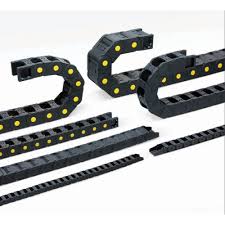 | Cable Drag Chain Cable drag chains are a vital component in modern industrial equipment and automation systems. View product → |
Frequently asked questions
What bend radius should a cable chain for hydraulic hoses have?
Choose a carrier whose nominal bend radius meets or exceeds the hose manufacturer’s minimum dynamic bend radius throughout the full stroke.
What should you measure before ordering a cable carrier for hydraulic hoses?
Measure the complete moving installation, including hose length, full travel, fixed and moving connection points, carrier path and available mounting space.
How much clearance do hydraulic hoses need inside a cable carrier?
Size the carrier for the hose outside diameter plus clearance for movement, expansion and installation. Separate hoses and cables when contact or interference could cause damage.
Which carrier construction suits hydraulic hose installations?
Match the carrier material and design to exposure from oil, coolant, chips, heat, abrasion, washdown and the machine’s travel speed and cycle frequency.