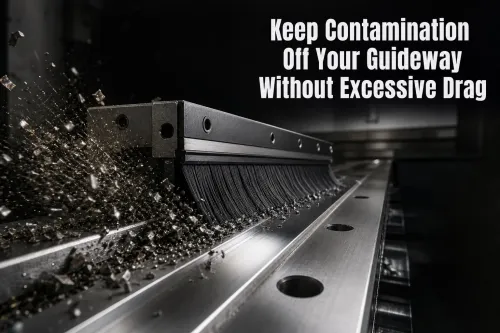
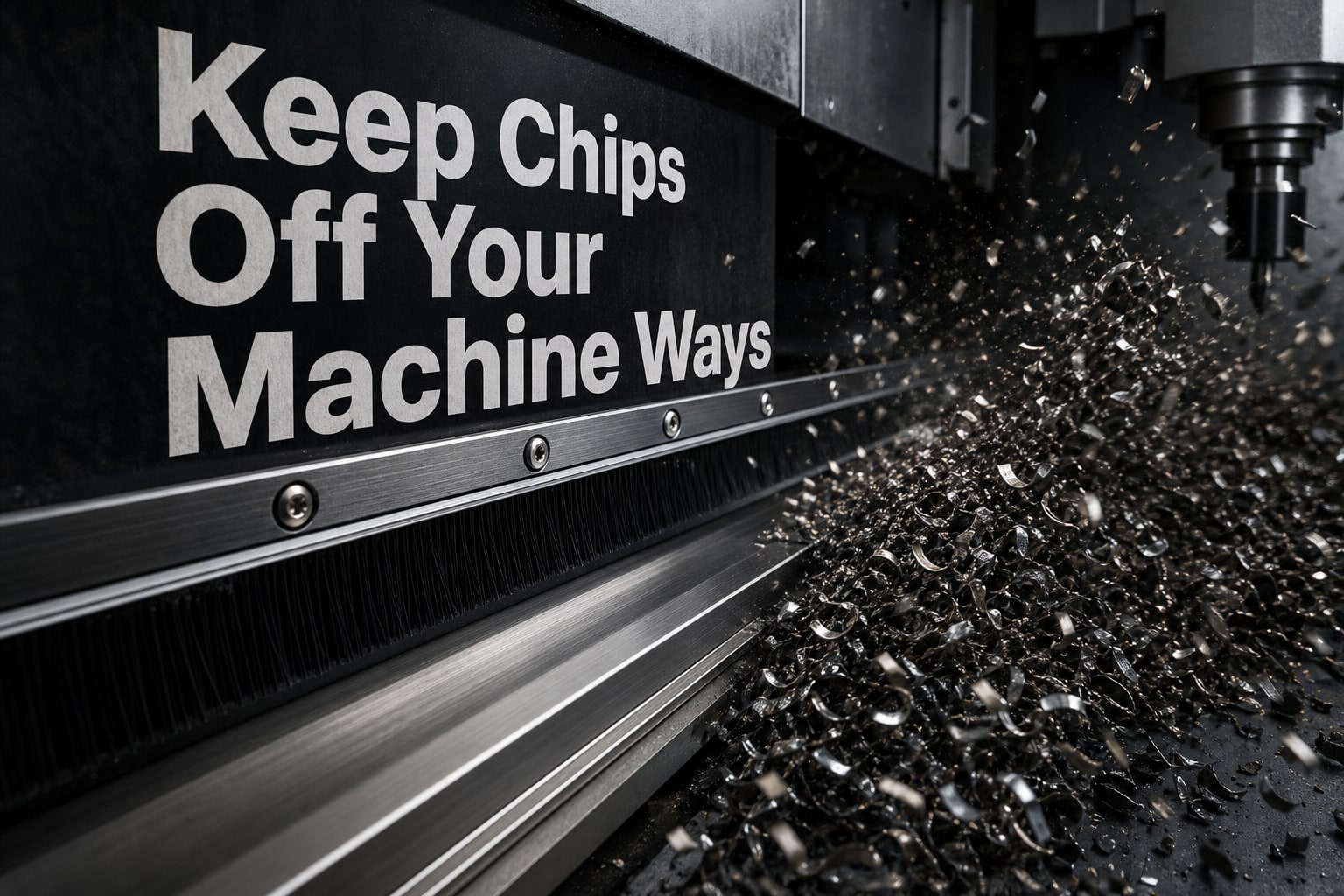
Chips, abrasive dust and coolant can reach a machine way before an operator notices a problem, then damage sliding or rolling surfaces through trapped contamination. By the end, you will know how the brush works, when it needs a cover alongside it, how to specify the fit and how to maintain or replace it without adding slide drag.
Key takeaways
- Match bristle material and density to chips, coolant, oil and axis speed.
- Measure the holder, contact height and mounting holes before ordering a replacement.
- Keep bristle contact light enough to protect the way without causing drag.
- Replace the element when bristles bend, shorten, shed or leave debris behind.
How the bristles block debris at the moving way
A brush wiper for machine ways protects a moving guideway by placing a flexible contact barrier across the exposed way surface. Axis movement carries chips and loose debris into the filament pack, where the bristle tips sweep or deflect them away while the holder keeps the brush aligned against the way-cover or guideway surface.
Filaments flex around small surface irregularities and small gap changes, so they maintain contact where a rigid scraper would lift or drag. They cannot close a large discontinuity, bridge an abrupt step, or create an airtight seal.
| Protection type | Contact behaviour | Main limitation |
|---|---|---|
| Brush wiper for guideways | Flexible filaments conform to small irregularities and deflect chips | Fine abrasive particles and coolant can pass through |
| Rigid scraper | Continuous edge contact removes material from a surface | It loses contact when the surface or gap changes |
| Sealed cover, bellows or telescopic cover | Encloses the guideway and blocks larger debris | It needs suitable clearance and does not eliminate every opening |
A brush wiper therefore works as a first-stage barrier alongside a chip enclosure, telescopic cover, bellows or other way-cover system.
It protects sliding or rolling contact by stopping contamination before it becomes trapped in lubricant, but it cannot remove contamination that has already entered the guideway; clean and inspect the guideway according to the machine or linear-guide manufacturer’s procedure.
Match the wiper to debris, motion and the protection system
A brush wiper for guideways is the right first-stage barrier at openings, joints and transitions where loose chips meet a surface with minor irregularities. It is not an airtight seal: fine abrasive dust and coolant can pass through, while stringy chips or dried coolant can load the filaments and turn them into a scratching source.
| Option | Best match | Limitation |
|---|---|---|
| Brush wiper | Loose chips, joints, openings and uneven transitions | Wide spans, abrupt steps, rack-and-pinion features and bridging chips can lift or overload it |
| Precision elastomer lip seal | Fine abrasive dust exclusion or leakage control | Needs a controlled, continuous sealing surface and correct compression |
| Rigid scraper | A defined edge against a continuous surface | Loses contact at steps, gaps and irregular guideway geometry |
| Sealed way cover | Broad exposed areas with chips and coolant | Requires space, mounting and service access |
| Telescopic steel cover | Heavy chip loads, impact and hot swarf | Adds mass and needs clearance for nested sections |
| Bellows | Flexible shielding against chips and coolant over moving travel | Can tear from sharp or hot swarf |
| Apron cover | Large travel areas and substantial chip protection | Needs room to roll or fold and does not replace every seal |
Choose nylon or polypropylene when protecting a precision surface from marking matters most. Stainless steel or brass filaments tolerate higher heat and aggressive debris, but metallic contact can scratch or gouge a hardened or contaminated way.
Use a cover or bellows to do the heavy work when debris is hot, stringy, abundant or likely to bridge the brush.
Specify a brush wiper that fits the machining center
Specify a brush wiper for machining centers by matching its carrier, contact geometry, axis motion and environment. Brush width alone cannot establish compatibility; a wide strip can still create interference, leave a bypass gap or drag on the slide.
Record these details before requesting a design:
- Machine make and model, axis travel and direction, guideway width, exposed guideway geometry, available clearance, overall holder length, holder cross-section and mounting-hole spacing.
- Brush-strip width and height, contact length, and the gap between the bristles and the protected surface. Include the holder’s mounting position and orientation.
- Filament length, diameter, density, orientation and stiffness; maximum axis speed; operating temperature; coolant and cleaning chemicals; chip shape; and exposure to hot or stringy swarf.
| Brush design | Protection and movement | Main trade-off |
|---|---|---|
| Dense, short bristles | Exclude chips strongly at a consistent contact point | Higher friction and greater tendency to retain swarf |
| Longer or less dense bristles | Conform better to uneven surfaces and small gap changes | Bend under chip loads and leave a weaker barrier |
| Stiffer or incorrectly oriented bristles | Resist deformation during fast travel or heavy chips | Increase slide force and risk interference |
Check the gap through the full axis stroke, not only at rest. A brush that fits one position can bind when the holder reaches a cover joint, exposed corner or changing guideway height.
Install, load and clean the wiper without damaging the way
Install the carrier in its original mounting position, preserving the specified orientation, end sealing and brush direction. Do not crush, fold or twist the bristles; a damaged filament pack creates gaps before the machine moves.
- Match the replacement carrier and retaining method to the original assembly. Confirm the specified brush contact or clearance before tightening fasteners.
- Move the axis slowly through its full travel, including reversal points and end-of-travel positions. Check for interference, uneven contact, cover distortion, stick-slip and abnormal slide force.
- Check the contact pressure at several points. Excessive preload increases friction and brush wear; insufficient contact leaves a bypass path for chips and coolant. Follow the wiper or machine manufacturer’s specified contact or clearance instead of forcing the brush against the way.
- Run the axis under normal operating load and inspect again. A wiper that changes slide force, lifts a cover or leaves a visible gap is incorrectly installed, even when the way looks covered.
- Use this brush wiper cleaning machine ways procedure: remove loose chips with a hand brush or vacuum, wipe the exposed surface with a lint-free cloth and approved cleaner, inspect for embedded particles, then restore the specified way lubricant.
- Keep compressed air out of routine cleaning. It can drive chips and coolant beneath the wiper or into a bearing, turning surface contamination into internal wear.
If particles remain embedded after wiping, stop and follow the machine or linear-guide manufacturer’s inspection procedure before moving the axis at normal speed. A wiper blocks new contamination; it does not remove debris already inside the guideway.
Know when replacement is due and how to order the correct element
A brush wiper replacement for machine tools is due when protection or motion has changed, not merely because the strip looks old.
Replace it after cleaning and alignment checks if filaments remain permanently flattened, filaments are missing, gaps appear along the contact line, fibers have hardened or suffered chemical damage, the carrier is loose, chips enter more readily, or slide drag becomes abnormal.
| Condition | What it indicates | Decision |
|---|---|---|
| Permanently flattened or missing filaments | Contact is no longer continuous | Replace the element |
| Visible contact-line gaps | Chips or coolant have a bypass path | Replace and inspect end sealing |
| Hardened or chemically damaged fibers | The material no longer follows the surface | Replace with compatible fibers |
| Loose carrier or abnormal slide drag | The assembly is moving or applying excess force | Stop and correct the mounting |
A replaceable brush wiper for machine ways saves service time only when its carrier, retaining method, brush height, orientation, end sealing and mounting position match the original. A generic strip with a different cross-section can interfere with travel, leave bypass gaps or increase slide force.
When ordering, send:
- Machine make and model, travel direction and exposed way geometry
- Carrier dimensions, retaining details, brush height and mounting position
- Chip type, temperature, coolant and cleaning chemicals
- Photographs and measured drawings of the complete installed assembly
SCUTES INDIA PRIVATE LIMITED can help compare those details with the existing assembly, rather than selecting a replacement by brush width alone.
Related product
 | NYLON AND METAL BRUSH WIPER Our Nylon and Metal Brush Wipers are high-performance industrial cleaning components designed for efficient wiping, cleaning, and surface finishing... View product → |
Frequently asked questions
How does a brush wiper protect machine ways from debris?
Its flexible bristles form a contact barrier that sweeps or deflects chips and loose debris away from the moving guideway surface.
How do you specify a brush wiper for a machining center?
Record the holder dimensions, brush profile, contact height, mounting-hole pattern, axis travel and the debris, coolant and oil conditions.
How should you clean a brush wiper and machine way?
Remove trapped chips without forcing them into the way, then clean the bristle pack and inspect the contact surface before restarting the axis.
When does a brush wiper replacement become necessary?
Replace the brush element when bristles lose contact, become permanently bent, shed material or allow chips and coolant past the barrier.