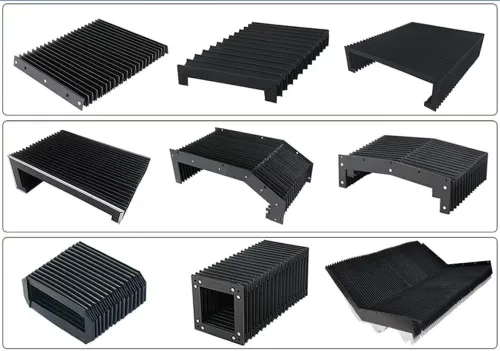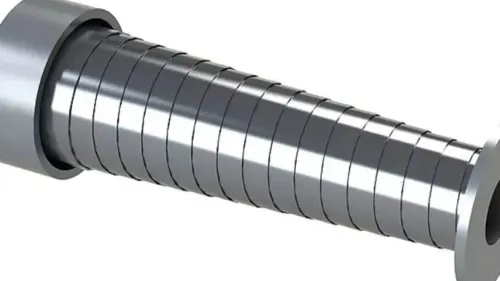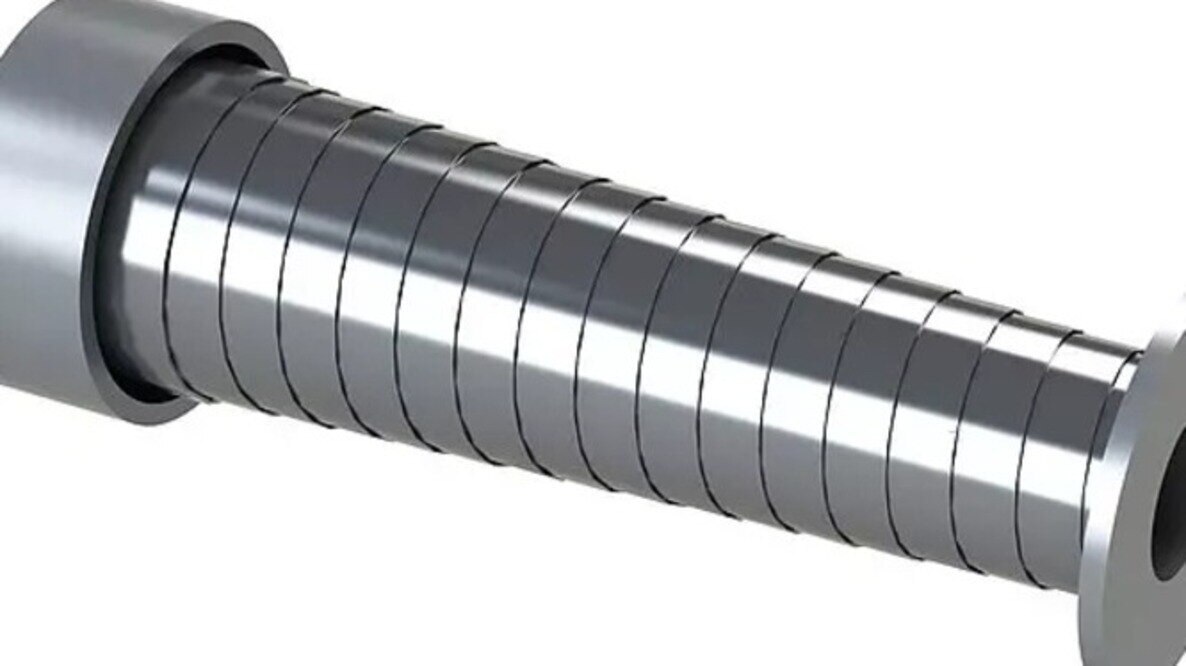
The correct cover depends on motion geometry, contamination, installation space and axis dynamics—not on the machine’s name or nominal travel alone. You will be able to select the suitable design, reject unsuitable options, and prepare a quotation request with the dimensions and operating data a supplier needs.
Key takeaways
- Use spiral spring covers for rotating shafts and tight axial spaces.
- Use telescopic steel covers for linear guideways exposed to chips and coolant.
- Give suppliers travel, closed length, open length, width and mounting details.
- Compare steel, stainless steel, bellows and wipers against your contamination and duty cycle.
Match the cover to the machine’s motion
Choose a spiral spring cover for a rotating shaft or a compact, mostly axial movement where installation space is tight. Choose a telescopic steel cover for a linear CNC guideway exposed to chips and coolant; its overlapping boxes provide rigid shielding that a wound strip cannot replace.
| Option | Choose it when | Do not choose it when |
|---|---|---|
| Spiral spring cover | The protected shaft, slide, or guideway needs compact coverage and the strip can extend and retract along its axis | Large chip loads, heavy coolant flow, hot swarf, or a rigid sealed barrier is required |
| Telescopic steel cover | A straight linear axis needs rigid protection from chips, coolant, and impact | Mounting faces are misaligned, end clearance is insufficient, or the axis has unsuitable lateral movement |
| Neither | The contamination or motion calls for bellows, roll-up, or apron protection | Selecting by stroke alone would hide a geometry or duty-cycle problem |
For a spiral spring, submit fully compressed length, maximum extension, outside and inside diameters, strip width, spring direction, mounting method, and allowable speed. Axis travel alone cannot verify fit or spring life.
For a telescopic cover, provide closed and extended lengths, box height and width, mounting-face tolerances, support points, end clearances, speed, acceleration, jerk, reversal frequency, and orientation. Parallel, stiff mounting surfaces are essential; misalignment causes rubbing, scraper wear, high drive load, and early failure.
Treat “spiral spring or telescopic cover for cnc machine builders in hyderabad” as a sourcing question, not a selection rule.
Let the contamination and duty cycle decide
Dry aluminium chips and light dust place less stress on a cover than abrasive cast-iron dust, flood coolant, or hot stainless-steel swarf. Match the protection to the contaminant, then check whether the axis repeats short strokes all day or makes long, fast travel; heat and duty cycle determine scraper life, spring fatigue, and drainage needs.
| Contamination or motion | Better choice | Reason and warning |
|---|---|---|
| Dry chips, light oil mist, rotating shaft or compact slide | Spiral spring cover | Its wound strip fits tight spaces and moving shafts. Confirm extension speed, spring direction, and clearance. |
| Heavy, sharp, hot chips on a linear guideway | Telescopic steel cover | Overlapping boxes deflect impact and carry chip loads. Add correctly rated scrapers and drainage. |
| Abrasive cast-iron dust or grinding dust | Enclosed telescopic system with suitable wipers | Dust works into joints and wears ordinary scrapers quickly. A cover alone is not a seal. |
| Welding sparks or extreme radiant heat | Neither as a standard choice | Use spark-resistant, heat-rated protection designed for the measured temperature and exposure. |
For a spiral spring cnc machine cover in hyderabad, do not submit axis travel alone. Give the supplier:
- Fully compressed length, maximum extension, outside and inside diameters, strip width, mounting points, spring direction, and allowable speed
- Axis orientation, stroke frequency, acceleration, operating temperature, coolant type, chip shape, and expected hours per shift
- Clearance around the shaft or guideway, plus the cleaning interval and scraper replacement plan
If coolant pools, the drainage path matters as much as the material. A rigid cover still leaks when its wipers, overlaps, or drains are poorly matched.
Submit the geometry a supplier must verify
Travel length alone cannot produce a reliable quotation. Submit the protected component’s size, movement envelope, mounting geometry, operating profile and available clearance; otherwise the cover may fit the stroke but bottom out, rub, or lose spring life.
- For a spiral spring cover, provide fully compressed length, maximum extension, outside diameter, inside diameter, strip width, spring direction, mounting arrangement and allowable travel speed.
- For a telescopic cover, provide closed length, extended length, box height and width, fixing-hole pattern, mounting-face tolerances, intermediate support points and clearance at both ends.
- For every axis, state travel, maximum speed, acceleration, jerk, reversal frequency, orientation, duty cycle, guideway or shaft dimensions, and the distance available around the moving assembly.
- Attach the machine and installation drawings, showing fixed and moving reference points. Specify chips, coolant, oil mist, grinding dust, sparks or hot material because scraper and drainage geometry depend on the contamination.
| Option | Geometry and motion inputs to verify | Consequence of missing data |
|---|---|---|
| Spiral spring cover | Axial stroke, compressed and extended lengths, diameters, strip width, direction and mounting | The spring can bind, overextend or fatigue before the axis reaches its limit |
| Telescopic steel cover | Closed and extended lengths, box dimensions, parallel mounting faces, supports and end clearances | Boxes can rub, scrapers wear unevenly, or the cover can bottom out |
| Both designs | Speed, acceleration, jerk, orientation, reversals and duty cycle | Nominal rapid-traverse speed hides vibration, guide loading and service-life problems |
For telescopic cover CNC builders in Hyderabad, treat “spiral spring or telescopic cover for CNC machine builders in Hyderabad” as an RFQ geometry question, not proof that either design suits the machine.
Compare covers with the alternatives and their materials
Choose a telescopic steel cover for a linear CNC guideway facing heavy chips; choose a spiral spring cover for a rotating shaft or a narrow mechanism where compact retraction matters. Neither is a universal substitute for the other.
| Option | Material and construction | Best comparison point |
|---|---|---|
| Telescopic cover | Overlapping steel boxes, often painted steel or stainless steel | Handles sharp, hot chips and impact, but needs parallel, stiff mounting surfaces, accurate alignment, scrapers and drainage. It is not automatically coolant-tight. |
| Spiral spring cover | Wound spring steel or stainless-steel strip | Fits rotating shafts and tight envelopes; limited protection against heavy chip piles, impact and abrasive grinding dust. |
| Bellows | Coated fabric, polyurethane, PVC, neoprene or multilayer textile | Covers irregular or long linear travel with low mass; punctures and burns more easily than steel. |
| Roll-up cover | Fabric, coated textile or interlocking slats | Suits compact linear protection and moderate contamination; check slat impact resistance, curling space and coolant compatibility. |
| Apron cover | Hinged steel or stainless-steel slats | Carries chip loads on broad horizontal or vertical ways; requires space for return movement and careful hinge maintenance. |
| Wipers | Polyurethane, rubber, felt or bronze elements | Scrape residue from an existing cover or way; they are wear parts, not a complete enclosure. |
| Exposed ways | No protective cover | Acceptable only where chips, dust, coolant and impact cannot reach the guideway; otherwise contamination becomes a maintenance problem. |
Check orientation before choosing. Horizontal, vertical, inverted and inclined installations change gravity loads, scraper pressure, drainage and retraction force. Do not use a telescopic cover to correct misaligned machine ways; rubbing boxes and uneven overlap will destroy scrapers and raise drive load.
Turn the specification into a dependable local purchase
Choose the machine protection supplier in Hyderabad that can prove fit, operating life and maintainability—not one that quotes only sheet thickness and axis travel. A dependable purchase starts with a drawing review and ends with documented acceptance checks.
- Request a dimensioned approval drawing showing fully compressed and extended lengths, cover mass, closed-length ratio, mounting faces, fixing holes, box height and width, shaft or guideway clearance, end clearances, intermediate supports and thermal-expansion allowance.
- For a spiral spring cover, verify inside and outside diameters, strip width, spring direction, mounting arrangement, maximum extension, allowable speed and acceleration. For a telescopic steel cover, verify overlap, travel, orientation and clearance at both ends; a stroke match alone will not prevent bottoming out.
- Demand test evidence using representative coolant, oil mist, chips, abrasive dust and operating temperature. The report should record maximum speed, acceleration, cycle count, drainage performance and scraper sealing, rather than simply stating “tested.”
- Ask how scrapers are replaced, how the cover opens for service, where coolant drains, and whether maintenance requires removing the cover from the machine.
- Confirm stocked spare scrapers, springs, wipers, seals and fasteners, plus lead times, replacement drawings and a named service contact in Hyderabad.
- Put axis travel, duty cycle, orientation, contamination, envelope limits and inspection documents into the RFQ. Compare the same checklist with SCUTES INDIA PRIVATE LIMITED and other suppliers.
Reject any offer that cannot show revision-controlled drawings, inspection records and a spare-parts route. If thermal growth can alter alignment, require a mounting detail that allows movement instead of transferring expansion loads into the guideway.
Related products
 | TELESCOPIC SPRING COVER Telescopic Spring Covers provide protection under extreme conditions. View product → |
 | TELESCOPIC COVERS A telescopic cover protects guide-way surfaces and components of moving axis of machines. View product → |
Frequently asked questions
When should CNC machine builders choose a spiral spring cover?
Choose a spiral spring cover for a rotating shaft or compact axial movement where installation space is limited.
When is a telescopic steel cover better for a CNC machine?
Choose a telescopic steel cover for a linear guideway exposed to chips and coolant because overlapping boxes provide rigid shielding.
What geometry details must you submit to a cover supplier?
Submit travel, closed and extended lengths, width, height, mounting arrangement, clearance, guideway dimensions and interference points.
Which alternatives should you compare with spiral and telescopic covers?
Compare bellows, wipers and different steel grades against chip size, coolant exposure, heat, speed, vibration and duty cycle.