
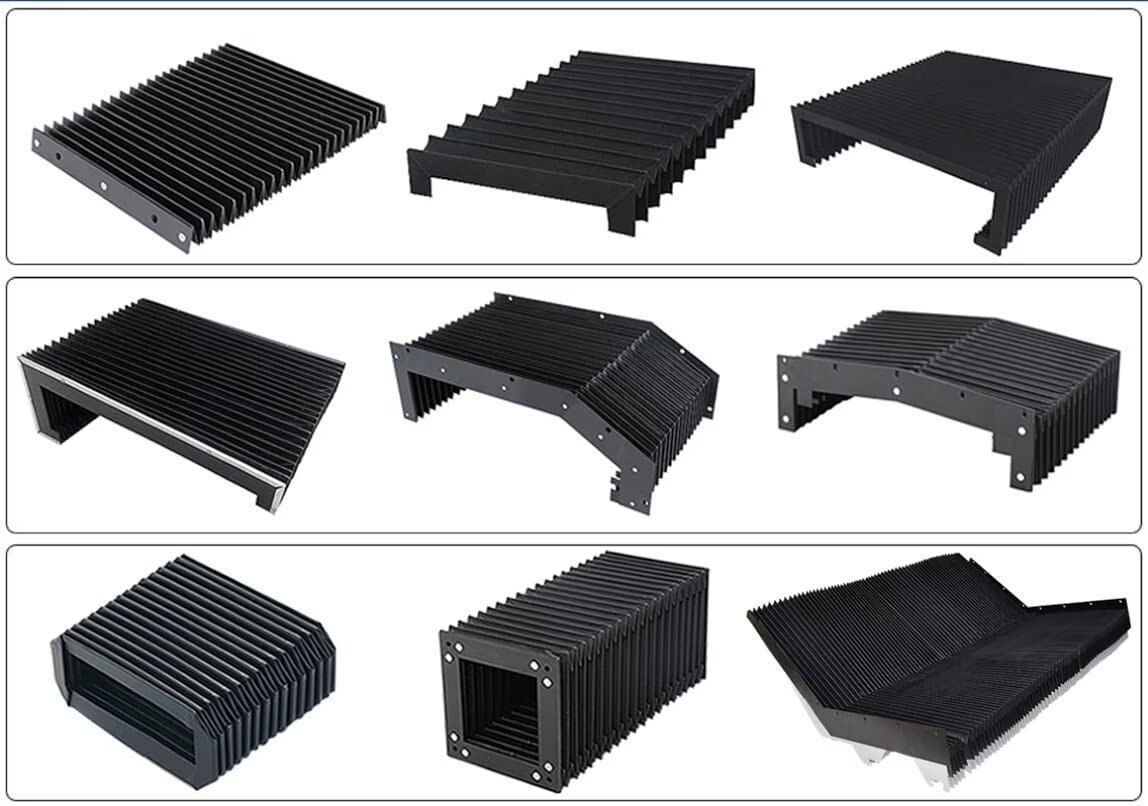
A leather bellow usually leaks because a fold, seam, joint, or mounting edge opens under movement—not because the cover is a pressurised fluid seal. You can narrow down the failure by inspecting the bellow in motion, separating leather damage from adjacent mounting leaks, and matching any replacement to the machine’s actual travel, clearance, and exposure conditions.
Key takeaways
- Check clamps, end frames and adjacent seals before replacing the bellow.
- Inspect folds and seams through the machine’s complete movement range.
- Protect leather from heat, dust, coolant and wash-down water.
- Replace the bellow only after measuring its full movement envelope.
Find out whether the bellow or its mounting is leaking
A leather bellow leaking in Dubai is not automatically a failed leather cover. Coolant, chips, dust or wash-down water can enter through a cracked fold, but the source may instead be a loose clamp, failed adhesive joint, gap in the end frame, adjacent seal or leaking machine enclosure.
Clean the bellow, dry it completely and trace the path of the contaminant. Then inspect it in these positions:
- Fully extended, where overextension can open splits at the first and last folds.
- Fully compressed, where cracked valleys, trapped chips and rubbing marks become visible.
- Mid-stroke, while moving the cover slowly by hand or through a controlled machine cycle.
- Against a bright light, checking for pinholes or a visible light path through the leather.
- At each stitched seam, bonded joint and clamped mounting edge, flexing the leather by hand.
A leak that appears only during travel points to a fold crack, puncture, abrasion point or incorrect installation. A wet line that begins outside the bellow points to the mounting or nearby enclosure instead. Check whether the frame sits square, the clamps are tight and the bellow rubs, twists or bottoms out at either end.
Mark the first wet or illuminated defect before repairing anything; sealing the wrong area will hide the real entry path.
Inspect the folds, seams and motion envelope for failure
A leak or loss of movement usually comes from damage that opens only during travel. Clean and dry the bellow, then inspect it fully extended and fully compressed; a relaxed cover can hide cracks in valleys, first and last folds, stitched seams and the leather-to-frame transition.
- Flex each fold by hand and look for cracking, pinholes, thinning, shiny abrasion or a visible light path through the leather.
- Check whether stitching has pulled apart, adhesive joints have lifted, or chips have punctured the cover.
- Watch for folds that rub, bunch, bottom out or reverse direction because of incorrect installation, excessive stroke or a displaced frame.
- Inspect clamps, fasteners and mounting plates. Corrosion, looseness or a gap at the mounting edge can imitate a leather leak.
- Run the machine through its normal travel while observing the suspected area. Do not pressure-test the cover like a hose; use normal motion and, if needed, a controlled low-pressure or non-destructive method agreed with the maker.
| Defect | What you see | What happens during operation |
|---|---|---|
| Cracked fold or valley | Split opens when flexed | Leak and reduced travel |
| Split stitching | Loose thread or separated seam | Gap enlarges under motion |
| Puncture or abrasion | Hole, thin patch or shiny wear | Dust, coolant or chips enter |
| Failed clamp or adhesive joint | Edge lifts or frame has corrosion | Apparent bellow leak at the mounting |
| Overextension or misalignment | Wrinkling, rubbing or bottoming out | Stiff movement and early failure |
These inspection points address recurring leather bellow problems in dubai without assuming thicker leather will fix a geometry or mounting fault.
Understand how Dubai exposure changes leather flexibility
A bellow that feels stiff after a summer shift has not necessarily become too thin: Dubai exposure can pull oils and finishing agents from leather, change its dimensions, and make folds crack during travel.
Direct sunlight adds ultraviolet damage. UV breaks down surface finishes and fibres, while high heat accelerates drying and thermal ageing. Repeated movement between a hot machine space, air-conditioned air and humid wash-down conditions drives expansion and contraction; the finish loses cohesion, then fine cracks open when the bellow compresses.
- Dust and sand work into folds as abrasive paste. They increase friction, scour the finish and force grit into stitch holes.
- Humidity and condensation soften leather temporarily, then leave it unevenly dry. That cycle can swell edges, loosen adhesive joints and promote mildew-related deterioration.
- Coolant and oil can extract or contaminate finishing compounds. A bellow may become swollen, sticky or brittle rather than simply wet.
- Alkaline cleaners, solvents and aggressive wash-down chemicals attack dyes, coatings, adhesives and thread. Rinsing does not reverse chemical damage.
These mechanisms create leather bellow flexibility problems through over-flexing, fold stress and loss of tear strength. Do not add an unknown oil: identify the leather finish and chemical compatibility first. If exposure exceeds leather’s resistance, compare coated fabric, polyurethane or neoprene; thicker leather alone can restrict folding and increase stress.
Decide between conditioning, repair and replacement
Clean and condition a leather bellow only when contamination or surface drying is the problem and the leather remains continuous, supple and structurally sound. Use a cleaner and conditioner approved for that leather tannage and finish; do not add an unknown oil, because it can weaken adhesive joints, swell fibres or attack the coating.
A compatible repair is reasonable when damage is localised and the surrounding leather passes inspection in both travel positions. Use this checklist:
- Clean and dry the cover before judging it; dirt can hide pinholes and make folds appear stiff.
- Flex every fold by hand and inspect against light. A repair suits a short split, isolated puncture or failed seam with firm leather around it.
- Match the repair material, thread, adhesive and finish to the existing leather. “Oil-resistant” alone does not prove compatibility with coolant, alkaline wash fluid or solvent.
- Reject conditioning when cracks reopen during flexing, the surface flakes, or the leather stays hard after cleaning and controlled drying.
- Choose replacement when cracks cross several folds, holes multiply, stitching pulls through, adhesive has released over a long section, or the cover has lost its shape and minimum bend radius.
A thicker cover is not a cure for recurring leather bellow flexibility problems. It can increase fold stress when overextension, rubbing, chemical attack or incorrect mounting caused the failure.
For leather bellow replacement in Dubai, specify the exposure and movement limits as well as the leather construction, so the new cover addresses the cause rather than repeating it.
Measure the replacement against the machine’s full movement
Measure the bellow at full extension, full compression and every change of direction before ordering. A replacement that matches only the outside length and width can rub a guideway, invert a fold, bottom out at the stroke limit or fail at its seams.
Give the supplier a drawing or measured specification containing:
- Mounting datum, end-frame dimensions and the fixing method
- Open length, compressed length and total machine stroke
- Travel direction, speed, cycle frequency and acceleration
- Fold count, fold pitch and the required compression per fold
- Clearance from the bellow to rails, tooling, chips and adjacent guards at maximum compression
- Minimum bend radius and any offset or angled movement
- Cable, hose or duct movement inside or alongside the cover
- Leather construction, thickness, protective finish, thread and seam method
- Frame material, clamp details and whether the frame floats or remains fixed
- Contact with coolant, oil, alkaline wash fluid, solvent, disinfectant, UV, salt air and dust
Photograph the old installation with the machine fully open and closed. Mark the rubbing point, measure the gap at the tightest location and record whether a cable or hose pulls the folds sideways; thicker leather will not correct poor geometry.
For recurring leather bellow problems in Dubai, include hot-to-air-conditioned cycling, humid wash-down and chemical exposure in the specification. During a leather bellow replacement in Dubai, SCUTES INDIA PRIVATE LIMITED can use those operating details to avoid treating thickness as the only solution.
Frequently asked questions
How can you tell whether the leather bellow or its mounting is leaking?
Clean and dry the area, then inspect the bellow folds, seams, clamps, end frames, adhesive joints and adjacent seals while the machine moves. A gap at the mounting points indicates an installation or enclosure problem rather than a punctured bellow.
What leather bellow problems occur in Dubai conditions?
Heat, intense sunlight, airborne dust, coolant, oil and wash-down water can remove flexibility, dry the leather, swell it or damage seams. Check for hard folds, cracking, surface shrinkage, loose stitching and contamination.
When should you condition, repair or replace a leather bellow?
Condition the leather when it is dry but structurally sound. Repair a local seam, hole or mounting fault when the surrounding folds remain flexible. Replace it when cracking, stiffness, distortion or repeated leakage affects the full movement range.
What must you measure before a leather bellow replacement in Dubai?
Measure the closed and extended lengths, folded height, width, mounting-hole pattern, frame dimensions, travel direction, clearance and the machine’s complete motion envelope. Check the measurement with the bellow fully compressed and fully extended.