
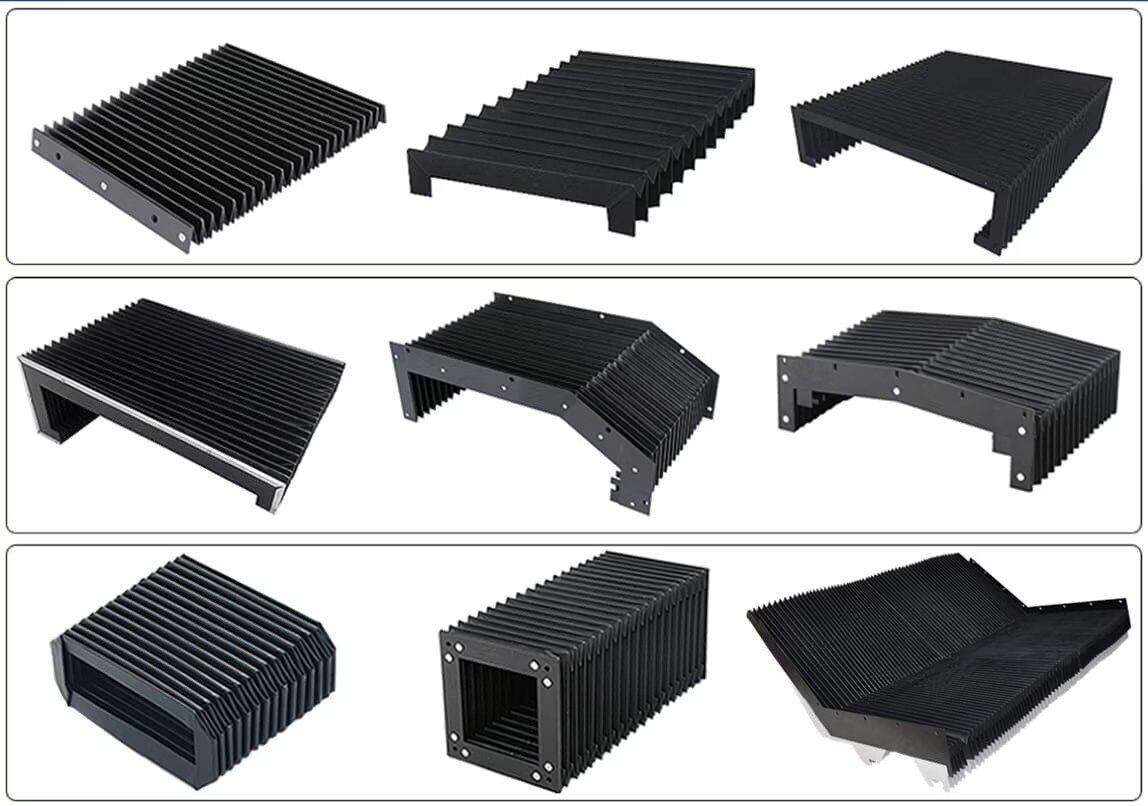
A scissor lift cover must follow a changing, crossing mechanism while resisting sand, ultraviolet exposure, water, oil and accidental contact. By the end, you will know which cover design fits your lift, which measurements and material questions to give a manufacturer, and how to test the finished assembly safely.
Key takeaways
- Map the lift’s full lowered-to-raised motion envelope before ordering.
- Measure length, folded height, clearance and skew at both travel limits.
- Specify fabric, seals and resistance to Dubai heat, dust, oil and coolant.
- Require dimensional checks and full-stroke testing before accepting the cover.
Start with the lift’s hazards and complete motion envelope
A cover that fits only at the lift’s parked height can bind, tear or expose the mechanism during a full stroke. Specify the scissor lift bellows around the complete motion envelope: minimum and maximum length, folded height, lateral expansion, arm clearance, platform travel, emergency lowering, and any twisting or side-to-side skew.
The scissor lift cover must shield:
- Crossed arms, pivots and moving joints from wind-blown mineral dust and sand
- Hydraulic components and lubrication points from water, oil and grease
- The mechanism from welding debris, chips and dropped objects
- Workers from contact with accessible pinch points
Protection must not create a new hazard. The cover must preserve operator visibility, access to controls, emergency descent, inspection and lubrication points, and the rated platform and load configuration.
A fixed-size rectangular sleeve is inadequate because the arms change angle as they open. Unequal movement on the left and right sides can pull one continuous cover sideways, causing folds to catch, fasteners to shear or fabric to rub against the arms.
Use a custom-fabric industrial bellows as the starting point for most outdoor lifts; it can accommodate changing footprint, stroke, folded height and mounting geometry better than a molded rubber accordion with fixed diameters and compression ratios.
Treat the installation as a machine modification. Attach the bellows to dedicated stationary and moving frames or clamp rails, not directly to load-bearing arms, unless the lift manufacturer approves the method. In Dubai, include ultraviolet exposure, high ambient temperature and airborne dust in the design review.
Match the cover design to the movement you need to shield
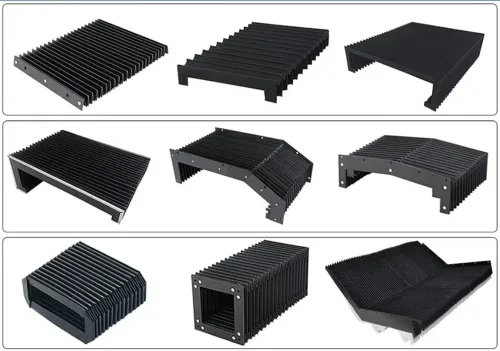
A scissor lift cover must follow the part that moves, not simply surround the lift at its widest point. Use a custom fabric bellows cover for outdoor lifts when the arms change angle, the folded height is tight, or the footprint expands sideways; fixed-diameter molded rubber covers rarely accommodate those changes.
| Design | Coverage geometry | When it fits |
|---|---|---|
| Accordion bellows | Encloses crossed arms between stationary and moving frames | Protecting the full arm mechanism through its stroke |
| Skirt-style bellows | Hangs around the platform perimeter or base | Blocking falling debris without enclosing every arm |
| Multi-sided enclosure | Covers the base, arms and platform-facing sides | Containing hazards around a broad working envelope |
| Segmented or guided bellows | Uses separate left/right sections or articulated panels | Handling unequal side travel, twisting or arm-angle changes |
A single rectangular sleeve can bind when the two scissor sides do not rise identically. Choose separate bellows, articulated sections or guided rails when one side leads, skews or twists during travel.
Mount the bellows cover to dedicated stationary and moving frames or clamp rails. Do not drill or weld into load-bearing arms without an engineering review; the alteration can damage corrosion protection, compromise structure and put fasteners inside a pinch zone.
Check every pleat, strip and fastener through raising, lowering, emergency descent and any platform movement. Keep the operator’s view, controls, inspection points, lubrication access and rated load configuration clear. A static fit at the lowered position proves almost nothing.
Measure the lift at both lowered and raised positions
Measure the lift at full mechanical lowering and full rated elevation, then repeat the check during intermediate travel. Record the cover envelope, not just the platform height: crossed arms can skew, twist or approach each other as their angle changes.
| Position | Measurements to record | Why it matters |
|---|---|---|
| Lowered | Overall length and width, folded height, mounting-face dimensions and hole pattern | Sets the minimum package and attachment geometry |
| Raised | Overall length and width, extended height and platform travel | Sets the maximum envelope and required stroke |
| Throughout travel | Arm, pivot, roller and joint clearances; lateral expansion; smallest bend radius | Prevents binding, shearing and pinch points |
Also record the number of folds, fold pitch, emergency-lowering position and any left-right difference in arm movement. A single measurement at the bottom can produce a bellows cover that stretches too far at the top or collapses into the mechanism.
Check every proposed attachment strip, fastener and pleat against the moving arms and rollers. Keep the cover clear of inspection, lubrication and hydraulic-service points, controls, emergency descent access and the operator’s sightline. Test the clearance with the platform carrying its rated load configuration; deflection can reduce the gap.
Give the supplier marked drawings or photographs showing both end positions, intermediate interference points, fixed and moving mounting faces, and the minimum clearance in millimetres. If the two sides travel differently, specify separate left and right sections or guided movement instead of assuming one rectangular scissor lift bellows will track correctly.
Specify Dubai-ready fabric, sealing and exposure resistance
Specify a coated fabric for a bellows cover for scissor lifts in Dubai, not merely “rubber” or “industrial bellows cover.” Outdoor service combines ultraviolet light, high ambient temperature, wind-blown mineral dust, rain and wash-down water.
| Material | Strength and limitation | Ask the supplier |
|---|---|---|
| UV-stabilized coated polyester | Flexible, abrasion-resistant and suited to custom pleats | Confirm coating type, fabric mass, UV test basis and seam life |
| TPU-coated fabric | Good flexibility and resistance to abrasion, oils and water | Confirm continuous and peak temperature limits |
| Neoprene-coated fabric | Useful against abrasion, oils and weathering | Request compatibility data for hydraulic oil, grease and cleaning chemicals |
| Silicone-coated fabric | Handles higher temperatures and resists weathering | Confirm tear strength, abrasion life and chemical limits |
Put these points into the request for quotation:
- State the continuous and peak temperature at the cover, including heat from hydraulic components, and require the usable range for the exact fabric, coating and seam construction.
- Name each exposure: hydraulic oil, grease, detergent, solvent, welding sparks, sunlight, coarse sand and fine dust. Ask for resistance evidence rather than a general “chemical resistant” claim.
- Specify rain protection, hose wash-down pressure and the required water-exclusion level separately. Do not accept an IP rating unless the assembled cover, seams, mounting interface and adjacent openings were tested under IEC 60529.
- Require abrasion-resistant pleat faces, protected closures and no sand-trapping horizontal ledges. Confirm mounting, replacement-panel availability and the expected number of full lift cycles.
Turn the specification into a safe supplier and acceptance test
A cover that fits when the lift is lowered can bind, tear, or pull out when the arms change angle. Treat an industrial bellows cover as a machine modification, not a cosmetic accessory.
Put these items in the request for quotation:
- Exact fabric construction, coating, mass or thickness, operating-temperature range, UV-stability evidence, abrasion rating, flame and chemical resistance
- Seam type, attachment method, fastener specification, mounting-face dimensions and replacement-panel availability
- Required folded height, stroke, fold pitch, clearance, left/right separation or guided sections where the mechanism moves unevenly
- Target number of complete lift cycles, inspection intervals and the agreed acceptance criteria
- Protection and access requirements for controls, inspection points, lubrication points, emergency descent and the rated platform/load configuration
For a bellows cover for scissor lifts in Dubai, ask the supplier to identify the tested fabric, coating and seam combination—not just quote “outdoor” material. Confirm resistance to ultraviolet exposure, high ambient temperature, wind-blown mineral dust, water, hydraulic oil and grease.
During installation review, cycle the unloaded lift slowly and check every fold, fastener and edge for rubbing, trapping, sharp contact or reduced visibility. Repeat with the rated load only under the lift manufacturer’s approved procedure.
The acceptance test must use repeated full-stroke cycles with the cover fitted. Record pleat inversion, seam tearing, fastener pull-out, trapped sand, interference with emergency lowering and access loss; SCUTES INDIA PRIVATE LIMITED should receive the same documented criteria if it is quoting the cover.
Frequently asked questions
What hazards must a scissor lift bellows cover protect against?
Assess dust, sand, coolant, oil, chips, heat, pinch points and mechanical contact across the complete lift motion envelope.
How do you match a bellows cover to scissor lift movement?
Specify the cover for vertical travel, folding, lateral expansion, arm clearance, twisting, side-to-side skew and emergency lowering.
What measurements are needed for a scissor lift bellows cover?
Record minimum and maximum cover length, folded height, width, attachment points and clearances with the lift fully lowered and raised.
What should a Dubai-ready scissor lift cover specification include?
Name the fabric, operating temperature range, sealing method and resistance requirements for heat, dust, oil, coolant and abrasion.
How do you test a bellows cover before accepting it?
Check dimensions, attachment security, clearance and sealing, then cycle the lift through its full stroke and emergency-lowering position.