
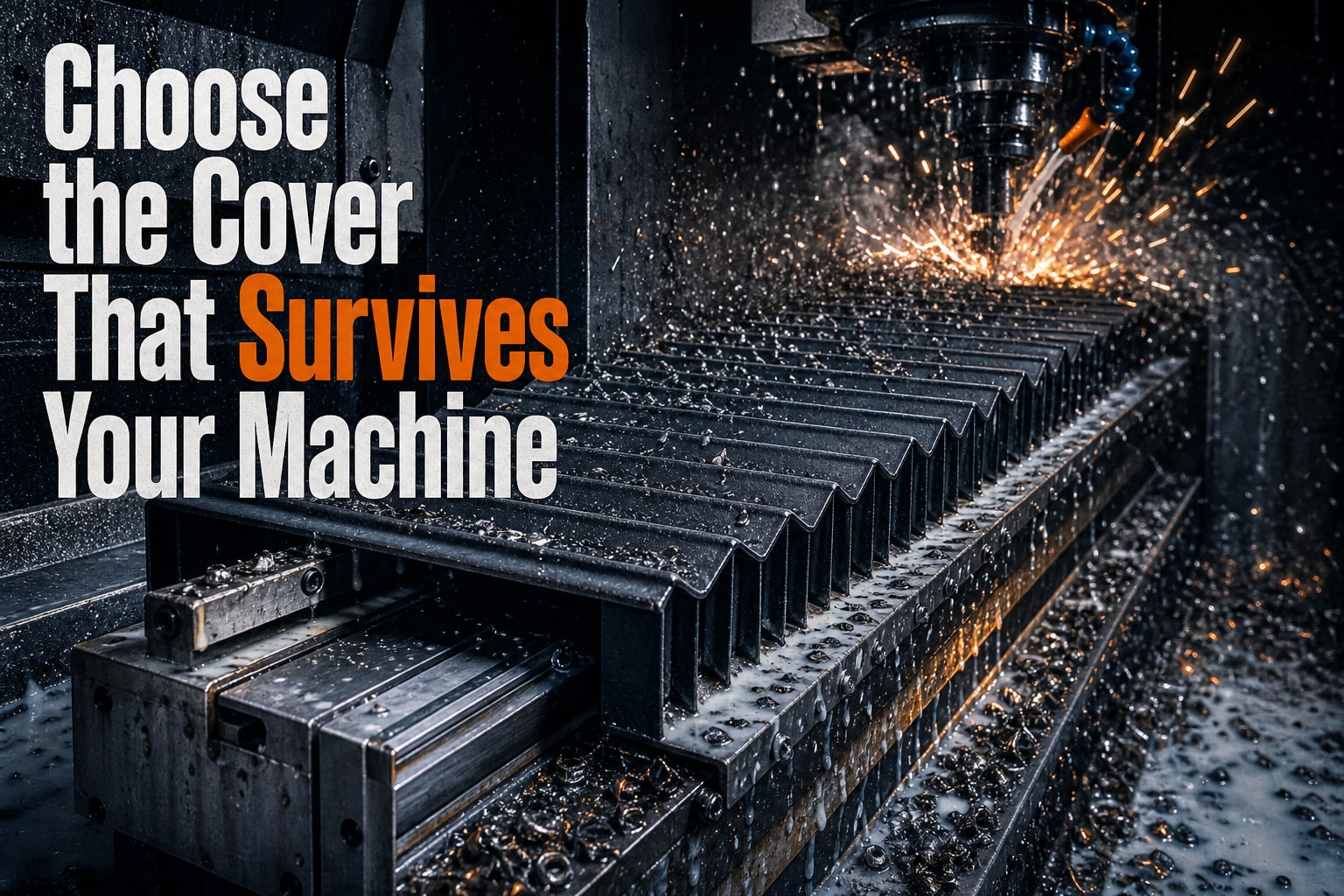
The right choice depends on more than whether a machine axis is horizontal or vertical: swarf impact, cover movement, folded height, speed, sealing and available clearance all change the answer. By the end, you will be able to match an apron or bellows to the axis geometry, define the dimensions and materials, and reject a design that will bind, sag, leak or wear prematurely.
Key takeaways
- Choose apron covers for guided sliding or rolling protection across exposed surfaces.
- Choose bellows when compact folded sections must expand along an axis.
- Specify chip size, coolant, sparks, dust, temperature and cleaning method.
- Check stroke, folded height, guides, clearances and mounting points before approval.
Start with the hazard and the way the cover moves
Choose between apron covers versus bellows by matching the hazard to the way the cover moves. An apron rolls or slides across a guided surface, while a bellows expands and compresses through folds.
| Option | What it means | When it applies |
|---|---|---|
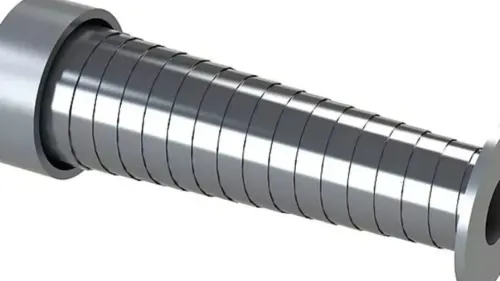
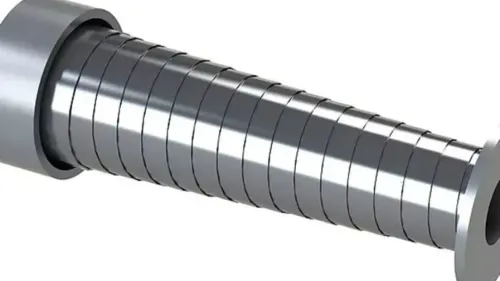
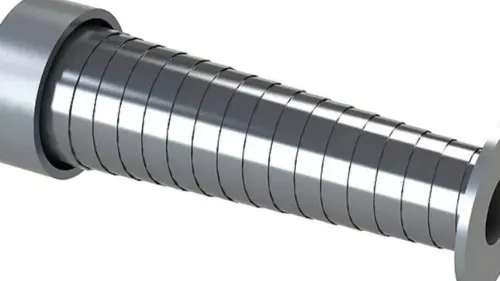
| Apron cover | Interlocking steel slats travel along a guided path | A relatively straight machine way faces heavy, sharp or hot swarf |
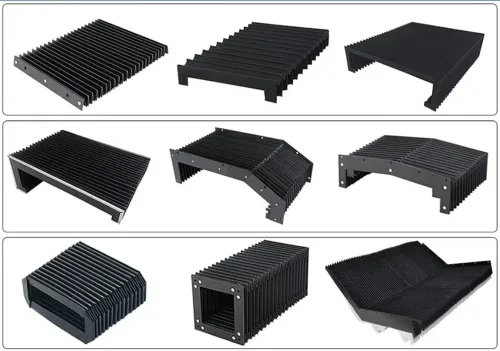
| Bellows | Folded material follows the protected shape | The path changes width, has a non-rectangular cross-section, requires compound movement or needs a compact folded package |
Choose an apron for severe swarf because steel slats resist impact and abrasion better than ordinary coated fabric. Do not use one where a tight reverse bend, small pulley or substantial lateral misalignment could bind the slats or damage their hinges.
An apron is not automatically sealed. Slat overlap, hinge condition, side guides, wipers, end seals and slat-joint orientation determine whether coolant and fine abrasive dust enter.
Choose bellows when the cover must follow contours that rigid slats cannot negotiate without articulated sections or extra guiding hardware. Check the machine envelope: pleat depth, fold radius and construction determine the compressed length, so a short-looking bellows can consume space at both ends.
A bellows is not automatically liquid-tight. Specify the ingress requirement and test method; inspect seams, corner transitions, mounting frames and fold abrasion rather than accepting the word sealed.
Use axis direction, stroke and folded height to narrow the choice
Choosing apron covers versus bellows starts with direction, cover speed, acceleration and the machine’s available folded-height envelope—not stroke alone. Use a guided apron for a straight horizontal guideway with room for rolling, folding or telescoping; use bellows for vertical axes, columns, spindles, inclined axes and irregular geometries that need flexible attachment or contour following.
| Option | Movement and suitable geometry | Installation limits |
|---|---|---|
| Guided apron | Rolls, folds or telescopes along a straight horizontal guideway | Needs clearance for its return path; cannot make a tight reverse bend, pass around a small pulley or tolerate major lateral misalignment |
| Bellows | Expands and compresses through folds around vertical, inclined, compound or non-rectangular paths | Follows contours and accepts flexible mounting, but deep pleats can consume substantial space at one or both ends |
Compare the required closed length and extended length with the machine envelope. The stroke is the difference between those positions, but selecting from stroke alone can leave no room for the compressed package, end frames or movement beyond the nominal travel.
A deep-pleat bellows needs space for its minimum fold radius and construction thickness. Measure that folded height at the actual mounting points, then check the extended dimension against the full axis travel.
An apron also needs support and clearance along its entire return route. Steel slats add moving mass, so high speed and acceleration increase reversing loads, guide wear and sag; check those values before choosing an apron for a long or fast stroke.
Match construction to chips, coolant, sparks and abrasive dust
Choose apron covers versus bellows by matching construction to the contamination, not by material name alone. Heavy, sharp or hot swarf favours an apron with interlocking steel slats; aluminium slats reduce moving mass but need suitable thickness and overlap to resist impact without accelerating hinge wear.
| Option | Construction | Best fit and trade-off |
|---|---|---|
| Steel apron | Interlocking steel slats, side guides, wipers and end seals | Welding spatter, hot chips and abrasive swarf; durable but adds moving mass, reversing loads and guide wear |
| Aluminium apron | Overlapping aluminium strips with protected hinges | Lower mass for faster axes; thinner slats or small overlaps reduce impact resistance and increase joint wear |
| Fabric bellows | Coated fabric over internal frames, with mounting flanges and defined folds | Coolant, dust and protected guideways; flexible and compact, but ordinary fabric is poor against sparks and hot chips |
| Reinforced bellows | Heat-resistant or spark-resistant fabric with metal lamellae | Direct thermal or abrasive exposure; improves protection while reducing flexibility and folded compactness |
Ordinary fabric bellows can burn, puncture or embed grinding debris when welding spatter, grinding sparks or hot chips strike directly. Specify fabric temperature limits for the actual duty cycle; reinforcement does not remove that requirement. Fold geometry, internal frame spacing and mounting-flange stiffness also determine whether folds buckle, rub or pull away.
For fine dust, coolant mist or washdown, specify drainage paths, sealed end frames, pressure-sensitive leakage points, accessible cleaning surfaces and wiper contact. Test the complete cover system with representative contamination, because an apron can admit fluid through slat joints and worn seals.
Neither construction is a personnel guard or structural walkway unless separately load-validated. Safety guarding and access prevention require their own risk assessment.
Check the complete envelope before approving the design
Check the complete envelope before approving the design: measure the cover at both closed and extended positions, not from travel length alone. Record:
- Closed length, extended length and folded height.
- Overall width and height, bend radius, and side clearance.
- Mounting-point locations and end clearances at both ends.
Check interference at both ends and at every position across the full stroke. Move the axis through its complete travel with access panels, tool changers, cable carriers, lubrication lines and nearby guards installed; a cover that clears at its endpoints can still collide mid-stroke.
Compare the dynamic risks in apron covers versus bellows before selecting construction:
| Factor | Apron cover | Bellows |
|---|---|---|
| Cover mass | Heavy steel increases acceleration force, reversing loads and guide wear | Lower mass reduces axis loading, but confirm the actual assembled mass |
| Unsupported span | Check support spacing and allowable sag | Check compression stability and allowable sag |
| Movement damage | Inspect slat hinges, overlaps and vibration | Check fold fatigue, corner abrasion and vibration |
Specify cover mass, travel speed, acceleration, support spacing and allowable sag together. A long unsupported apron can sag into the way; an over-compressed bellows can buckle or fatigue at its folds.
A cover over a cable carrier does not replace cable bend-radius, support or strain-relief requirements. Keep power and data cables within the carrier manufacturer’s specified radius and separation; the cover provides environmental shielding, not cable support or dynamic load carrying.
Write a purchase specification that survives real machine service
Choose apron covers versus bellows by writing the operating duty into the purchase specification, not by accepting a generic “sealed” label. Compare suppliers against the same machine data and require a representative contamination test.
| Option | Strength | Main service risk |
|---|---|---|
| Apron cover | Low folded height and strong chip resistance on supported runs | Higher moving mass, slat-hinge wear and sag at high acceleration |
| Bellows | Low mass, flexible coverage and compact protection around irregular geometries | Pleat abrasion, seam leakage and greater compressed length |
State these requirements in the enquiry:
- Axis orientation, stroke, speed, acceleration, support arrangement and allowable sag.
- Chip temperature, chip size, abrasive dust, coolant or oil type, concentration and exposure frequency.
- Washdown method, nozzle pressure, water temperature and required ingress test method; specify the target IP rating only with its test conditions.
- Material temperature limit, wiper material and contact geometry, drain paths, mounting-flange dimensions, inspection access and replacement-part availability.
- Drawings showing compressed and extended dimensions, fold depth, slat thickness, hinge construction, unsupported-span limits and allowable bend radius.
Require the supplier to demonstrate drainage, end-frame sealing, wiper contact and leakage under representative chips, coolant and washdown. SCUTES INDIA PRIVATE LIMITED can help convert machine-envelope data and contamination duty into a cover drawing, but you must approve every stated limit and the test contamination.
Inspect for cracked or delaminated fabric, burned pleats, loose lamellae, damaged slat hinges, hardened wipers, blocked drains and loose fasteners. Replace the assembly when lost wiping contact lets contamination pass.
Related products
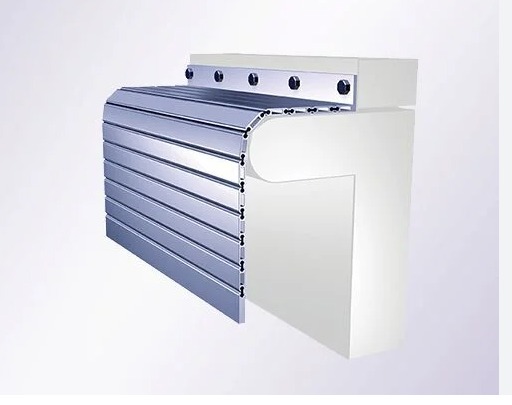 | APRON COVER Effectively engaged in offering a vast collection of outstanding quality products which include Apron Covers. View product → |
 | Laser Machine Bellows Laser Machine Bellows are specialized protective coverings designed to safeguard the vital internal components of laser machines. View product → |
Frequently asked questions
When should you choose apron covers instead of bellows?
Choose an apron cover when protection must roll or slide across a guided surface and the installation allows that movement.
When are bellows the better choice?
Choose bellows when the cover must expand and compress through folds along an axis, especially where compact folded height matters.
How do chips, coolant, sparks and abrasive dust affect the choice?
Match the construction and materials to the hazard: chip impact, liquid exposure, hot sparks and abrasive dust each demand different protective details.
What must you check before approving a machine-cover design?
Check axis direction, stroke, folded height, guides, mounting points, moving clearances and the complete envelope throughout the machine cycle.
What belongs in a purchase specification for an apron cover or bellows?
State the axis, travel, extension and folded dimensions, hazard types, temperature, cleaning method, mounting arrangement and service conditions.
Related product
 | SCISSOR LIFT BELLOWS Scissor Lift Bellows are one of the broadly demanded stabilizer for which we are considered an acclaimed designed in the market. View product → |