
A machine apron cover cannot be sized from the machine’s advertised axis stroke or overall casting width. You need measurements for the protected opening, full motion envelope, mounting faces, retracted package and any obstruction that the cover must clear. By the end, you will have a practical measurement schedule and drawing brief for requesting a suitable cover.
Key takeaways
- Measure the protected opening before using the machine’s nominal table size.
- Calculate cover length from full travel plus both mounting allowances.
- Record width, height and retracted envelope at the tightest clearances.
- Send a dimensioned drawing showing motion, mounting points and nearby obstructions.
Start with the opening, travel and mounting area
The machine apron cover dimensions required for a usable quote begin with the protected opening, not the machine’s nominal table size. Measure the opening width, the travel or stroke, and the fixed mounting area at each end of that movement.
| Measurement | Record | Do not substitute |
|---|---|---|
| Protected opening | Clear width and length exposed to chips or coolant | Casting or table width |
| Motion | Start and end positions, plus required travel | Maximum machine axis travel |
| Retracted package | Available height, depth and width at both ends | Extended cover size |
| Mounting area | Face dimensions, bolt pattern, guides and edge clearances | A flat mounting line |
Show the full motion envelope on a dimensioned drawing or CAD model. Include the minimum and maximum cover height, depth and width, guide or rail intrusion, and every obstruction. The rolled, folded or stacked apron must fit inside the compressed space; a cover with adequate stroke can still collide with the machine when retracted.
List these figures in the dimensional schedule:
- Opening width and required side overlap
- Extended and compressed lengths
- Mounting-face geometry and hole pattern
- Guide engagement, support rails and edge returns
- Maximum allowable compressed or retracted height
- Available clearance above, below and behind the apron
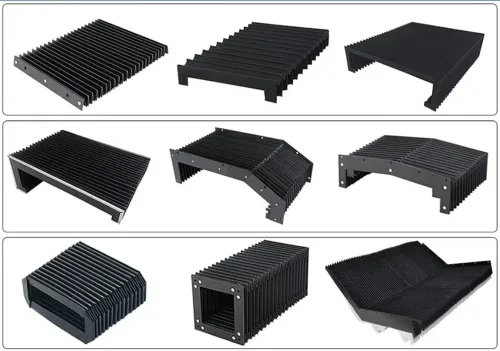
For a fabric or bellows-style apron, add fold depth, number of folds, mounting-frame size and minimum permitted fold radius. Fold depth changes the folded package, so do not leave it for the supplier to infer.
Calculate cover length from actual motion
Calculate required apron length from the movement the cover must seal, not from the machine’s nominal axis stroke. Measure the protected opening at its most exposed position, then at its least exposed position; include permitted overtravel and any service position. The difference is the actual cover travel.
Use this calculation:
- Required travel = maximum exposed opening position − minimum exposed opening position, including overtravel or service movement.
- Extended length = required travel + overlap beyond both stroke limits + end-attachment lengths.
- Add the bend, rolling or retraction allowance needed to keep the apron from pulling tight or lifting at either end.
For aluminium slat aprons, use the supplier’s effective slat pitch after slat overlap, not the nominal slat width. A guessed overlap can leave the cover short when the slats articulate.
Then check the retracted package. The cover’s compressed or stacked length must fit inside the available space at the end of travel, with clearance from the machine envelope. A cover can have sufficient extended travel and still collide when folded.
Record the minimum and maximum height, depth and width through the entire motion, not only the two end positions. These machine apron cover dimensions let the supplier check guides, edge returns, mounting attachments and the folded package against real machine geometry. Draw both travel limits and mark every overtravel or maintenance position.
Size the width, height and retracted envelope
The machine apron cover dimensions must describe the full moving envelope, not only the protected opening. Size the cover for its greatest lateral width and its minimum and maximum height and depth during travel; the guide system can extend beyond the apron itself.
Record these dimensions at both ends of movement:
- Protected opening width, plus the specified side overlap, guide engagement and edge clearance; do not substitute the machine table or casting width.
- Maximum and minimum cover width, including guide rails, edge returns, supports and any parts that project sideways.
- Cover height and depth when fully extended, including the space needed for guides and mounting hardware.
- Compressed height or depth when the apron is fully retracted; a rolled, folded or stacked package can enter a machine obstruction even when travel is correct.
- Mounting-face width, height, bolt pattern and usable clearance behind or beside the mounting face.
- Rolled diameter, folded stack height or slat-pack thickness, based on the actual slat thickness, pitch, overlap and minimum bend radius.
The retracted package is often the controlling dimension. Draw the available envelope at each travel limit and mark coolant lines, guards, tables, housings and service access; then compare those clearances with the extended and retracted cover.
Give the supplier this dimensioned drawing or CAD model with a schedule of maximum width, minimum and maximum height, depth, travel limits and mounting geometry. “Custom size” alone invites redesign.
Specify construction and mounting dimensions for a custom cover
A supplier needs custom machine apron cover dimensions for the opening, the moving path, the mounting faces and the cover’s construction—not just the machine’s nominal size. Provide a dimensioned drawing or CAD model showing fixed faces, guide locations, obstructions and clearance at both ends.
Construction details change the required package:
| Feature | Steel-slat apron | Bellows-style or fabric apron |
|---|---|---|
| Slat or fold data | Slat width, pitch or overlap, thickness, hinge design and end termination | Number of folds, fold depth, fabric thickness and end panels |
| Guide and mounting data | Guide-track width, depth, engagement, rail spacing and attachment-hole pattern | Mounting-frame width, height, flange dimensions and attachment-hole pattern |
| Retraction data | Minimum rolling radius, rolled diameter and compressed height | Minimum fold radius and compressed height; fold depth changes the folded package |
| Edge protection | Side returns and required overlap beyond the protected opening | Frame overlap, edge returns and sealing clearance |
Give the supplier a schedule containing:
- Protected opening width and height, measured at the actual gap rather than across the table or casting
- Extended and compressed lengths, cover width and height, available clearance above, below and beside the retracted cover
- Mounting-face width and height, bolt-hole centres, thread sizes, datum edges and allowable fastener access
- Guide-rail dimensions, lateral clearances, end stops and any interference from coolant lines, tooling or guards
- Operating temperature, coolant or oil exposure, chip load and required movement speed
“Custom size” without these figures often produces a cover that spans the opening but collides with the machine when retracted.
Send a drawing that makes the dimensions usable
Send a dimensioned installation drawing or CAD model, not a note saying “custom size.” The drawing makes custom machine apron cover dimensions usable by showing datums, tolerances, mounting faces and the space the cover occupies throughout its movement.
- Mark the protected opening separately from the surrounding casting, table or enclosure, and identify every datum used for measurement.
- Dimension the mounting face: width, height, flange thickness, bolt-hole diameters, hole centres, edge distances and the mounting direction—front, rear, top or underside.
- Show the fixed clearance at both ends of travel, including the height and depth occupied by a rolled, folded or stacked apron.
- Add guide or rail width, engagement depth, support surfaces, edge returns and every obstruction visible in the machine envelope.
- For a slat apron, specify slat width, pitch or overlap, thickness, joint detail, end termination and the minimum allowable roll radius.
- State a tolerance beside each critical dimension; do not leave fit-critical sizes as unspecified ± values. Identify inspection datums and mark dimensions that the supplier may confirm after selecting the construction.
- Complete the machine apron cover dimensions required schedule with travel speed, acceleration, cycle frequency, axis orientation, coolant or oil exposure, chip size, ambient temperature and cleaning method.
A section view is essential when the cover passes beneath a guard or into a recess. Giving SCUTES INDIA PRIVATE LIMITED that section view with the schedule lets the supplier check the compressed package, guide engagement and mounting hardware before fabrication.
Related product
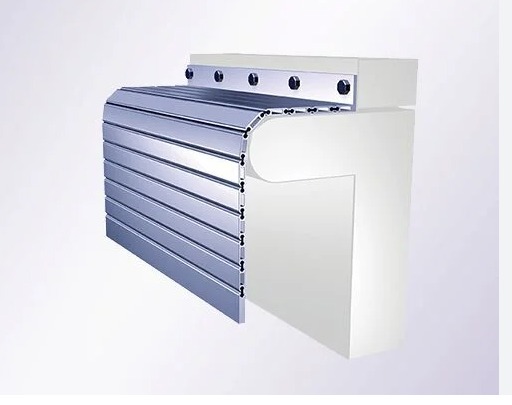 | APRON COVER Effectively engaged in offering a vast collection of outstanding quality products which include Apron Covers. View product → |
Frequently asked questions
What measurements are required for machine apron cover dimensions?
Measure the protected opening width, opening height, machine travel or stroke, and the fixed mounting area at both ends. Record nearby obstructions and the available retracted envelope.
How do you calculate the length of a machine apron cover?
Base the length on the actual movement the cover must protect, then add the mounting allowances and the space required for the cover when retracted.
Which width and height dimensions matter for a custom machine apron cover?
Specify the clear opening that needs protection, the cover’s available width and height, and the smallest surrounding clearance during extension and retraction.
What should a drawing for a custom machine apron cover include?
Show the protected opening, travel direction, extended and retracted positions, mounting faces, fixing-hole locations, end allowances, nearby obstructions and all key dimensions.