
A cover that matches axis travel can still collide with a drag chain, bottom out before full stroke, or fail under acceleration. By the end, you will have a measurement schedule, supplier-comparison checklist and acceptance-test brief for selecting a cover that fits the machine and remains serviceable.
Key takeaways
- Give closed and extended lengths, section dimensions, clearances and mounting references.
- Choose a drawing-based replacement when the existing cover fits and its geometry is documented.
- Match steel construction, guides, seals and overlaps to contamination, speed and acceleration.
- Specify acceptance tests, service life, repair access and lifetime cost before requesting quotes.
Start with the machine envelope, not the axis stroke
Start with the machine envelope, not the axis stroke. For custom telescopic covers for machinery, provide the closed length, maximum extended length, section count, section width and height, section pitch, required overlap, guideway clearance, adjacent-component clearance, stroke, travel speed, acceleration, mounting-hole pattern and machine datum references.
Record the operating arrangement before proposing custom telescopic covers dimensions:
- State whether the cover is horizontal, vertical, inverted or side-mounted.
- State the direction in which the sections move during extension and retraction.
- Include cable carriers, hoses, rotary unions, clamps and guards in the motion envelope.
- Measure clearance at both fully closed and fully extended positions, including axis reversals.
A cover can satisfy the axis stroke yet bottom out because its compressed length is too long. It can also obstruct a cable carrier, pinch a hose, or lack side clearance when sections shift under acceleration.
Measure from fixed machine datums, not moving section edges:
| Item | Fixed datum and measurement | Record |
|---|---|---|
| Closed length | Mounting face to fixed end stop, cover closed | Millimetres |
| Maximum extended length | Same datums, cover fully open | Millimetres |
| Section geometry | First section’s fixed edges | Count, width, height, pitch, overlap |
| Clearances | Guideway centreline and adjacent fixed components | Minimum side, top and bottom gaps |
| Motion | Machine-axis datums | Stroke, speed, acceleration |
| Mounting | Machined mounting face | Hole pattern, hole sizes, offsets |
| Orientation | Machine coordinate system | Horizontal, vertical, inverted or side-mounted; movement direction |
Decide whether you need a drawing-based replacement or a new design
Choose a drawing-based replacement only when the existing drawing is approved and the cover fitted the machine correctly. If the cover failed, bottomed out, leaked chips or was incorrectly fitted, treat it as evidence—not as the dimensional authority.
- Photograph the cover fully open and fully closed, then identify the machine, axis, travel direction and mounting orientation.
- Measure compressed and extended lengths from fixed machine datums. Record section width, height, sheet thickness and the total number of nested sections.
- Record section overlap at several positions, including both travel limits and at least one midpoint. Note flange locations, mounting faces and every mounting-hole centre-to-centre dimension.
- Measure the guideway envelope and the space available around it at both limits. Mark interference zones around hoses, drag chains, rotary unions, cable carriers and inspection access.
- Record the wiper profile, material and holder arrangement, plus coolant type, cleaning chemicals and chip form. Photograph wear and distortion instead of copying them into the specification.
- Send a video of the cover moving at production speed, including reversals, alongside machine drawings, sample sections and site measurements.
A telescopic cover replacement supplier reproduces an approved drawing and checks that it matches the machine. A manufacturer reverse-engineering a new assembly uses samples, photographs, drawings and measured motion envelopes to correct the design.
| Option | Evidence used | Correct choice |
|---|---|---|
| Drawing replacement | Approved drawing and verified fit | Existing design is sound |
| New assembly | Samples, site measurements and motion video | Existing cover is wrong or failed |
Match construction to loads, contamination and movement
Match construction to loads, contamination and movement rather than choosing by a “heavy-duty” label. Compare sheet grade and thickness, section geometry and overlap, guide shoes, stops, fasteners, surface treatment and scraper material against the actual machine duty.
| Feature | Compare | Why it matters |
|---|---|---|
| Sheet and geometry | Grade, thickness, unsupported span and section width | Thicker steel increases stiffness but also moving mass, drive load, noise and reversal impact |
| Overlap and joints | Overlap length, labyrinth-like joints and corner details | Short overlaps leak chips and splash during acceleration or reversal |
| Guides and stops | Guide-shoe material, running clearance and stop cushioning | Poor guidance causes rubbing; hard stops multiply impact loads |
| Fasteners and finish | Bolt access, locking method, corrosion treatment and coolant resistance | Loose fasteners or coating failure contaminates the guideway |
| Scrapers and wipers | Material, profile, pressure and replacement method | Wipers are replaceable wear parts, not permanent seals |
Ask the manufacturer for operating limits for peak speed, acceleration, deceleration, reversal frequency, cycle frequency, temperature, coolant and cutting-oil chemistry, chip size, chip impact, mounting orientation and allowable deflection. A telescopic cover blocks chips and splash; it is not a pressure-rated coolant seal.
Require sloped surfaces, drainage and drain paths that do not discharge onto the protected guideway.
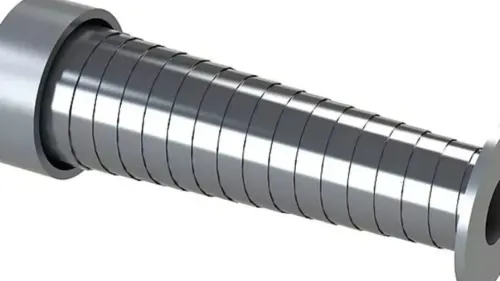
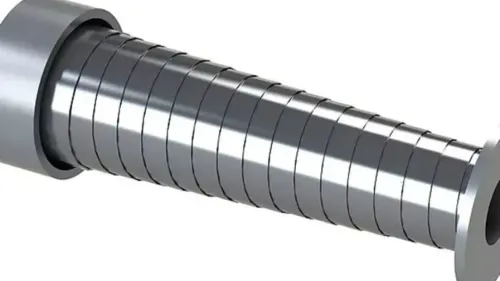
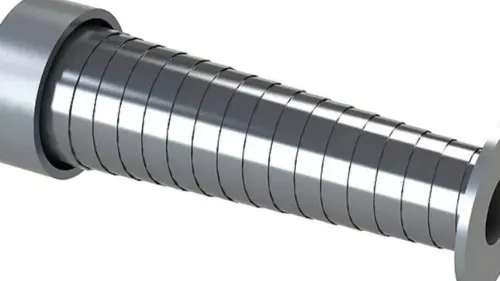
Select custom telescopic spring covers separately. Request strip material and thickness, coil diameter, minimum bend radius, travel, mounting method and cycle life for a custom telescopic spring cover. Do not substitute it for a rigid box-section cover because the travel matches; coil fatigue, contamination and mounting orientation decide suitability.
Test the supplier’s engineering and fabrication capability
Test capability by comparing what the supplier actually engineers, fabricates and verifies—not what its catalogue calls the product. Use this framework for custom telescopic way covers:
| Supplier type | What to verify | Main risk |
|---|---|---|
| Custom telescopic cover manufacturer | Designs section alignment, overlap, deflection, guide shoes, end stops and mounting interfaces | A cover fits the drawing but binds during acceleration |
| Steel telescopic cover manufacturer | Fabricates and welds sections, controls off-centre drive forces, and tests repeated cycling | Skewing, section climbing, worn guide shoes or stop impact |
| Spring-cover supplier | Calculates strip fatigue life, bend radius, orientation and contamination limits | A spring cover is substituted for a rigid cover where chips or impact demand stiffness |
| Bellows manufacturer | Designs folds, frames, travel and attachment points for the actual motion | A flexible cover collides with nearby equipment |
| Reseller | Identifies the original designer and provides traceable drawings, inspection records and replacement support | No accountable engineering owner when the cover fails |
Ask who calculates overlap and deflection, installs guide shoes and end stops, and documents steel grade, weld procedure and surface treatment. Require evidence of inspection for skewing, section climbing, guide wear and repeated stop impact.
A useful discussion with SCUTES INDIA PRIVATE LIMITED should test whether its engineering team reviews the full motion envelope, including hoses, cable carriers and rotary unions—not simply whether it offers several machine-protection products.
- Request a maximum-speed, maximum-acceleration cycle test using the actual coolant and chip conditions.
- Check drainage, abnormal noise, section interference and rated travel at both axis reversals.
Related products
 | TELESCOPIC COVERS A telescopic cover protects guide-way surfaces and components of moving axis of machines. View product → |
 | TELESCOPIC SPRING COVER Telescopic Spring Covers provide protection under extreme conditions. View product → |
Put the acceptance test and lifetime cost in the quotation
Put the acceptance test and lifetime cost into the quotation, not into a later dispute. Require the supplier to submit a test method, pass criteria and recorded results for the supplied cover.
- Run repeated full-stroke cycles at the machine’s maximum production speed and acceleration, using the actual coolant and chip conditions.
- Check every reversal for section interference, binding and abnormal noise.
- Verify end stops, drainage paths and inspection access.
- Confirm that rated machine travel remains unrestricted throughout the test.
- State the minimum safe overlap at every position, allowable deflection, mounting orientation, wiper wear limit and wiper replacement method.
Include the design review in the ISO 12100 risk assessment and check guard-related requirements against ISO 14120. These standards guide risk assessment and guard construction; they do not prescribe a universal telescopic-cover geometry. Approve the cover against the machine’s hazards, access points and movement.
Compare quotations on operating cost, not purchase price alone.
| Quotation basis | Low initial-price view | Lifetime-cost view |
|---|---|---|
| Wipers and guides | Replacement interval omitted | Interval, parts and labour stated |
| Cleaning | Access not defined | Cleaning points and access time stated |
| Spares | Complete cover replacement | Replacement sections held or available |
| Repair | Welded assembly replaced after damage | Individual sections and guides repairable |
| Downtime | Removal time omitted | Removal, refitting and expected downtime priced |
Reject a quotation that hides these assumptions. A cheaper cover becomes expensive when one damaged wiper requires complete removal and a new assembly.
Frequently asked questions
What dimensions should you give a custom telescopic cover manufacturer?
Provide the closed length, maximum extended length, section count, section width and height, section pitch, overlap, guideway and adjacent-component clearances, stroke, travel speed, acceleration, mounting-hole pattern and machine datum references.
When should you choose a drawing-based telescopic cover replacement?
Choose a drawing-based replacement when the original geometry, mounting points, section sequence and clearances are documented and the existing envelope remains suitable. Request a new design when the machine, travel or contamination conditions have changed.
How do you match a custom telescopic cover to machine conditions?
Specify construction and details against the actual load case: steel thickness and section design for impact, seals and overlaps for chips or coolant, guide arrangements for speed and acceleration, and heat-resistant materials where temperature requires them.
What should a telescopic cover quotation and acceptance test include?
Include approved drawings, material and finish, closed and extended dimensions, clearances, mounting details, travel speed, test cycles, noise or binding limits, inspection records, warranty terms, spare parts and the expected service life.