
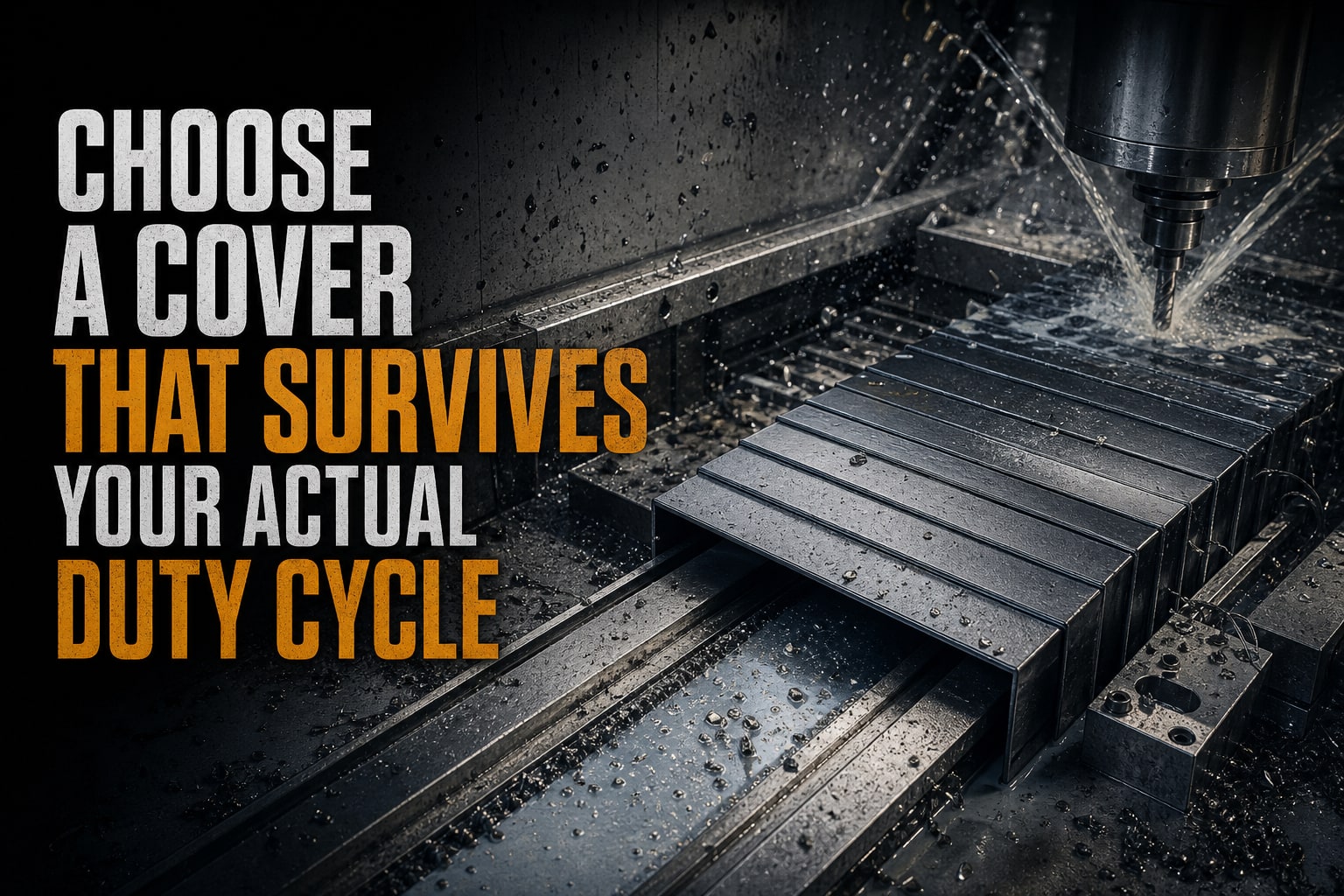
A quotation based only on machine width and travel is not enough to produce a cover that clears the machine, drains coolant and survives repeated acceleration. By assembling the right measurement package, testing the design across its full stroke and checking the supplier’s documentation and service plan, you can compare manufacturers on evidence rather than appearance or a headline speed rating.
Key takeaways
- Send a dimensioned sketch showing travel, closed length, clearances and mounting faces.
- Match construction to chips, coolant, heat, load and the cover’s orientation.
- Compare stage geometry and movement against the machine’s real duty cycle.
- Require controlled drawings, test evidence, installation checks and replacement support.
Give every bidder the measurements needed to design the cover
Send a dimensioned machine sketch, not only the overall width and travel. The supplier needs the complete custom telescopic covers dimensions set to check stage nesting, mounting, clearance and service access.
- Closed length, open length, usable stroke and required overtravel
- Number of stages, individual stage width, height, length and box pitch
- Guideway width, height, position and fixed machine reference points
- Mounting-hole pattern, hole diameters, bolt access and datum faces
- Allowable envelope above, beside and behind the guideway
- Travel orientation, maximum speed, acceleration and cycles per hour
- Adjacent-axis positions, maximum compression clearance and interference zones
- Chip size and direction, coolant or lubricant type, splash exposure and ambient temperature
- Wiper location, drainage direction and areas requiring inspection or cleaning
State how the cover will be serviced. Identify whether wipers, springs, scrapers and damaged stages must be removable without taking off the machine table, and mark each intended replaceable wear component. A low quotation becomes expensive when a worn scraper requires complete cover replacement.
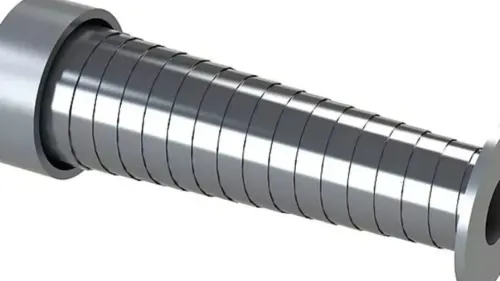
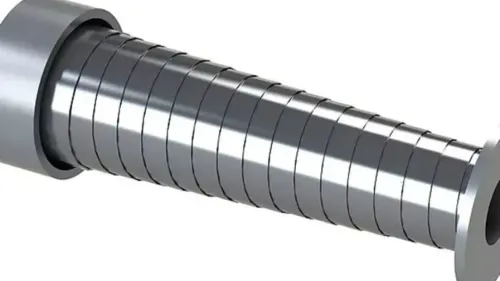
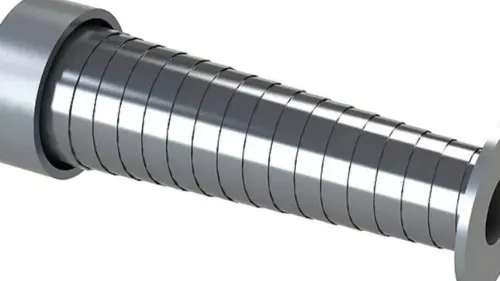
Do not write “custom telescopic spring covers” without clarification. Specify either a nested custom telescopic way cover or a coiled spring-steel cover.
For the coiled type, provide the available winding radius, strip width, strip thickness, mounting method, speed and expected cycle life; it is not a substitute for a rigid, stage-supported cover on a wide way.
Request a controlled manufacturing drawing with tolerances, inspection records for alignment and holes, material certificates where needed, and a revision history. Include full-stroke testing with representative chips and the intended coolant in the quotation acceptance criteria.
Choose construction for the load, fluid and mounting orientation
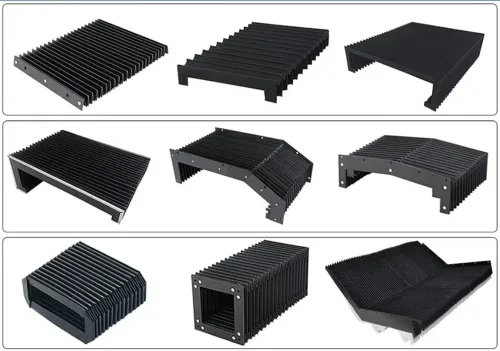
Choose a standard cover when its stage capacity, sealing arrangement, material and permitted orientation match the machine without forced modifications; choose a custom design when load, fluid, travel, clearance or mounting differs; choose a coiled spring cover only for a narrow linear element that allows winding.
| Option | Construction | When it applies | When it is unsuitable |
|---|---|---|---|
| Standard telescopic cover | Rigid nested stages with established wipers and guides | A common horizontal application with moderate chips, coolant and supported travel | Modified mounting, unusual drainage, tight clearances or vertical loading |
| Custom telescopic cover | Engineered stages, guides, scrapers, drainage and mounting | High acceleration, aggressive coolant, inverted or vertical travel, unusual loads or restricted envelopes | A simple application where standard dimensions already fit |
| Custom telescopic spring cover | Coiled spring-steel strip that winds and unwinds | Narrow linear shielding with a defined minimum winding radius | Wide machine-tool ways requiring stage support and rigid load carrying |
Do not let “custom telescopic spring covers” remain ambiguous in a quotation. Specify either “nested telescopic way cover” or “coiled spring-steel cover,” then require the supplier to state strip width, thickness, minimum winding radius, mounting method, speed and expected cycle life.
Ask a steel telescopic cover manufacturer to identify the sheet grade, thickness, surface treatment, weld and formed-corner treatment, and compatibility with your coolant. Chloride-bearing fluid can attack seams, welds and trapped interfaces even when the visible sheet looks sound.
Treat orientation as a design input, not a 90-degree rotation. Confirm drainage, chip accumulation, wiper loading, anti-lift support and stage buckling resistance, and require access to replace wipers, springs and scrapers without removing the machine table.
Compare geometry and performance against the actual duty cycle
A design proves itself when its geometry and test results match the machine’s actual duty cycle, not when it merely fits the drawing. For custom telescopic covers for machinery, require evidence from full-stroke trials at operating speed, acceleration and cycle frequency, using the intended coolant, lubricant and representative chips.
| Design | Evidence it suits the duty | Failure signal |
|---|---|---|
| Nested rigid way cover | Stage support, controlled overlap, stable running force and no visible deflection across the full stroke | Stage lifting, binding or coolant pooling |
| Coiled spring-steel cover | Stated minimum winding radius, strip width, thickness, mounting method, speed and cycle life | Proposed as a substitute for a wide, stage-supported way cover |
| Either design | Wipers maintain contact, joints resist splash and endurance testing produces no leakage or abnormal noise | Passes a dry workshop test but fails with abrasive fines or coolant |
Put these acceptance limits in the purchase specification: permissible running force, noise level, leakage or splash tolerance, wiper contact, full-stroke operation and a defined endurance-cycle result. A cover that reaches the ends of travel but overloads the axis will shorten drive and guideway life.
Check serviceability before comparing prices. Ask how technicians remove wipers, springs, scrapers and damaged stages, whether they can work without removing the machine table, and which parts are replaceable wear components. Replacing an entire cover for one worn scraper turns a low purchase price into extended downtime.
Specify “nested telescopic way cover” or “coiled spring-steel cover”; “custom telescopic spring covers” describes two different products. Treat custom telescopic way covers as debris barriers, not safety guards or collision stops.
Demand manufacturing evidence, controlled drawings and replacement support
Distinguish a capable custom telescopic cover manufacturer from a sample copier by asking who owns the design and how the result will be reproduced. A sample proves that one cover was made; it does not prove controlled dimensions, repeatable fit or a workable replacement plan.
Request these records before approving production:
- A dimensioned manufacturing drawing showing sheet thickness, stage dimensions, mounting holes, wiper details and stated tolerances.
- A revision-controlled drawing with revision number, approval date and a record of what changed.
- Inspection records for stage alignment, mounting-hole position and closed and extended dimensions.
- Material certificates identifying sheet grade, thickness and weld-related materials. A steel telescopic cover manufacturer must also state surface treatment and coolant compatibility.
- A spare-parts list identifying wipers, springs, scrapers and damaged stages as replaceable items.
Ask how the supplier handles a replacement five years later. The answer should include drawing retention, revision matching, wiper profile and material, and whether technicians can remove wear parts without removing the machine table. Replacing a complete cover because one scraper failed can turn a low purchase price into extended downtime.
When comparing SCUTES INDIA PRIVATE LIMITED with another supplier, request the same evidence from both; a company name cannot replace drawing control. Also remove ambiguity from the order: specify “nested telescopic way cover” or “coiled spring-steel cover,” because “custom telescopic spring covers” can describe products with different mounting, radius and service-life requirements.
Related products
 | TELESCOPIC COVERS A telescopic cover protects guide-way surfaces and components of moving axis of machines. View product → |
 | TELESCOPIC SPRING COVER Telescopic Spring Covers provide protection under extreme conditions. View product → |
Verify installation, full-stroke movement and future service before acceptance
Before approving a new cover or choosing a telescopic cover replacement supplier, inspect the installed unit under real operating conditions, not only on a bench. Run full extension and retraction with the machine table, tooling and adjacent services in their working positions.
Watch for contact during acceleration, stage transitions and maximum compression; a cover that clears both end stops can buckle midway.
- Confirm leakage and splash performance with the intended coolant, and check whether abrasive chips embed in the wipers or enter the joints.
- Measure running force and listen for abnormal noise; rising force points to misalignment, trapped debris or excessive wiper pressure.
- Check visible stage deflection, wiper contact, drainage and complete travel without binding.
- Run a defined endurance test using representative chips and coolant, then record cycle count, damage and force changes.
For custom telescopic covers for machinery, inspect service access before signing acceptance. Ask how to remove wipers, springs, scrapers and damaged stages, whether servicing requires removing the machine table, and which parts are replaceable wear items. A complete-cover replacement for a worn scraper can turn a low purchase price into costly downtime.
| Supplier evidence | Acceptable proof | Warning sign |
|---|---|---|
| Controlled design | Dimensioned drawing, tolerances and revision history | “Made to sample” only |
| Installation quality | Alignment and mounting-hole inspection records | No measured inspection data |
| Future support | Replacement-wiper stock and removal instructions | Supplier cannot identify wear parts |
| Cover type | “Nested telescopic way cover” or “coiled spring-steel cover” stated clearly | “Custom telescopic spring cover” without specifications |
Frequently asked questions
What dimensions should you give a custom telescopic cover manufacturer?
Provide a dimensioned machine sketch with travel, open and closed lengths, width, height, stage count, mounting faces, clearances, nesting space, access points and service constraints.
How do you choose construction for custom telescopic covers?
Specify construction from the actual chips, coolant, oil, heat, impact load and mounting orientation. These conditions determine material, seals, scrapers, guides, wipers and reinforcement.
How should you compare telescopic cover performance?
Compare stage geometry, movement speed, acceleration, cycle frequency, stroke length, vibration, chip load and fluid exposure against the machine’s complete duty cycle.
What evidence should a telescopic cover manufacturer provide?
Request controlled approval drawings, material and component details, manufacturing inspection records, movement or fit checks, installation instructions and a documented replacement-support process.