
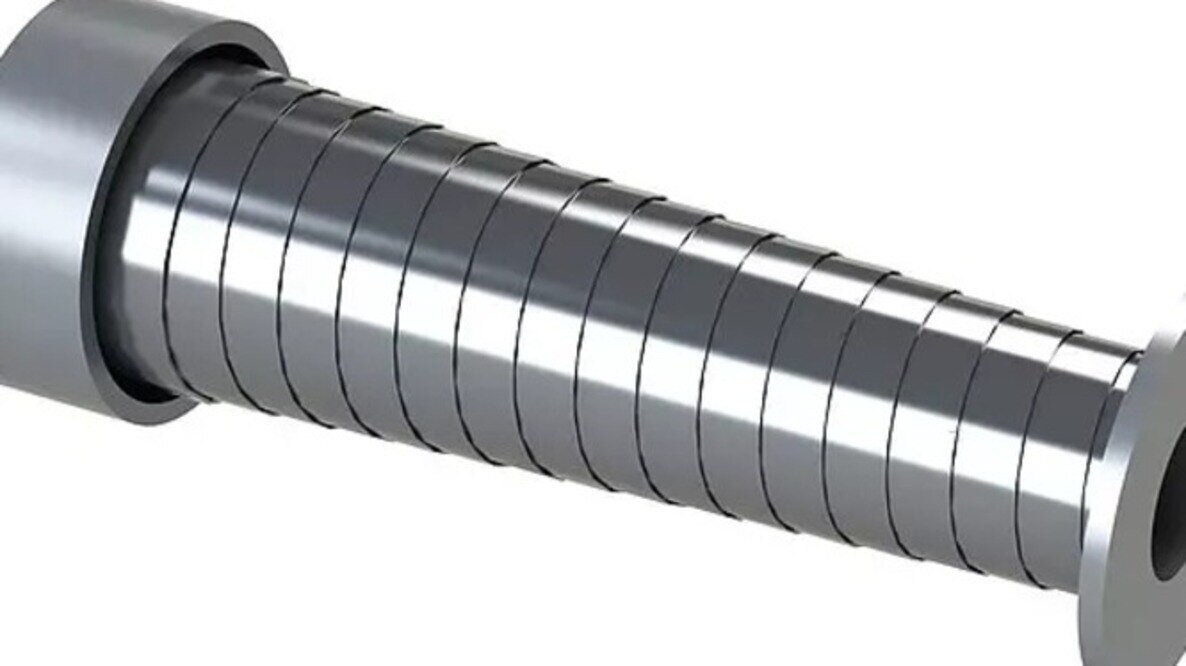
A telescopic cover can have the correct dimensions and still bind, chatter or fail to retract because its spring force does not match friction, acceleration, contamination and mounting orientation. By the end, you will be able to distinguish the spring from the shielding sections, size the complete assembly, check installation fit and specify a test that reflects real machine conditions.
Key takeaways
- Specify restoring torque, stroke length, arbor size and spring travel together.
- Allow for guide friction, wiper drag and changing cover geometry.
- Prevent binding with aligned guides, controlled clearances and regular debris removal.
- State temperature, contamination, corrosion exposure and installation space in the purchase specification.
What the Spiral Spring Does Inside the Cover
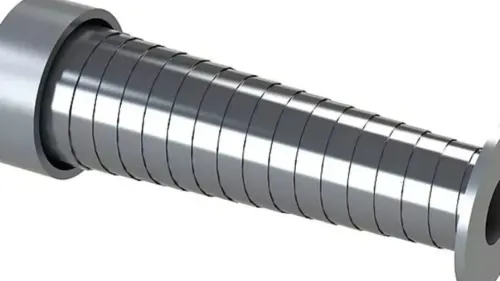
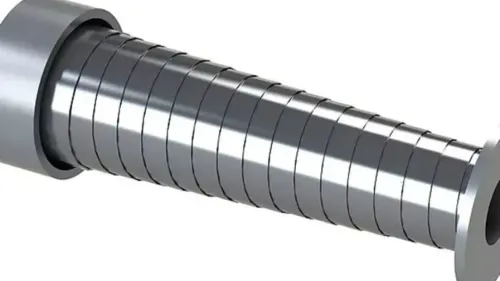
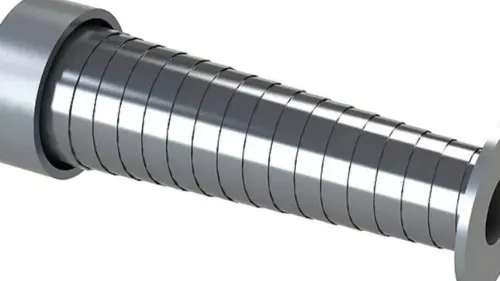
The spiral spring supplies restoring torque; it does not carry the machine load. As the telescopic cover opens, the spring winds or unwinds around its arbor and stores energy. That torque pulls the cover sections back toward the closed position, overcoming guide friction and wiper drag while keeping the assembly seated.
The telescoping steel sections provide the barrier, while the guideways and mounting frame carry chip impact, vibration and moving mass. A machine spring cover is therefore a complete assembly, not a spring alone.
As the machine axis moves away from its home position, the linked sections slide out in sequence and protect the exposed guideway or opening. On the return stroke, spring torque draws the sections together, controlling their collapse instead of leaving them to bunch or fall under their own weight.
Correct pre-tension keeps contact through the stroke, so repeated cycles do not depend on gravity or on the protected machine part pushing the cover.
This separation explains the spiral spring cover benefits: compact retracted length, rapid movement and reliable take-up over repeated cycles. The spring force is not constant, however. Friction, seal drag and fatigue consume part of the available torque, so the cover must be guided and supported independently.
If the spring is asked to resist cutting forces or machine loads, it will lose return force or fail prematurely.
How Cover Movement Changes Through the Machine Stroke
At the closed end of the machine stroke, the telescopic sections sit in their shortest, overlapping stack and the spiral spring holds the assembly retracted. As the axis advances, each section slides out in sequence, maintaining overlap while the spring unwinds and supplies take-up force.
| Stroke position | Cover movement | Main check |
|---|---|---|
| Closed | Sections overlap; spring is wound and ready to retract | Compressed length and stored spring force |
| Advancing | Sections extend; guides, rollers and wipers carry the moving load | Section overlap, pitch and guide clearance |
| Reversing | Spring rewinds and pulls sections inward | Return force against friction and acceleration |
| Extended | Sections reach maximum protected travel | Extended length, end stops and deflection |
A spiral spring telescopic spring cover for benefits such as compact storage still needs more space than the nominal slide. Its moving envelope includes the cover outside diameter, guide clearance, mounting brackets and section movement. Insufficient clearance causes rubbing at one point in the cycle, then binding or buckling at speed.
Reliable travel depends on the protected stroke, compressed length, extended length, section pitch and overlap. Specify shaft diameter, cover outside diameter, available mounting space, travel speed, acceleration and allowable deflection together; changing one dimension alters the others.
For moving shaft protection, keep the cover concentric and clear of the rotating shaft. A telescopic cover shields a machine opening, not the shaft, coupling or rotating-joint hazard. Size spring force against guide friction, wiper drag, moving mass and contamination, because available return torque changes through the stroke.
How to Match the Assembly to Load, Environment and Space
Spring force must exceed the resistance of guide friction, wipers, acceleration and contamination throughout the stroke—not just the cover’s weight. Because spiral-spring torque changes as the spring winds, specify usable force at both retracted and extended positions.
1. Define the motion: record stroke, speed, acceleration, cycle rate and mounting orientation. A vertical machine spring cover needs enough upward return force to overcome gravity; a horizontal cover needs less, but guide friction still matters.
2. Set the geometry: provide shaft or slide dimensions, protected opening, extended length, compressed length and available mounting space. Preserve section overlap and guide clearance, then allow for the moving envelope; a compact retracted cover still travels wider than the nominal machine dimension.
3. Choose materials from the exposure: use corrosion-resistant steel where coolant, humidity or wash-down attacks carbon steel, and confirm spring compatibility with the fluid. State maximum enclosure temperature, airborne sand or dust, coolant type, wash-down pressure and cleaning frequency.
4. Match sealing to the contaminant: specify wipers for fine dust and coolant, reinforced scrapers for chips, and drainage paths where fluid can collect. Do not use a telescopic cover as moving shaft protection; a rotating shaft needs a fixed concentric guard, end supports and entanglement protection without contact.
5. Attach a section drawing showing mounting faces, clearances and sealing surfaces. This prevents “spiral spring cover” from being quoted as a roll-up cover, shaft guard or incomplete spring-assisted assembly.
How to Prevent Binding, Buckling and Premature Spring Failure
A cover that binds usually has misalignment, excessive drag or incorrect spring pre-tension—not an undersized spring alone. Mount the spring drum, guides and telescoping sections on a common centreline; an offset mount makes coils rub, while insufficient clearance lets sections contact during acceleration. A long horizontal cover can also sag and buckle when extended.
| Failure or symptom | Typical cause | Test |
|---|---|---|
| Rubbing, chatter or uneven travel | Misaligned guides, tight rollers, excessive wiper drag or excessive acceleration | Move through the full stroke at operating speed and inspect contact marks |
| Coil buckling | Unsupported span, wrong mounting orientation or spring force that is too high | Test fully extended and during rapid reversal; watch for lateral coil deflection |
| Incorrect pre-tension | Spring installed at the wrong winding position or with the wrong overlap | Measure retraction force at both stroke ends against the supplier’s specified range |
| Trapped chips | Damaged wipers, open section gaps or chip packing at the spring pocket | Cycle with representative hot chips and coolant, then inspect pockets and overlaps |
| Loss of return force | Spring set, fatigue, corrosion or repeated overload | Repeat the complete cycle and compare initial and post-test force |
Do not accept a static extension test as proof. Run repeated cycles with the intended wipers, coolant, chip exposure, speed and acceleration, then check section impact, guide wear and final return position.
The spiral spring cover benefits of compact storage and rapid return matter only if this test remains smooth. If noise, sealing or very low friction dominates, compare a bellows or roll-up cover.
What to Put in a Purchase Specification for Dubai
If your search says “telescopic spring cover in dubai,” do not send only the machine model and axis length. Dubai identifies a location, not a performance classification.
A telescopic spring cover in Dubai needs a drawing or section view showing the protected travel, closed and extended lengths, section pitch, shaft or spindle diameter, outside diameter, mounting space, orientation, rotation and allowable deflection.
Give the supplier this information:
- Travel, cycle frequency, speed, acceleration and deceleration
- Maximum enclosure temperature, not only ambient temperature
- Coolant name and chemistry, chip size, airborne sand or dust exposure, and corrosion risk
- Wash-down pressure, nozzle distance, water temperature and cleaning frequency
- Required sealing level, wiper material, acceptable friction and expected wiper replacement interval
- Mounting faces, guide arrangement, interference limits and available clearance
- Whether the cover shields motion or forms part of an access guard
SCUTES INDIA PRIVATE LIMITED can use these details to distinguish a spring-assisted telescopic steel cover from a roll-up or rotating-shaft cover and size the complete assembly correctly. Treat the spiral spring as a restoring-force component, not a load-bearing guard.
Specify an acceptance test covering the full stroke at operating speed and acceleration, with the intended wipers and representative coolant, chips or dust; also check repeated cycling for binding, chatter, spring-force loss and chip packing. For guarding, document the risk assessment against ISO 12100, guard requirements in ISO 14120 and safety distances in ISO 13857.
Related product
 | TELESCOPIC SPRING COVER Telescopic Spring Covers provide protection under extreme conditions. View product → |
Frequently asked questions
What does the spiral spring do inside a telescopic spring cover?
It supplies restoring torque as the cover opens, helping overcome guide friction and wiper drag while returning the sections toward the closed position. It does not carry the machine load.
How does cover movement change through the machine stroke?
Spring torque, section overlap, guide friction and wiper drag change as the cover extends and retracts. Check movement across the full stroke instead of sizing the spring at one position.
How do you match a spiral spring assembly to the machine?
Match restoring torque and travel to the cover geometry, then check load conditions, operating environment, arbor space, guide arrangement and clearance around moving parts.
How can you prevent binding, buckling and premature spring failure?
Keep the guides aligned, control lateral movement, remove chips and dust, prevent excessive spring travel, and inspect for corrosion, distorted sections and uneven retraction.
What belongs in a Dubai purchase specification for a telescopic spring cover?
State the machine stroke, closed and extended dimensions, cover material, section arrangement, restoring torque, spring travel, mounting details, operating speed, temperature, contamination, corrosion exposure and available installation space.