
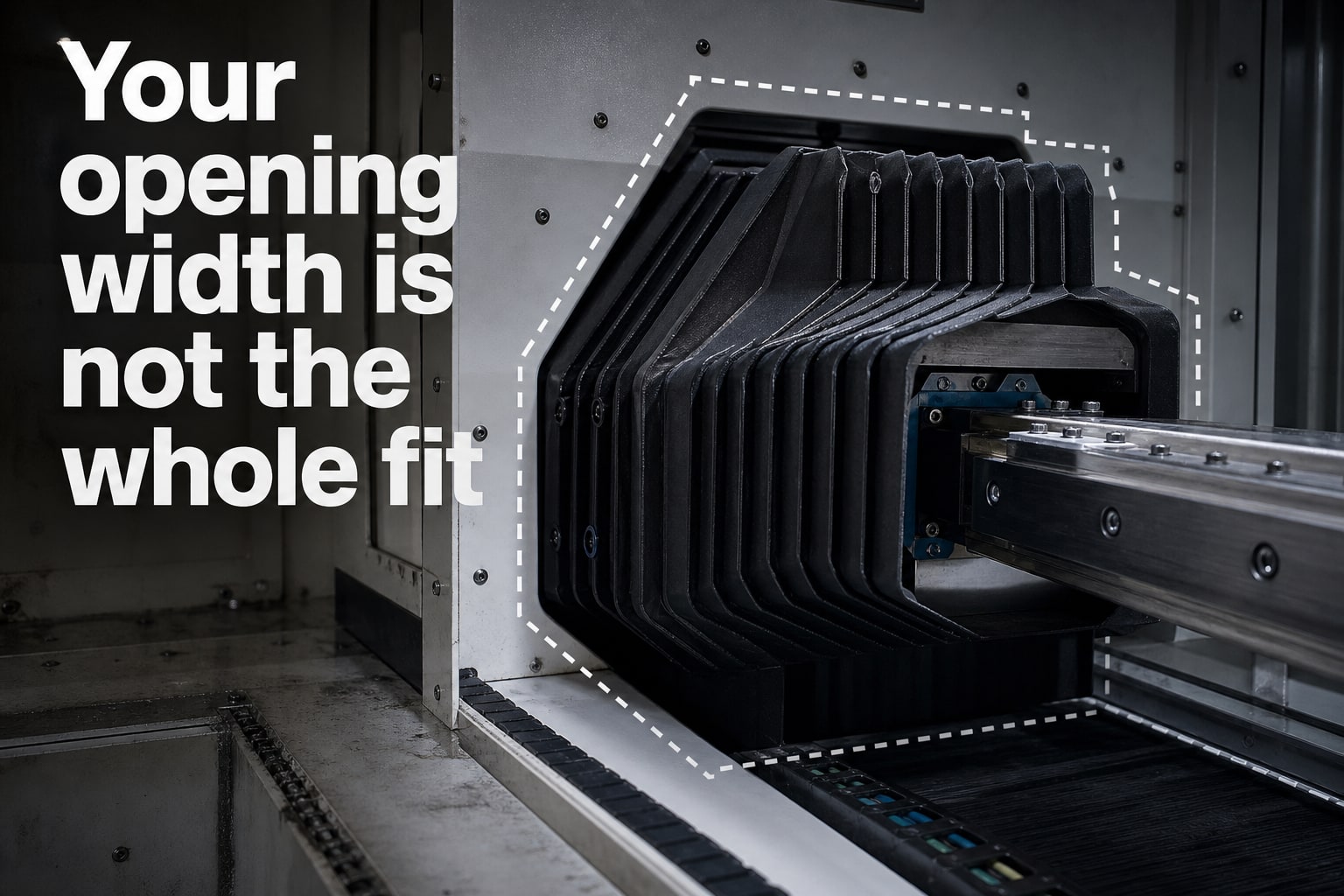
A cover that matches only the guideway opening can still bind, sag, strike tooling or consume the space needed by a cable carrier. By mapping the machine’s travel, mounting points, operating conditions and retracted envelope, you can give a fabricator the information needed to produce a cover that moves with the axis rather than against it.
Key takeaways
- Measure travel, retraction space and mounting elevations before quoting.
- Record coolant, oil, chips, heat and speed at the cover location.
- Test the cover through full travel before approving production.
- Choose bellows or telescopic covers when an apron cover cannot clear obstacles.
Start with the machine’s motion, not the opening width
Custom apron cover fabrication starts with the machine’s motion and clearance envelope, not the opening width. Define usable axis travel, the cover position at both ends, travel direction, mounting elevations, minimum and maximum cover length, opening width, and available retraction space.
Give the fabricator these inputs:
- Fully extended and compressed cover positions
- Slat width, side-frame width, guide clearances, and end mounting hardware
- Retracted stack height and the machine pocket available for it
- Travel speed, acceleration, cycle frequency, and axis orientation
- Unsupported span, chip load, coolant exposure, and allowable deflection
A standard cover selected by nominal width and length can bind at end travel, restrict the axis, or leave the guideway exposed. A custom apron cover manufacturer checks the complete envelope instead.
| Cover type | Construction | Where it fits |
|---|---|---|
| Articulated slat apron | Hinged metal slats running in guides | Chip-heavy guideways needing rigid protection |
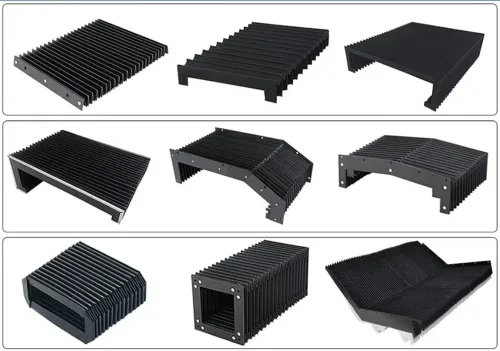
| Fabric bellows | Flexible coated fabric folding at the pleats | Compact protection around irregular moving parts |
| Roll-up cover | Flexible material wound on a drum | Long travel where a retracted stack must stay small |
| Telescopic steel cover | Overlapping rigid steel boxes | Heavy chips, coolant, and demanding guideway protection |
These products are not interchangeable. A controlled drawing should show slat profile or pitch, materials, guides, mounts, interface tolerances, travel direction, overall dimensions, and stack height; a quotation listing only width, length, and material cannot prove fit. Keep the cable carrier separate, with clearance for its bend radius and movement.
Measure the full custom apron cover envelope
Measure custom apron cover dimensions at both fully extended and fully compressed positions before requesting a quotation. Record the cover’s folds, sag, slat lift and any cantilevered section; the nominal opening alone cannot confirm fit.
1. Measure the protected opening width between the surfaces requiring protection. Then measure the overall available width, including slat width, side guides, side frames, mounting plates and fastener access. These parts consume space beyond the opening.
2. Measure usable travel length from the fixed end to the moving end. Record the fully extended length, compressed length and retracted stack height, including the clearance needed for the stack to enter a side pocket.
3. Measure mounting height at both ends, guide width, guide-rail position and side-frame space. Note datum surfaces, bolt centres and whether you can remove the cover without dismantling the machine.
4. Measure end clearances at full extension and full compression. Include the cover’s bend radius, return path and any cable carrier bend-radius envelope, outer height and width.
5. Repeat the measurements for the actual orientation. A horizontal cover can sag between guides; a vertical cover can suffer slat lift or uneven loading from gravity. Record the resulting gap and alignment, not just the theoretical dimensions.
6. Measure adjacent tooling, guards, lubrication points, inspection doors, machine panels and cable routes. Check these against the extended cover and the retracted stack.
7. Draw a scaled sketch and mark the fixed end, moving end and direction of return movement. Add every measured interference point, including folds, sag and cantilevered sections, then send the sketch with photographs and machine drawings.
Give the fabricator the operating conditions and interface details
Before quoting, provide the custom apron cover fabrication requirements in a controlled drawing package, not only opening width and length. Include photographs with a scale, machine drawing, axis travel, speed, acceleration, cycle frequency, mounting-point coordinates, bolt pattern, datum surfaces, guide-rail location and available installation space.
1. Define the interface: fixed-end and moving-end attachment, mounting plates, fastening method, allowable fastener access, and whether the cover must be removed without dismantling the machine. State slat width, thickness, strip spacing, hinge construction, edge finishing, side seals and end seals.
Small errors in mounting height or parallelism cause rubbing that looks like a slat failure.
2. Record the environment: coolant type and concentration, washdown pressure, chip size, chip temperature, abrasive content, operating temperature, and whether chips fall, slide or strike the cover. These details control hinge wear, seal life and corrosion.
3. Supply the motion envelope: travel direction, retracted stack space, tooling clearances, and the cable carrier’s full bend-radius envelope at extension and retraction. Include the carrier’s moving and fixed coordinates so custom apron cover manufacturing does not obstruct cables or exceed the pocket.
4. Confirm the material choice against the load, not appearance.
| Material | Choose when | Main trade-off |
|---|---|---|
| Aluminium | Low mass, moderate impact and compatible coolant | Thin sections reduce mass and stack height but dent more easily |
| Stainless steel | Corrosive coolant, washdown or high corrosion exposure | Better resistance with greater mass and cost |
| Coated carbon steel | Abrasion and impact with controlled corrosion exposure | Economical, but coating damage exposes edges to corrosion |
Test fit through every movement and decide when another cover is better
Verify an apron cover by running a prototype or first article through its complete three-dimensional envelope, not by checking static dimensions alone. Test full extension, full compression, acceleration, deceleration and rapid reversals, including end-of-travel and vertical-axis behavior.
Confirm that slats clear tooling, guards, lubrication points, cable carriers and adjacent parts, while guides stay parallel without rubbing.
During the test, inspect:
- Sag and cantilever loading at full extension.
- Hinge impact where the cover retracts.
- Slat overlap and side-seal contact throughout travel.
- Coolant drainage, chip shedding and trapped debris.
- Access for cleaning, inspection and lubrication.
- Cable-carrier bend-radius clearance at extension and retraction.
Record the results against the custom apron cover dimensions, including the retracted stack and mounting hardware. These findings belong in the custom apron cover manufacturing review, because acceleration can expose binding or slat lift that a drawing will miss.
| Option | What it means | When it applies |
|---|---|---|
| Aluminium-strip apron | Guided articulated slats | Moderate chips or coolant exposure |
| Fabric bellows | Flexible folded enclosure | Irregular three-dimensional travel or compact folds |
| Roll-up cover | Flexible rolling barrier | Access matters more than rigidity |
| Telescopic steel cover | Rigid heavy-duty enclosure | Heavy chips, impact and guideway protection |
Choose another solution for high-temperature cutting, severe sharp-chip impact, very high-speed motion, complex three-dimensional movement or complete enclosure requirements.
Approve a controlled drawing before fabrication begins
Before production, expect a custom apron cover manufacturer to issue an approval layout, not only a quotation. Custom apron cover fabrication cannot be verified from width, length and material alone.
1. Check the drawing for overall dimensions, slat pitch or profile, material and finish, guide and mounting details, travel direction, extended and retracted lengths, stack height and interface tolerances. Confirm fixed-end and moving-end attachment, bolt access and removal clearance.
2. Ask the manufacturer to state every design assumption. The document should identify the bend radius, allowable deflection, seal contact, coolant drainage path and cable-carrier clearance. A carrier can interfere with the retracted stack even when it has a separate mounting.
3. Require a first article or prototype review at full speed. Observe reversals, end-of-travel behaviour, guide alignment, slat overlap, coolant exposure and access for cleaning or removal. Static dimensional inspection will not reveal binding, slat lift, impact during retraction or acceleration-related interference.
SCUTES INDIA PRIVATE LIMITED can be considered alongside other industrial fabricators when its design review addresses these machine-specific details rather than quoting only nominal dimensions. Approve production only against a verifiable fit drawing and operating test; the cover’s material name alone does not prove that it will track, seal and retract correctly.
Related product
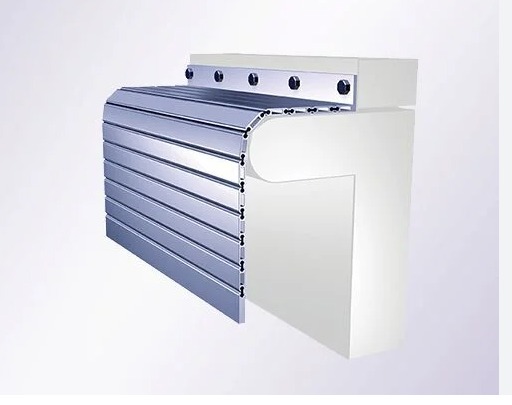 | APRON COVER Effectively engaged in offering a vast collection of outstanding quality products which include Apron Covers. View product → |
Frequently asked questions
Why should custom apron cover fabrication start with machine motion?
Motion determines usable axis travel, travel direction, end positions, mounting elevations and the clearance envelope. Opening width alone cannot define a workable cover.
Which custom apron cover dimensions must you measure?
Provide minimum and maximum cover length, opening width, available retraction space, mounting elevations and the cover position at both ends of travel.
What operating details belong in custom apron cover fabrication requirements?
Give the fabricator travel speed, cycle frequency, coolant and oil exposure, chip size, operating temperature, cleaning method and interface details such as mounting points and obstructions.
When is another machine cover better than a custom apron cover?
Choose another cover type when the apron cannot retract within the available space, clear nearby obstacles, follow the required motion or withstand the operating conditions.