

A linear rail fails when chips, coolant, abrasive dust or heat reach its raceways, bearing blocks and lubrication film. By the end, you will understand how the cover travels with the carriage, how to measure the installation, and how to choose construction that matches the machine rather than assuming every cover provides liquid-tight protection.
Key takeaways
- Anchor the cover to the carriage so it advances with the moving axis.
- Keep chips, coolant and abrasive debris away from rails, blocks and seals.
- Measure travel, rail width, cover width and drum envelope before specifying.
- Match fabric, slats, seals and speed to the machine environment.
How the cover travels with the linear carriage
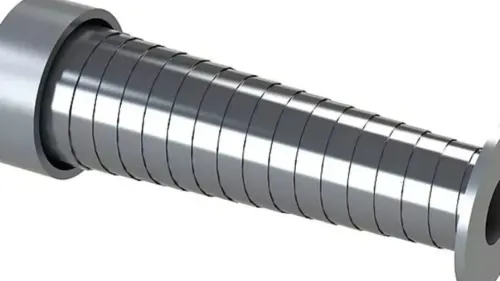
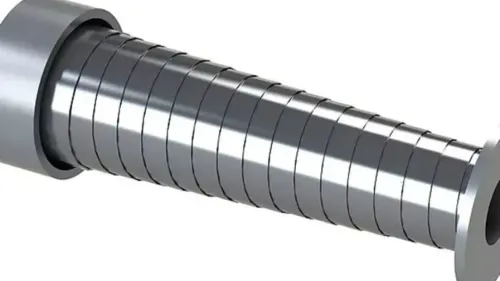
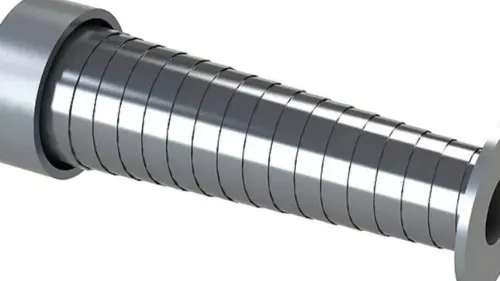
A roll up cover for linear rails moves with the carriage by anchoring one end to the moving assembly and routing the cover over the exposed guideway toward a drum.
As the carriage advances, the cover winds onto the drum behind it; as the carriage returns, the drum releases the cover to close the newly exposed rail section. The drum may sit on the carriage or the machine frame, depending on the travel direction and available retraction space.
The moving attachment keeps the barrier aligned with the carriage instead of leaving a fixed opening over the rail. Correct sizing includes the full travel distance, carriage attachment length, frame-fixed length, overlap, cover width and the drum’s minimum bending diameter.
Size from rail length alone and the cover can run short, foul the carriage, or retract poorly.
The cover’s protection reaches the areas most exposed to contamination:
- Rail raceways where rolling elements carry the load
- Bearing-block wipers and seals
- Lubrication film and grease points
- Rail mounting surfaces and adjacent drive components
Leave access to lubrication fittings, inspection points and carriage hardware. A blocked fitting can turn a protective cover into a cause of premature rail wear.
The cover excludes chips, swarf, dust and liquid, but it is not automatically liquid-tight. Coolant can enter through longitudinal edge gaps, seams, end closures or poorly fitted side guides, and the cover does not replace the guide block’s seals or wipers.
Never use it as a platform, chip conveyor or load-bearing guard; impact can deform the cover, damage the drum or transfer force into the linear guide.
What the cover protects inside the guideway
A roll up cover for linear rails shields the rail raceways, bearing blocks, lubrication film, mounting surfaces and nearby drive components from chips, swarf, dust and coolant. It forms the outer barrier; the guide block’s seals and wipers remain the final defence around the rolling contacts.
| Protected area | What the cover blocks | What built-in seals and wipers do |
|---|---|---|
| Rail raceways | Chips, abrasive dust and liquid landing on the rolling tracks | Limit contamination entering the bearing block at its opening |
| Bearing blocks | Large debris striking or settling around the block | Wipe the rail surface and retain contamination at the block interface |
| Lubrication film | Coolant and swarf that dilute or carry away lubricant | Help retain grease and spread lubricant across the contact path |
| Mounting surfaces | Debris accumulating around rail fasteners and carriage seats | Provide little protection outside the block’s sealing edges |
| Adjacent drive components | Contamination reaching a ballscrew, rack or encoder beside the rail | Protect only the guide block, not neighbouring machine parts |
Do not treat the cover as a liquid-tight enclosure. Seams, longitudinal edge gaps, end closures and attachment points can admit coolant, while a damaged wiper can carry fine chips inside. The cover also does not lubricate the rail or compensate for neglected relubrication.
Keep lubrication fittings and inspection points accessible. During service, remove chips from the cover, drum, guides and wipers rather than blowing them toward the rail with compressed air, which can force contamination past the cover edge.
How a roll-up cover compares with other rail protection
A roll up cover for linear rails is the better choice when end-of-travel space is tight and the rail needs a retractable barrier rather than a rigid enclosure. It uses less space along the axis than a telescopic cover, but the drum still needs a defined envelope, mounting clearance and access for cleaning.
| Option | Advantage over a roll-up cover | When the alternative is better |
|---|---|---|
| Telescopic steel cover | Handles heavy, sharp or hot swarf with strong rigid panels | Choose it on a machine producing abrasive chips where end-space and added mass are acceptable |
| Bellows | Follows complex movements and covers wider, irregular areas | Choose it when flexibility and broad enclosure matter more than compact retraction |
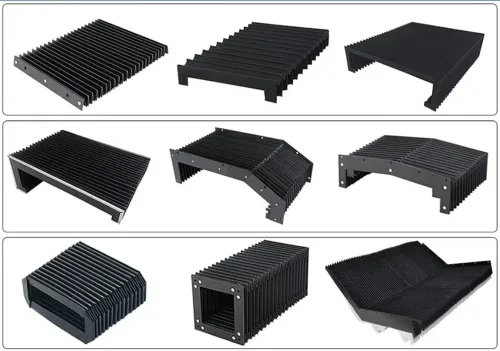
| Apron cover | Uses interlocking slats for durable protection across long exposed sections | Choose it when the cover faces substantial chip impact and has room to extend or fold |
| Brush wiper | Removes loose particles at a contact edge with little added structure | Choose it as a supplementary cleaner, not as the main barrier against coolant or fine dust |
Choose the roll-up design when low moving mass, compact axis packaging and quick access matter. Choose another option when the cover will face sustained hot swarf, severe abrasion or an irregular path that prevents controlled winding. A roll-up cover also fails as a solution if its drum blocks lubrication fittings, inspection points or carriage fasteners.
Its material must match chip temperature, coolant chemistry and bend-radius demands, not just rail width.
How to measure the rail and drum envelope
Record the axis travel, rail length, carriage position, cover width, attachment points, and complete drum envelope before requesting a roll up cover for linear rails. Measure the machine, not just the rail: the cover length includes the moving section, fixed frame attachment, carriage attachment, and the overlap needed to prevent an opening at full extension.
- Measure usable travel from the carriage’s two end positions.
- Record the rail and carriage-block width, plus the cover width required to shield the full guideway.
- Mark the fixed-frame and moving-carriage attachment faces, including bolt access and the distance from each face to the rail centreline.
- Specify the minimum drum diameter approved for the cover material or slat design; a smaller drum can crease, buckle, or overload the winding system.
- Measure the drum envelope: diameter, axial width, height, depth, and the space required for the rolled cover at maximum retraction.
- Check clearance above the rail block, beside the carriage, and at the drum transition. Include tolerances for alignment, deflection, chips, and coolant.
- Record the mounting orientation and the required guide or support surfaces so the cover cannot sag into the carriage or rub the rail block.
| Measurement | If omitted | What the confirmed dimension prevents |
|---|---|---|
| Travel plus overlap | Exposed rail at an end position | Coverage gaps |
| Drum envelope | Collision with guards or nearby axes | Installation redesign |
| Carriage and transition clearance | Rubbing, creasing, or slat binding | Premature wear |
| Mounting alignment | Uneven winding and pulled attachments | Repeated failures |
How to match construction to chips, coolant and axis motion
Match the construction to the chip load, coolant chemistry and axis motion—not to rail width alone. A roll up cover for linear rails needs enough travel for the carriage-fixed section, frame-fixed section and overlap, plus a drum diameter that lets the material retract without kinking.
1. Choose slatted metal for hot, sharp or abrasive chips; it resists cutting and heat better than coated fabric. Choose coated fabric when low mass, flexible routing and a tight bend radius matter. Check compatibility with the actual coolant, wash-down fluid and operating temperature.
2. Close the paths that defeat the cover. Specify side guides, end closures, longitudinal edge seals, wipers and carriage attachments as one system. A cover is not liquid-tight by itself; gaps along its edges can carry coolant and fine chips onto the guideway.
3. Match the drum, guides and fasteners to axis speed, acceleration, vibration and mounting orientation. Check that the cover does not rub the carriage, snag at full travel or wind unevenly. Abnormal winding signals excessive friction, misalignment or lost spring tension.
4. Define service access before installation. Remove chips from the cover, drum, guides and wipers without directing compressed air toward the rail. Inspect for torn fabric, bent slats, loose fasteners, damaged seals and declining spring tension.
When evaluating a design from SCUTES INDIA PRIVATE LIMITED, ask for the selected material, temperature and coolant limits, edge-sealing method, minimum drum diameter and inspection interval rather than accepting a generic “durable” specification.
Related product
 | Roll Up Cover A roll-up cover is a highly durable and flexible protective solution designed to safeguard machinery, equipment, and valuable assets from dust,... View product → |
Frequently asked questions
How does a roll-up cover travel with a linear carriage?
One end attaches to the moving carriage while the cover routes over the exposed guideway and winds onto a drum, allowing it to extend and retract with carriage motion.
What does a roll-up cover protect inside a linear guideway?
It shields rails, bearing blocks, recirculating elements, seals and lubrication film from chips, coolant, oil, dust and mechanical impact.
How does a roll-up cover compare with other rail protection?
A roll-up cover suits axes needing compact storage and unobstructed carriage travel; bellows, telescopic steel covers and wipers fit different space, heat, impact and contamination conditions.
What measurements are needed for a roll-up linear rail cover?
Record axis travel, exposed rail length, rail and carriage width, mounting points, cover clearance, drum diameter, drum width and the full retracted envelope.
How should construction match chips, coolant and axis motion?
Specify the cover material, slats, seals, wipers, tension system and drum design against chip size, coolant exposure, heat, travel speed, acceleration and cycle frequency.