
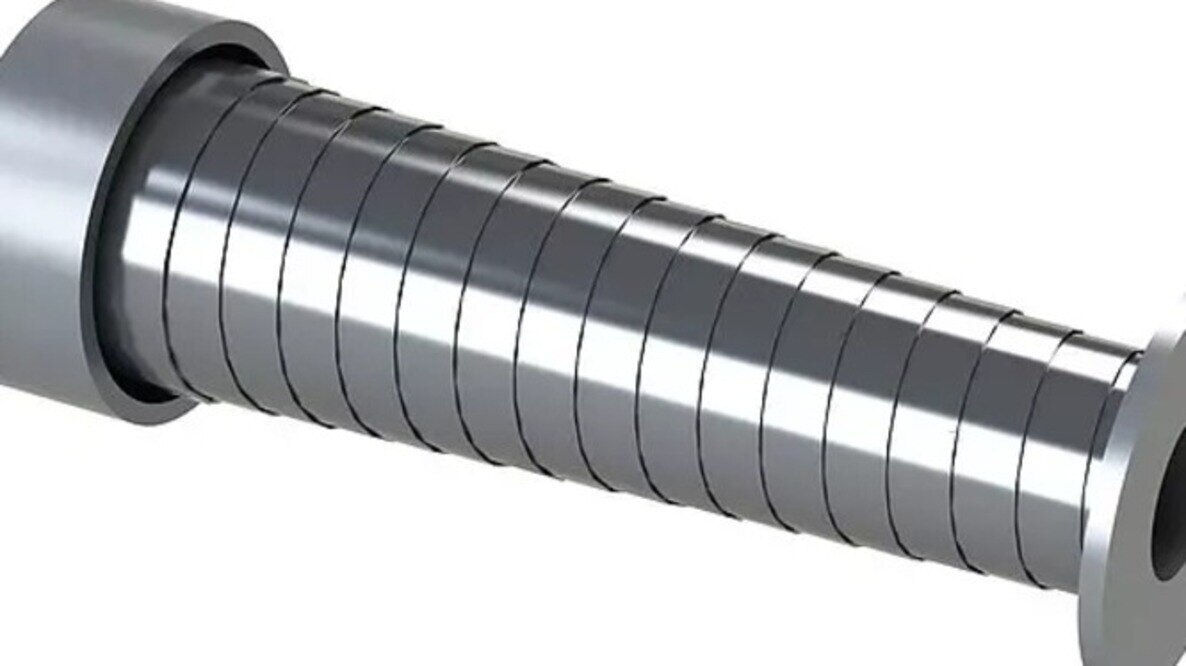
Fine desert dust, coastal salt, hot chips and rapid temperature changes can defeat a cover that looks suitable on paper. By the end, you will be able to match a spiral spring cover to the machine’s motion and exposure, specify measurable materials and sealing features, and compare supplier quotations without assuming that “protective” means dust-tight.
Key takeaways
- Confirm travel, shaft diameter, clearance and mounting space before ordering.
- Specify temperature, abrasive dust and corrosion exposure from the actual machine location.
- Treat dust resistance as a tested cover-and-seal system, not a visual feature.
- Compare installation access, cleaning intervals, replacement parts and supplier documentation.
How a spiral spring cover moves—and where it falls short
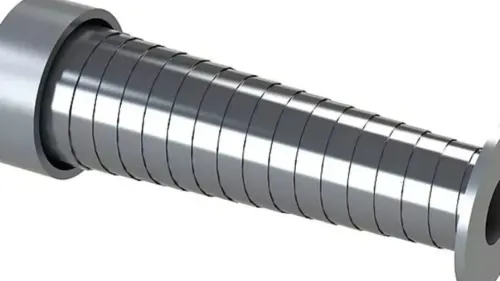
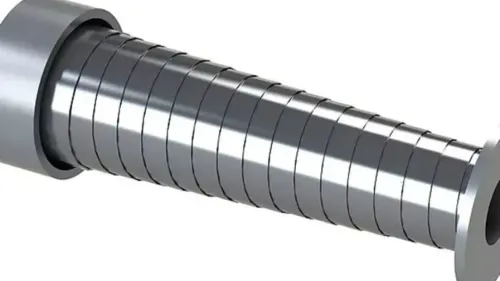
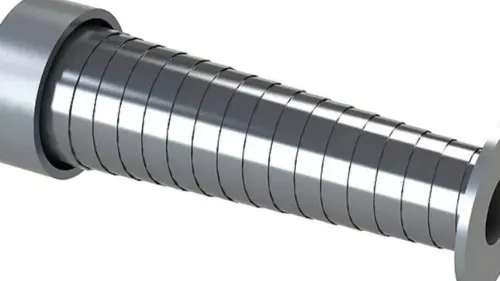
A spiral spring cover is an overlapping strip or coil assembly wrapped around a shaft or cylindrical moving part. Spring tension rolls the strip into a compact coil as the shaft retracts and feeds it out as the shaft travels, creating a moving barrier over the exposed section.
It is not normally a sealed enclosure: turn interfaces, end clearances, shaft openings and poorly seated wipers can admit fine dust.
| Cover type | Protection and movement | Best fit |
|---|---|---|
| Spiral spring cover | Compact, spring-driven barrier around cylindrical shafts | Short radial space and reciprocating shafts |
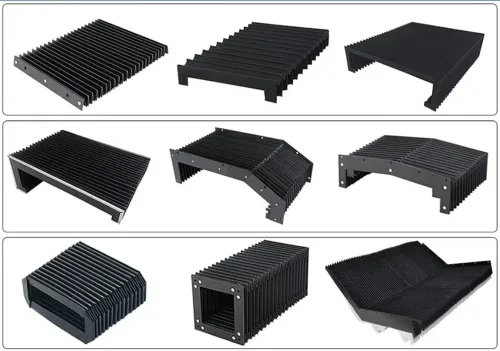
| Bellows | Flexible folds provide broader enclosure, with seams and end frames | Guideways, slides and irregular shapes |
| Steel telescopic cover | Rigid overlapping boxes resist chips and impact | Machine-tool guideways |
| Roll-up cover | Flexible curtain winds onto a drum | Larger flat openings |
| Apron cover | Linked slats or plates provide a rugged sliding shield | Heavy chips and broad horizontal surfaces |
For spiral spring cover conditions in Dubai, treat the design as dust control, not dust sealing. Fine mineral dust can migrate through the turns and combine with oil or coolant into abrasive paste; large chips and direct debris demand a more robust shield.
Spiral spring machine protection in Dubai is the wrong choice for heavy hot chips, impact, direct high-pressure washdown, intense radiant heat or any application requiring a sealed enclosure. Specify another cover when those loads dominate.
Match the cover to Dubai’s heat, dust and corrosion exposure
A spiral spring cover for heat dust in Dubai must be specified for the cover’s measured environment, not the outdoor forecast. Record separate figures for continuous temperature, short-duration peak temperature and duty cycle at the cover. Include solar loading, hot chips, coolant temperature, nearby motors and heat trapped inside an enclosure.
Fine mineral dust migrates into narrow clearances, then combines with oil or coolant into abrasive paste. Define spiral spring cover conditions in Dubai at the actual site: inland abrasive dust differs from coastal chloride exposure or saline washdown, so do not assign every installation one ISO 9223 corrosion category.
| Option | Main consideration | Specify |
|---|---|---|
| Carbon spring steel | Strong fatigue performance, but vulnerable to rust | Treatment, finish and coating |
| Ferritic stainless | Better atmospheric corrosion resistance; grade-specific spring performance | Exact grade, heat treatment and magnetic requirements |
| 304 or 316 austenitic stainless | 316 generally resists chloride pitting better than 304 | Surface finish and protection from trapped deposits |
“Stainless steel” alone is insufficient. Ask for strip grade, heat treatment, surface finish, edge treatment, coating, compatible fasteners and written cleaning instructions; chloride trapped between turns, carbon-steel hardware and iron contamination can still cause localized corrosion.
For spring cover dust resistance in Dubai, require the wiper or seal material, grease temperature range, coolant and cutting-oil compatibility, and the cleaning method. Check thermal expansion between the steel cover and aluminium mounts: cold clearances or wiper loading that look correct can bind when hot.
Measure the machine before choosing a spring cover
A shaft diameter alone cannot select a cover. Draw the machine at full travel, showing shaft or guide diameter, protected length, stroke, compressed length, extended length, mounting-face dimensions, orientation, and every radial and axial clearance.
Record the motion profile:
- Maximum speed, acceleration, cycle frequency and direction changes.
- Whether the shaft rotates as well as reciprocates.
- The closest positions of the chuck, toolholder, cable carrier, coolant line, fittings and adjacent guard through the complete stroke.
| Check | Record | Failure if missed |
|---|---|---|
| Length and clearance | Compressed and extended lengths, radial and axial gaps | Fouling or dust entry |
| Motion | Speed, acceleration, reversals and cycle frequency | Flutter or end impact |
| Interfaces | Mounting faces, end positions and nearby parts | Misalignment or restricted travel |
For spiral spring machine protection in Dubai, ask the supplier to confirm minimum compression, end fixation, pretension, bend or deflection limits, and allowable speed and acceleration for your actual diameter, orientation and moving mass. Request the added drive torque from brushes or wipers.
Insufficient compressed length makes the coils foul nearby parts. Excessive clearance admits dust. High-speed travel can make the strip flutter or strike the ends; thicker strip alone will not cure that. Before approving the drawing, include hot clearances and differential expansion between the cover, shaft and mounting faces.
Specify dust resistance as a tested system, not a visual feature
Treat spring cover dust resistance in Dubai as a testable system, not a visual impression. Define the contaminant before selecting features: fine construction or road dust, sand, abrasive metal swarf, coolant mist, cutting oil, welding spatter or hot chips. These are different failure loads.
1. Match protection to exposure. Use overlapping coils for direct debris, end seals for mounting gaps, shaft wipers for the rod interface, scrapers for adhering particles, and drainage for coolant or oil. Add a positive-pressure enclosure where the machine permits it and fine dust is persistent; do not specify every feature by default.
2. Check the friction penalty. Tight brushes and elastomeric wipers improve exclusion but increase drive torque, heat and wear. In abrasive dust, they can trap particles against the strip and accelerate scoring. Set an allowable added torque and inspection interval.
3. Reject appearance-based IP claims. IEC 60529 enclosure tests do not automatically represent a reciprocating spiral cover with moving overlaps and open end interfaces.
4. Run an acceptance test using the actual, or a documented representative, dust; the real coolant or cutting oil; the intended temperature; and the complete motion cycle. Afterward, inspect turn interfaces, wipers, mounting ends and the protected shaft, then record drive torque and visible ingress.
Require the supplier to state what the test excludes, including particle size, fluid type, temperature, speed, stroke, cycle count and pressure. That statement defines the real spiral spring cover conditions in Dubai—not the catalogue photograph.
Plan installation, maintenance and the supplier comparison
Before buying, ask for a dimensioned approval drawing that shows both mounting ends, clearances, travel and orientation. For spiral spring machine protection in Dubai, obtain these written limits and controls:
- Strip grade, heat treatment, surface finish, edge treatment and coating; “stainless steel” is not enough.
- Seal and wiper materials, continuous and peak temperature limits, and whether those limits include grease, coolant and reciprocation.
- Lubricant type, relubrication interval, coolant compatibility, corrosion precautions and compatible fasteners.
- Maximum speed, acceleration, pretension, minimum compression, deflection and added drive torque.
- Replacement coils, wipers, fasteners and lead times, plus a documented acceptance procedure using representative dust, real fluid, temperature and the complete motion cycle.
Align both ends during installation and set pretension exactly as specified. Provide cleaning access, respect compression and deflection limits, and treat the spring as stored-energy hardware; never release or dismantle it without the supplier’s safe procedure.
SCUTES INDIA PRIVATE LIMITED belongs in the comparison when it reviews your machine drawing and states these limits in writing.
Inspect coils, edges, fasteners, wipers and spring tension. Remove dust without driving grit into the turns, verify lubricant compatibility, and replace bent or cracked coils. Shorten inspection intervals during sandstorms, heavy cycling or coolant exposure.
Compare a spiral spring cover for heat dust in Dubai on service evidence, not price alone.
| Criterion | What to compare |
|---|---|
| Access | Cleaning and inspection time |
| Evidence | Dust, fluid and motion test records |
| Risk | Added torque, parts lead time and downtime cost |
Related product
 | TELESCOPIC SPRING COVER Telescopic Spring Covers provide protection under extreme conditions. View product → |
Frequently asked questions
How does a spiral spring cover move, and where does it fall short?
A spring-tensioned strip rolls into a compact coil as the shaft retracts and feeds out as it travels. It protects exposed sections but does not replace a complete enclosure where dust can enter through gaps or adjacent openings.
What conditions should you match for a spiral spring cover in Dubai?
Specify the machine’s heat, abrasive dust, humidity, salt exposure and cleaning chemicals. Match the cover material, finish, seals and spring design to those conditions rather than choosing from appearance alone.
What should you measure before choosing a spring cover?
Record shaft diameter, maximum travel, retracted length, extended length, available radial and axial clearance, mounting points and nearby obstructions.
How do you specify spring cover dust resistance?
Ask for documented test results or inspection criteria for the complete installed system, including overlaps, end seals, mounting interfaces and the dust conditions tested.
What should you compare when selecting a supplier?
Compare dimensional review, installation instructions, maintenance access, cleaning requirements, replacement components, lead time and evidence supporting the stated operating conditions.