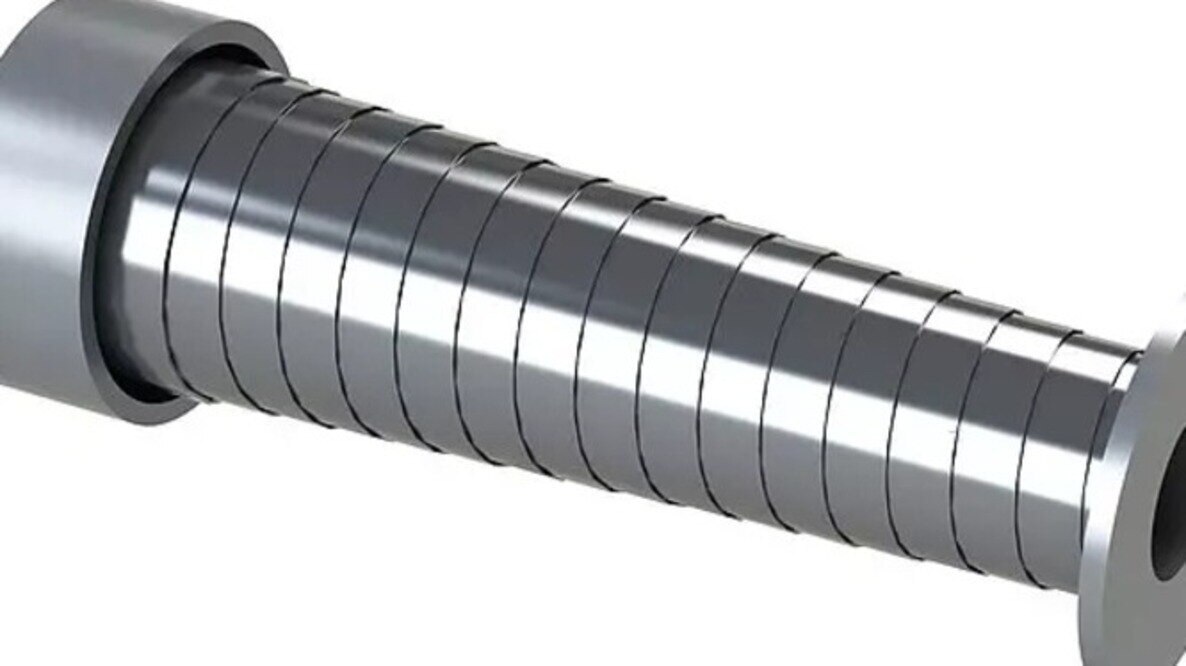
Yes, but only when the spring is designed as part of the bellow assembly rather than added as a generic support. By comparing spring positions, pressure effects, movement data and inspection requirements, you can decide whether reinforcement is mechanically sound and prepare a specification that a supplier can verify.
Key takeaways
- Use a spiral spring when suction or bending could collapse the bellow wall.
- Place the spring where it supports the bend without rubbing the duct or machinery.
- Specify pressure, temperature, movement, dimensions and cycle rate before ordering.
- Check spring compression, clearance and flange loads at both movement limits.
When a spiral spring makes a duct bellow workable
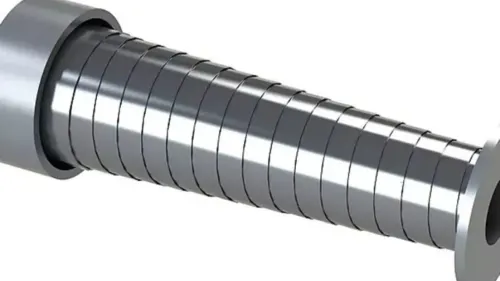
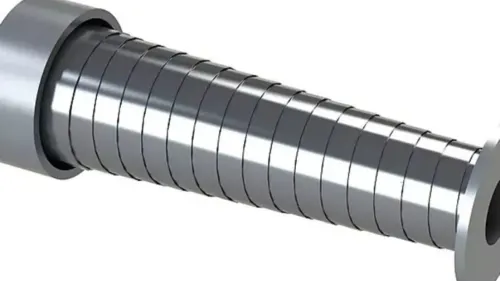
A spiral spring makes a fabric or elastomeric duct bellow workable when suction, negative pressure, or repeated bending could fold its wall inward. The helical support spreads the load along the bend, preserves an open air path, and reduces local kinking while the bellow moves between connected duct sections.
It is reinforcement, not a pressure rating. The spring does not prove that the fabric, seams, cuffs, flanges, or attachment hardware can withstand internal pressure, vacuum, temperature, airflow, or cyclic movement. Treat the bellow and spring as one tested assembly; choosing the spring from duct diameter alone is unsafe.
Use the spring only when the specified minimum bend radius and compression and extension strokes leave the coils clear of the wall. A spring that binds during compression can shorten the stroke, rub through fabric, create a pinch point, or push loads into duct flanges.
It cannot compensate for unsupported duct weight, poor guides, excessive sag, or misalignment.
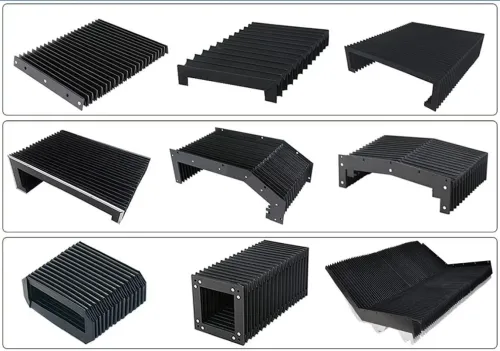
A spring-reinforced duct bellow is not a metal expansion-joint bellows. Formed metal convolutions provide a pressure boundary and are engineered for pressure thrust, stability, and fatigue; a flexible duct bellow usually serves as an air connection or motion-protection element.
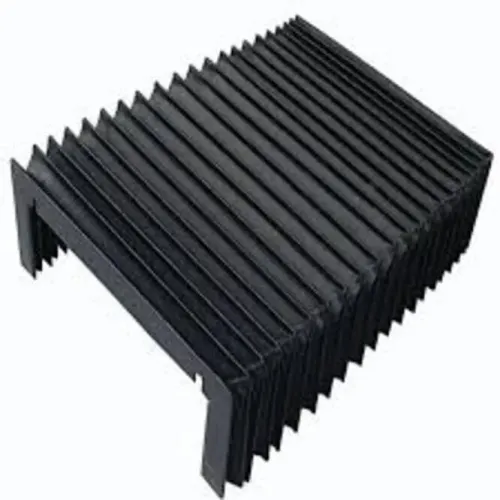
Nor is it a telescopic spring cover, which protects a machine member externally rather than carrying airflow.
Confirm the design covers:
- Minimum bend radius and full stroke
- Pressure or suction and temperature
- Cycle count, vibration, and support arrangement
- Wall, seam, cuff, and flange protection
Where the spring belongs: inside, outside or in a pocket
The safest default is an external spring in a dedicated pocket, not a loose coil in the airflow. That arrangement supports the flexible wall during suction and bending while keeping the bore smooth and preventing conveyed dust, fibres or vapour from striking the spring.
| Spring position | Main benefit | Main risk |
|---|---|---|
| Inside the bore | Direct support against inward collapse | Reduces available area, increases turbulence and pressure drop, and exposes the spring to corrosion, particle impact and cleaning damage |
| Outside the wall | Keeps the airflow unobstructed and simplifies internal cleaning | The coil can rub, snag or abrade the wall unless its movement and clearances are controlled |
| In a welded or sewn pocket | Holds the spring in position and separates it from the conveyed stream | A poorly placed pocket can pinch the wall, shorten the stroke or create a hard ridge that wears through the fabric |
Use an internal spring only when collapse control outweighs airflow and cleanability concerns. For abrasive, dusty or hygienic service, place the spring outside the air path and specify a pocket that allows the bellow to flex without clamping the coil. A pocket is not automatically safe: inspect its seams, bend radius and end stops.
A search for duct bellow with spiral spring canberra identifies a location, not a design. Confirm bore clearance, movement and cleaning access before accepting any spiral spring duct bellow Canberra quotation. A duct bellow supplier Canberra search cannot replace those dimensions.
The operating data that decides spring suitability
A spring choice based only on duct diameter is a failure waiting to happen. Calculate the full operating envelope before selecting wire diameter, coil pitch, spring rate, or material.
| Parameter | Calculate | Why it matters |
|---|---|---|
| Duct geometry | Inside diameter, compressed length, extended length, axial stroke, lateral movement, and minimum bend radius | A tight bend or excessive stroke can crush the wall, seam, or end cuff |
| Loading | Internal pressure, suction or vacuum, unsupported weight, and flange loads | A reinforcement spring does not automatically make the bellow pressure-rated |
| Environment | Minimum and maximum temperature, humidity, chemicals, dust, and airflow velocity | Carbon steel can corrode; stainless wire improves resistance but does not suit every chemical or temperature |
| Motion | Cycle count, cycle rate, vibration frequency, and start-stop pattern | Fatigue and rubbing depend on repeated movement, not just the total stroke |
| Clearance | Spring outside diameter, pocket clearance, and contact points through the stroke | Insufficient clearance creates abrasion, pinching, or a restricted movement |
Select the spring after checking its force against the bellow’s collapse load under suction. Then confirm that the spring neither pushes the flexible wall outward nor transfers movement forces into the duct flanges.
The phrase spiral spring duct bellow canberra identifies a location, not a specification. A Canberra buyer searching duct bellow supplier Canberra still needs to provide the dimensions, pressure, vacuum, temperature, chemistry, airflow, movement, and required cycle life. Without those figures, a quotation compares shapes rather than safe operating performance.
How to prevent collapse, rubbing and flange loads
Keep the spring from carrying loads it was never designed to carry. A helical reinforcement can resist local collapse, but unsupported duct weight, excessive bend, or a restricted stroke will push force into the bellow wall, cuffs and flanges.
1. Set the installed length, compressed length, extended length, axial stroke and lateral offset before fitting the assembly. Add a stop or external restraint where the bellow could exceed its specified stroke; over-extension can pull seams apart, while over-compression creates folds that rub against the spring.
2. Provide guides and independent duct supports on both sides. The spring must not act as a hanger, and the flexible section must not sag onto a sharp frame, nearby pipe or equipment nozzle. Use flexible alignment rather than forcing the flanges into position.
3. Keep the spring concentric and restrained at its ends. If it sits inside the airflow, specify a smooth, secure arrangement with clearance from the wall; rubbing can wear fabric, elastomer or coatings and can release particles. Check the helix for pinch points through the full bend cycle.
4. Tighten flange fasteners evenly and use gaskets that match the duct material and temperature. Do not pull misaligned ductwork together with bolts, because that preloads the connection and transfers vibration into the bellow.
Before accepting a quotation, reject any answer that gives only a diameter. A search for duct bellow supplier canberra is a location query, not evidence of suitable stroke, support design, vacuum resistance or flange-load control.
What to put on the enquiry before ordering in Australia
Put the design conditions on the enquiry, not merely “spring-reinforced duct bellow.” Searches for industrial duct bellows Australia describe a sourcing category; they do not prove suitability for your service. State whether the item is a flexible air-path connection or an external protective cover.
- Give the clear bore, compressed and extended lengths, axial stroke, lateral movement, bend radius and required cycle rate.
- State the connection type, flange dimensions, bolt pattern, end restraints, guide arrangement and support spacing.
- Specify positive operating pressure, maximum vacuum or suction, airflow velocity, vibration frequency and any pressure transients.
- Name the media, temperature range, humidity, ozone, chemicals, abrasive dust and cleaning method.
- Identify the wall material, reinforcement, spring material, spring position, allowable compression and minimum coil clearance.
- Request drawings showing the assembled envelope, pinch-point protection and loads transmitted to each flange.
- List required evidence: material data, pressure or vacuum test results, leakage limits, fire and smoke classification, insulation and acoustic requirements.
For HVAC work, ask the supplier to identify which parts of AS 4254 apply to the ductwork and flexible ductwork, then verify project-specific fire, smoke and leakage requirements. Do not treat a spiral spring as a pressure rating; a metal expansion-joint bellows is a different pressure-boundary design.
SCUTES INDIA PRIVATE LIMITED can be asked to separate a duct-bellow proposal from a telescopic spring-cover proposal, preventing an external machine-protection component from being specified as an air-path assembly.
Related product
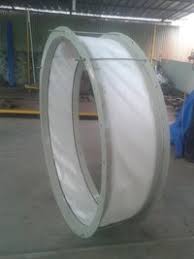 | Duct Bellows HVAC systems and industrial ducting rely on high-quality duct bellows for durability and performance. View product → |
Frequently asked questions
When does a duct bellow need a spiral spring?
Use a spiral spring when suction, negative pressure or repeated bending could fold the wall inward and restrict airflow.
Where should the spiral spring sit in a duct bellow?
The spring can sit inside, outside or in a dedicated pocket. Select the position that supports the bend while maintaining clearance and preventing contact with the conveyed material.
What operating data determines spiral spring suitability?
Provide positive or negative pressure, temperature, duct diameter, bend radius, axial and lateral movement, cycle rate, conveyed media and installation orientation.
How do you prevent collapse, rubbing and flange loads?
Check the bellow at full extension, compression and lateral offset; provide spring clearance, control the bend radius and verify that movement does not transfer damaging loads into the flanges.