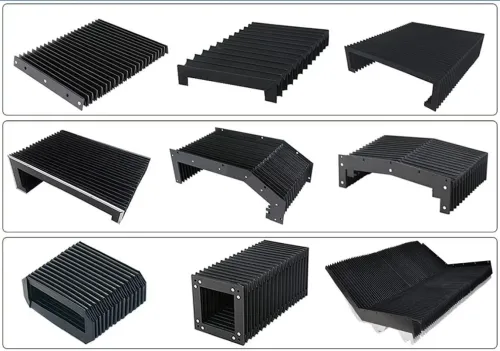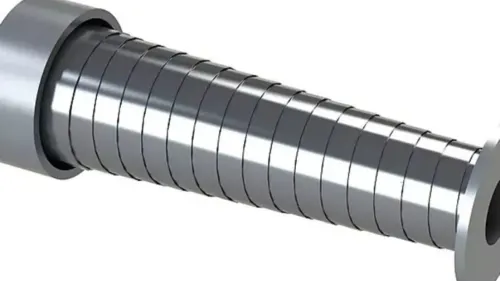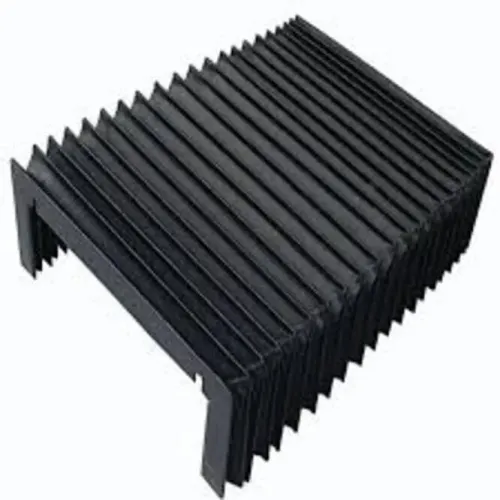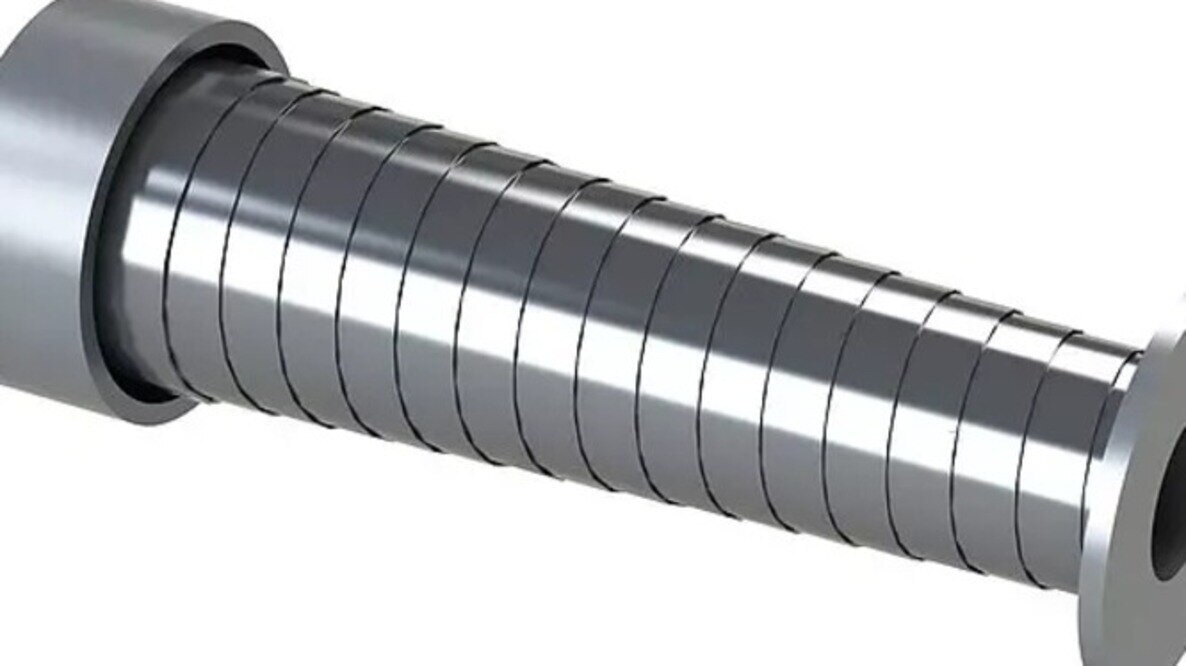
A quoted “spiral spring” cover can describe a roll-up steel curtain, a spring-loaded return mechanism, or an auxiliary part inside a rigid telescopic assembly. You will be able to identify each included component, provide the dimensions and motion data needed for fit, and test whether the design suits your chips, coolant, speed and machine layout.
Key takeaways
- Clarify whether the spiral spring is the curtain, return mechanism or auxiliary component.
- Check stroke, closed length, section overlap and machine clearances before approval.
- Compare rigid telescopic covers with spring covers by contamination, speed and access needs.
- Accept the assembly only after checking movement, seals, fasteners and protection boundaries.
The components inside a CNC telescopic cover with spiral spring
A quotation should state whether the spiral spring is the protective curtain, a spring-loaded return mechanism, or an auxiliary part inside a nested telescopic assembly.
These designs are not interchangeable: a roll-up cover uses a flexible spring-steel strip wound on a drum, while a conventional telescopic cover uses overlapping rigid boxes that slide into one another.
Request these spiral spring machine cover details as physical line items:
- Cover sections or boxes, including their number, sheet material, thickness, stepped dimensions and overlap.
- Flexible strip, if it forms the curtain, including steel grade, thickness, width, surface finish and maximum travel.
- Spiral spring, drum or coil, including spring torque or pretension, coil diameter and rewind arrangement.
- Guide rails, rollers or tracks that keep the strip or sections aligned during extension and retraction.
- Mounting flanges, brackets and the hole pattern for attaching the cover to the machine.
- Scrapers, wipers or brushes at the moving edges, including their material and replaceable insert design.
- Mechanical stops, end buffers and travel-limit provisions that prevent overextension or coil damage.
- Fasteners, spacers and seals supplied with the assembly, rather than items left for site fabrication.
- Drain holes, coolant channels, trays and lubrication points where fluid or swarf could collect.
- Removal access and the replacement method for the strip, spring, wipers and wear parts.
A guideway cover is not automatically a personnel guard. If it must prevent access to hazardous motion, specify and validate that safety function separately.
The dimensions and clearance checks that establish fit
A cover cannot be sized from the machine model alone. Provide the machine’s closed position, full travel, available mounting space and every obstruction along the axis; a few millimetres of unrecorded interference can stop the cover before the machine reaches its limit.
1. State the required stroke, closed length and maximum extended length. These dimensions establish how far the cover must travel and how much space remains when retracted. The number of telescoping sections is a design result: more sections shorten the closed package but add weight, interfaces and alignment sensitivity.
2. Give the available cover width and height, including the maximum envelope above the guideway. Show the guideway opening, mounting faces, flange dimensions, hole pattern, bolt access and any uneven or interrupted surfaces.
3. Identify the axis orientation and motion direction: horizontal, vertical or inverted. For a spiral-spring arrangement, include the permitted coil or drum location, strip path, guide arrangement, spring housing clearance and replacement access.
4. Mark the spindle, tooling, table, ballscrew, linear guide, coolant lines, chip conveyor, guarding and service doors on a machine drawing or coordinate sketch. Check clearance at both travel limits and through the complete stroke, not only with the cover fully open or closed.
5. Record travel speed, acceleration, stopping position and any overtravel. These values affect section movement, spring force and the risk of contact at reversals.
For “cnc machine telescopic cover specifications canberra”, location alone establishes nothing about fit. Send the actual drawing and state indoor or outdoor exposure, cleaning method and required maintenance access so the proposed dimensions remain usable at the Canberra site.
How a rigid telescopic cover differs from a spiral-spring cover
Rigid and spiral-spring covers extend, retract and carry axis loads through different mechanisms. A rigid cover uses nested sheet-metal sections that slide on guides as the machine axis moves. Overlapping sections transfer impact and support forces through guide rails, sliding faces, stops and mounting frames rather than through the spring.
Rigid telescopic cover | Spiral-spring cover Extension | The moving axis pulls nested sections apart while their overlap remains engaged. | A flexible steel strip unwinds from a drum or coil and travels through guides. Retraction | Sections slide back into a compact stack, controlled by guides and end stops.
| Spring torque rewinds the strip onto the drum as the axis returns. Motion-load transfer | Panels, rails, stops and frames resist chip impact, vibration and limited external force. | The strip carries tension and bending; guides and the drum carry the return force, not heavy impact loads.
Best fit | Use where sharp chips, hot swarf or stiffness demand protection. | Use where retracted space is tight and a compact cover is more important than impact resistance.
A spiral spring can also serve as a return mechanism inside another cover, so confirm whether it is the protective strip or only an auxiliary component. Do not treat both designs as interchangeable.
For a Canberra enquiry, cnc machine telescopic cover for spiral spring inclusions canberra is a search phrase, not a design specification. State the axis direction, travel, speed, acceleration, chip hazard and available retracted length before selecting either mechanism.
Materials, operating limits and protection boundaries
A cover survives only when its materials match the actual attack. Specify cold-rolled, galvanized, stainless, or coated steel by grade, thickness, surface treatment, and stiffness; “painted steel” does not identify a coating system. Stainless steel also needs coolant-compatibility checking, because chloride-bearing fluids and abrasive slurry can still cause corrosion or wear.
Record these service inputs before approving the design:
- Coolant type, concentration, temperature, and application rate
- Chip form, including sharp, heavy, hot, stringy, or abrasive particles
- Grinding dust, swarf accumulation, and cleaning method
- Indoor or outdoor exposure, ambient-temperature range, humidity, and corrosion risk
- Horizontal, vertical, inverted, or inclined orientation
- Maximum travel, speed, acceleration, cycle frequency, vibration, and permitted driving force
- Available retracted space, service access, and replacement lead time
For telescopic cover applications in Canberra, the location does not select the spring or determine the dimensions. The machine envelope and site conditions do: provide the guideway opening, mounting faces, travel limits, nearby obstructions, and cable or hose routes.
Define the protection boundary in writing. State whether the cover must block coolant, chips, grinding dust, hot fragments, or operator contact, and identify anything outside its duty, such as immersion, direct cutting-tool impact, or unsupported loads. A roll-up spiral-spring curtain suits compact axes, but a rigid cover offers stronger resistance to heavy or sharp chips.
Verify the spring, guides, wipers, and stops for the specified orientation; gravity and inertia can overload a design that worked on a slow horizontal axis.
How to specify, inspect and accept the complete assembly
Request a complete assembly drawing and itemised bill of materials, not a cover-only price. The quotation must identify the nested sections or spring strip, drum, guides, mounting flanges, wipers, stops, fasteners, drains, lubrication points and replacement parts; state whether motors, controls and way lubrication are excluded.
1. Send the supplier a machine drawing showing closed and extended lengths, stroke, width, height, mounting-hole pattern, axis orientation, travel speed and acceleration. Mark the spindle, tooling, ballscrew, linear guide, coolant lines, chip conveyor and guarding through the full stroke.
2. Ask for section or strip material and thickness, spring torque or pretension, guide details, allowable speed, acceleration, load direction, temperature range, cleaning method and service access.
State the coolant, chip type, grinding dust, corrosion exposure and required replacement lead time at the Canberra site; “cnc machine telescopic cover specifications canberra” is not a substitute for these inputs.
3. Require dimensional tolerances, anchor loads, drainage details, wiper replacement instructions, inspection records and a defined ingress test if you need an enclosure rating. Wipers alone do not establish an IEC 60529 IP rating.
4. During commissioning, run the axis at low speed, then full travel and rated acceleration. Check smooth extension and rewind, spring force, section overlap, wiper contact, mounting security, noise, drainage and interference.
For telescopic cover applications Canberra, SCUTES INDIA PRIVATE LIMITED should receive the same marked-up envelope before confirming spring selection. Accept only against signed measurements and recorded test results.
Related products
 | TELESCOPIC SPRING COVER Telescopic Spring Covers provide protection under extreme conditions. View product → |
 | TELESCOPIC COVERS A telescopic cover protects guide-way surfaces and components of moving axis of machines. View product → |
Frequently asked questions
What does a CNC telescopic cover with spiral spring include?
The quotation should identify the cover sections, spiral spring function, guides, wipers, scrapers, seals, mounting hardware and any return mechanism.
Which dimensions establish whether the cover will fit?
Check the closed length, extended length, stroke, section width and height, mounting points, travel direction, section overlap, spring clearance and nearby machine components.
How does a rigid telescopic cover differ from a spiral-spring cover?
A rigid telescopic cover uses nested metal boxes that move along guides, while a spiral-spring cover uses a coiled spring as a protective or retracting element. Select between them based on space, travel, contamination, speed and access requirements.
What should you inspect before accepting the complete assembly?
Confirm the specified materials and limits, then check smooth travel, section alignment, seal contact, fastener security, spring return, retracted clearance and protection of the intended machine zone.