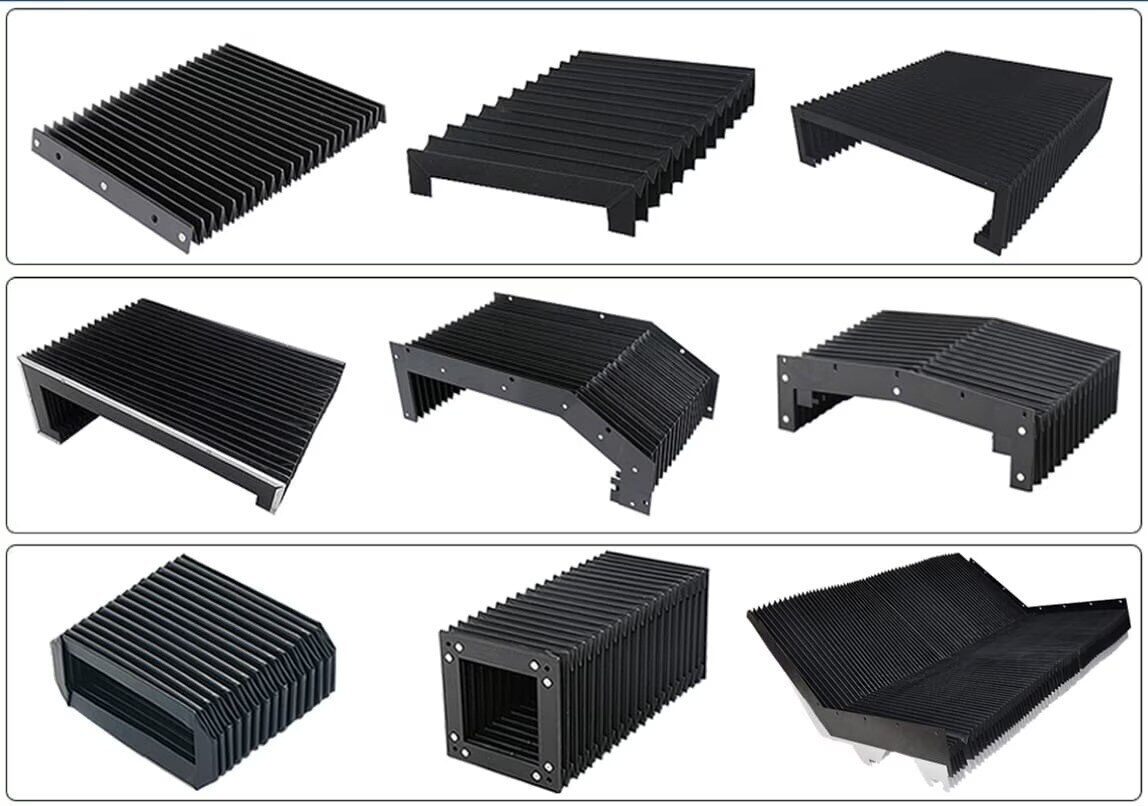
The correct cover depends on more than axis travel: fine smoke residue, hot spatter, coolant, beam-path clearance, motion speed, and the need for sealed separation all change the answer. By the end, you will be able to compare the two constructions, measure the installation space, identify laser-specific risks, and write a supplier specification that avoids a premature failure.
Key takeaways
- Choose round bellows for continuous enclosure and flexible protection around moving axes.
- Choose spiral spring covers where compact clearance and metal shielding suit the application.
- Measure stroke, compressed length, outside diameter, and mounting space before ordering.
- Specify contaminants, heat load, speed, and guarding instead of relying on product names.
What separates a round bellow from a spiral spring cover?
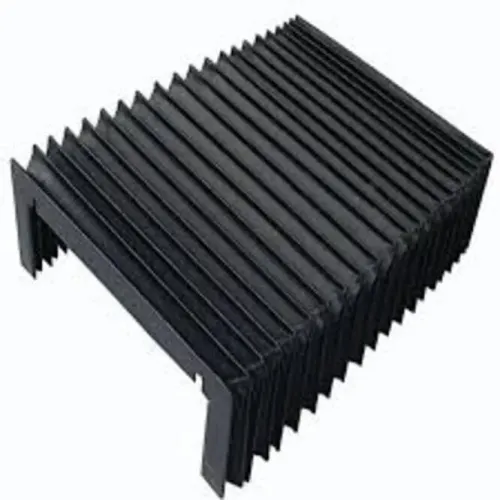
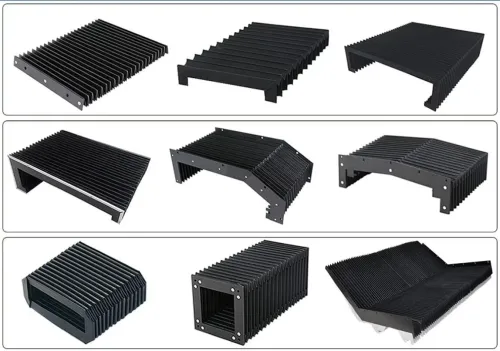
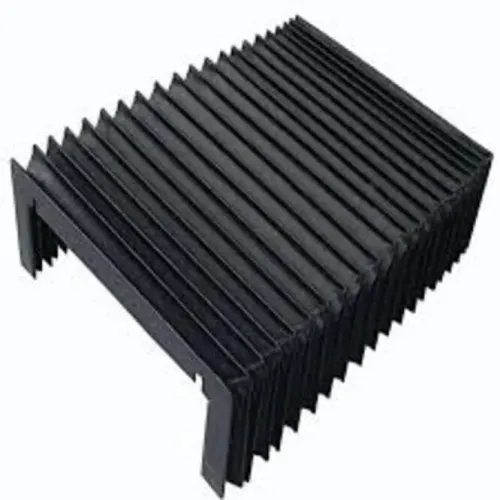
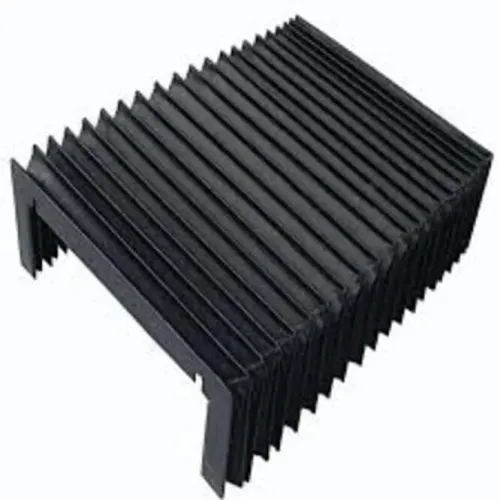
A round bellow expands and contracts through pleated fabric or coated material, forming a continuous enclosure around a moving axis. Its end frames attach to the machine and moving carriage, while the folds accommodate stroke and minor misalignment.
Sealed seams and end connections determine whether it separates the mechanism from fine dust, smoke residue, or coolant mist.
A spiral spring cover uses a wound strip of spring steel that travels through overlapping coils as the protected part moves. It creates a compact metal shield, not a sealed bellows enclosure; open coil gaps, end openings, and poor drainage can admit contamination.
| Construction | Protection behaviour | Suitable laser-machine location |
|---|---|---|
| Round bellow | Continuous flexible separation; requires correct fold geometry, compressed length, and sealed ends | Linear guideways, ball screws, focusing-head axes, and beam-adjacent mechanisms where dust or mist must stay away |
| Spiral spring cover | Rigid overlapping coil shield; compact and resistant to abrasion, but not dust-tight or coolant-tight by default | Exposed shafts, screws, rotary axes, and narrow machine spaces where chips or mechanical contact are the main threat |
For a round bellow laser machine application, leave room for full compression so folds do not rub, buckle, or trap chips. A spiral cover suits a short, straight, well-supported travel path; it is a poor substitute where smoke residue or coolant must be excluded continuously.
Neither design automatically guides power, signal, fiber-optic, gas, or coolant lines. Provide a separate cable carrier or routed protection system with the required bend radius, torsion control, separation, and strain relief.
Match the cover to the contaminant and heat load
A useful laser machine bellow comparison starts with the hazard, not the axis stroke. A round bellow gives continuous separation when its fabric, folds, seams, and end connections are sealed; a spiral spring cover exposes coil interfaces that need wipers, scrapers, labyrinths, or a secondary shield.
| Hazard or load | Better starting choice | Selection condition |
|---|---|---|
| Fine dust | Round bellow | Seal the ends and seams; folds can collect abrasive dust. |
| Smoke residue | Round bellow | Use a smooth, cleanable material and prevent deposits from entering at the mounts. |
| Coolant or mist | Round bellow | Confirm coolant and cleaning-chemical resistance; do not assume the fabric is liquid-tight. |
| Sharp chips | Spiral spring cover | Its metal surface tolerates impact and abrasion better than textile folds. |
| Hot chips or molten spatter | Spiral spring cover or metal-shielded bellow | Check contact temperature, radiant heat, and spatter exposure; add a sacrificial shield. |
| Assist-gas turbulence | Round bellow | Continuous coverage reduces paths for smoke and fine particles, if the mounting is sealed. |
| Vibration | The lighter, properly supported design | Compare moving mass, acceleration, coil resonance, fold flutter, and mount stiffness rather than choosing by label. |
| Laser-generated heat | Neither cover alone | Keep the cover outside the beam and hot plume; use heat shielding, reflective metal, standoff distance, and a verified temperature rating. |
The spiral option is not dust-tight or coolant-tight by default. A cover that protects against mechanical contamination does not establish laser safety under IEC 60825-1 or machine guarding under ISO 12100; assess those functions separately.
Measure the axis before choosing a cover
A cover needs more than the axis stroke. Measure the space occupied at both ends of travel, because a cover that fits when extended can bottom out when compressed, rub a guideway, or lose coverage at the opposite end.
Record these dimensions and conditions before comparing machine protection options:
- Extended length and compressed length, including the cover’s minimum fold or coil length
- Stroke, outside diameter, inside diameter, shaft or guideway clearance, and available space at full travel
- Mounting-hole pattern, flange position, and any fixed obstruction near the axis
- Axis orientation, horizontal or vertical mounting, and the unsupported span
- Speed, acceleration, vibration, reversing frequency, and permitted moving mass
- Misalignment, angular movement, and minimum bend radius where the axis does not remain straight
| Dimension | Round bellow | Spiral spring cover |
|---|---|---|
| Extended-to-compressed ratio | Confirm pleat geometry and compression limit; over-compression causes fold rubbing or collapse | Confirm coil overlap and telescoping length; tight packing can snag |
| Radial clearance | Allow for fold bulging, support rings, and lateral movement | Allow for coil runout, mounting guides, and shaft eccentricity |
| Motion quality | Handles moderate misalignment and irregular travel better | Needs controlled alignment; skew can jam or scrape coils |
| Coverage at reversal | Check that folds reopen fully without trapped chips | Check overlap, end seals, and wipers at every position |
| Installation space | Reserve clearance around the largest folded diameter | Reserve clearance for coil growth and drainage orientation |
Test the cover through the complete stroke at operating speed, including rapid reversals. Static clearance alone will not reveal a fold that flutters into the laser head or a coil that catches a cable.
Check clearance, guarding, and the complete machine layout
Prevent interference by checking the cover in the machine’s complete 3D layout at every axis position, not only at zero. Confirm clearance at maximum extension, maximum compression, acceleration, vibration, and during maintenance access.
Verify each point before releasing the design:
- Move the laser head through the full work envelope and confirm that the round bellow or spiral spring laser cover cannot strike the head, focusing optics, nozzle, fixture, or workpiece.
- Check the cover’s outside diameter, compressed length, mounting hardware, and end frames against nearby guideways, shafts, rotary axes, and enclosure panels.
- Route power, signal, fiber-optic, assist-gas, and coolant lines independently. A cover does not replace a cable carrier, bend-radius control, torsion allowance, or strain relief.
- Confirm that the cover cannot touch limit switches, proximity sensors, hard stops, linear scales, or their targets at either travel limit.
- Trace chip, spatter, smoke, coolant, and cleaning-fluid paths. Add wipers, scrapers, labyrinths, or a secondary shield where coil joints or bellows folds leave exposure.
- Keep the cover outside the beam path and verify that it cannot obstruct the focusing lens, nozzle adjustment, extraction flow, interlock access, or emergency-stop operation.
- Check that guarding remains closed and effective after installation. IEC 60825-1 laser-product safety and ISO 12100 machine-risk assessment address different hazards.
Run a slow dry cycle after installation, then inspect witness marks, cable tension, sensor faults, and restricted travel. A clearance failure at operating speed can damage the cover before an operator sees it.
Use a specification-based decision instead of a product label
Give the supplier a duty specification, not “a cover for a laser.” State:
- Axis stroke, speed, acceleration, cycle rate, compressed and extended lengths
- Outside and inside diameters, shaft clearance, mounting-hole pattern, bend or offset requirement
- Dust, chips, spatter, coolant, smoke residue, vibration, and cleaning method
- Temperature at the cover, heat-radiation exposure, material limits, and required ingress performance
- Whether the moving member contacts the cover throughout travel, plus cable, fiber, gas, and coolant routing
A useful laser machine bellow comparison looks like this:
| Option | What it means | When it applies |
|---|---|---|
| Round bellow | Pleated flexible enclosure with defined folded length and end fittings | Choose it for sealed protection against fine contamination, coolant, smoke residue, or heat when the axis needs flexibility, an offset, or continuous coverage. |
| Spiral spring cover | Overlapping wound metal coils forming a compact shield | Choose it for straight shafts, screws, or guideways facing chips and mechanical impact when low moving mass and short installation space matter. Confirm coil overlap, orientation, wipers, end seals, drainage, and tested contamination limits; it is not dust-tight or coolant-tight by default. |
| Combined arrangement | Separate covers assigned to separate hazards or zones | Use a bellow at a sealed axis interface and a spring cover at a chip-facing guideway, while keeping lines in a correctly sized cable carrier. |
Neither option guides power, signal, fiber-optic, gas, or coolant lines. Specify their bend radius, torsion, separation, and strain relief separately. SCUTES INDIA PRIVATE LIMITED can be included in the comparison when its design review addresses these measured conditions rather than supplying a product label.
Keep laser enclosure, beam-stop, and interlock decisions under IEC 60825-1 and ISO 12100 risk assessment; a machine protection cover is not a laser safety system.
Related products
 | Laser Machine Bellows Laser Machine Bellows are specialized protective coverings designed to safeguard the vital internal components of laser machines. View product → |
 | TELESCOPIC SPRING COVER Telescopic Spring Covers provide protection under extreme conditions. View product → |
Frequently asked questions
What separates a round bellow from a spiral spring cover?
A round bellow uses pleated fabric or coated material to form a continuous enclosure around a moving axis. A spiral spring cover uses overlapping metal coils that expand and retract as the axis moves, providing a compact shield.
How do you match a cover to laser-machine contaminants and heat?
Identify the contaminants first, such as dust, chips, coolant, fumes, or abrasive particles. Then check the expected surface temperature, radiant heat, laser wavelength exposure, cleaning method, and required material resistance before choosing the cover.
What measurements are needed before choosing a cover?
Record axis stroke, extended and compressed lengths, shaft or guideway diameter, cover outside diameter, mounting-face dimensions, travel speed, acceleration, and the available clearance around the moving assembly.
Why must clearance, guarding, and the complete machine layout be checked?
The cover needs room to extend, compress, bend, and attach without rubbing nearby parts. Check interference with cable carriers, optics, access doors, guards, service tools, and the full range of machine motion.