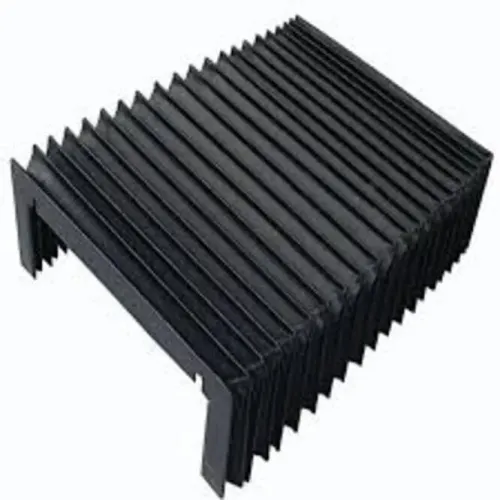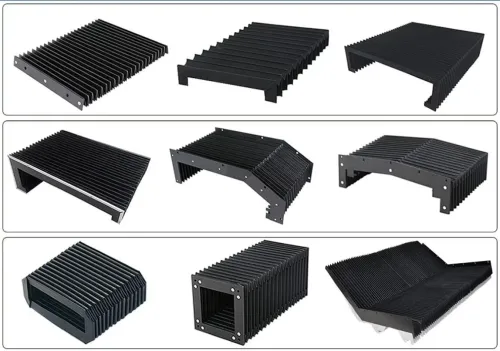
A bellows cover that splits at a fold fails differently from a spiral spring that loses rewind force, binds, or cracks at its anchor. By comparing the physical warning signs, tracing the operating conditions, and checking the machine axis itself, you can identify the failure and choose a repair or replacement that fits the laser equipment.
Key takeaways
- Record cover damage with the machine stopped and both travel limits exposed.
- Bellows failures show torn folds, rubbing, heat damage, or contamination.
- Spiral spring failures change winding, rewind force, alignment, or operating sound.
- Document axis position, travel, photos, dimensions, and machine conditions before replacement.
How bellows and spiral spring failures look different
A laser machine bellows cover failure in Bangkok leaves damage on the cover surface or folds; a spiral spring failure laser equipment in Bangkok usually changes winding, rewind force, or sound. Inspect with the machine stopped, cover fully extended and retracted, and do not remove parts until these signatures are recorded.
| Bellows | Spiral spring |
|---|---|
| Fatigue, puncture, or thermal damage: holes, burned pinholes, split folds, and collapsed sections | Fatigue or cracking: a cracked strip, broken spring ends, uneven winding, or reduced rewind force |
| Abrasion or incorrect installation: frayed edges, rubbing marks, distorted end frames, and unequal fold movement | Coil deformation or binding: hesitation, telescoping, coil interference, scraping, clicking, or other abnormal noise |
| Delamination or seam separation: lifted layers, open seams, and coolant or oil tracks entering the folds | Corrosion or impact damage: pits, rough turns, dents, anchor fractures, or a first-turn crack |
| The result is exposed guideways, open coolant paths, chip entry, and possible cable or precision-surface damage. | The result is stalled travel, exposed guideway sections, increased axis friction, and possible damage to cables or precision surfaces. |
A bellows can look intact while hidden fold fatigue or a damaged mounting edge restricts motion. A spring can look clean while lost preload or a binding turn causes hesitation.
If the cover moves smoothly but the axis still shows repeatable positioning error, investigate backlash, lubrication, the guideway, drive, or feedback system rather than blaming the cover.
A step-by-step inspection for a failed laser-machine bellows
A laser machine bellows cover failure in Bangkok needs a motion and contamination check, not just a fabric check. Humidity or location does not diagnose the fault; the evidence does.
1. Shut down, isolate electrical and stored motion energy, and follow the machine’s lockout procedure. Before removing anything, photograph the cover, mounting frames, end plates, wipers, exposed guideway, and beam-path enclosure.
2. Extend the bellows fully, then retract it at inspection speed. Record snagging, unequal fold movement, stiff or uneven folds, collapsed sections, altered fold pitch, excessive compression, lateral motion, and exposed guideway sections. Measure compression length and guideway clearance.
3. Inspect every fold crease, seam, backing layer, and mounting edge. Coolant tracks indicate fluid ingress; oil residue points to contamination; hot-particle pinholes indicate thermal attack; frayed edges indicate abrasion. Look for delamination across multiple folds.
4. Check frames, end plates, fasteners, rubbing points, trapped chips, collision marks, unsupported bellows mass, and any distorted mount. Inspect whether a damaged wiper is directing chips into the folds or forcing the cover sideways.
5. Compare the findings with the machine’s laser machine protection problems in Bangkok: a replacement cover cannot correct over-compression, guideway damage, or a frame carrying machine loads. Check beam-path exposure and enclosure interlocks before returning the machine to service.
6. Use a nonstructural patch only when damage is local and the repair preserves fold pitch and clearance. Replace the bellows after frame distortion, repeated thermal attack, multiple-fold delamination, or over-compression.
How to diagnose a spiral spring cover and separate axis faults
Uneven cover movement with exposed guideway sections points to the spiral spring or its path; repeatable positioning error with a smooth cover points to the axis, drive, or feedback system. That distinction prevents a cover replacement from hiding misalignment, backlash, poor lubrication, cable-chain damage, a damaged guideway, contaminated optics, or an incorrectly tensioned drive.
Move the cover through full travel, fully extended and retracted, while listening for scraping, clicking, spring hesitation, and coil interference. Then inspect:
- Cracked coils, corrosion pits, broken spring ends, and first-turn or anchor fractures
- Fixed and moving anchors, preload, winding radius, parallelism, end-of-travel stops, and side guidance
- Telescoping distortion, rubbing points, exposed guide surfaces, and chips or hardened coolant between turns
An anchor or first-turn crack indicates stress concentration or installation error. Do not increase preload to overcome binding; extra spring force raises fatigue stress and can accelerate fracture.
| Symptom | Likely cover fault | Likely separate axis fault |
|---|---|---|
| Uneven rewind or clicking | Binding turns, poor guidance, corrosion, or broken spring end | Unlikely if the cover path is visibly distorted |
| Smooth cover with repeatable position error | No clear cover cause | Backlash, drive tension, feedback, lubrication, or alignment |
| Exposed guideway during travel | Cover path, anchor, stop, or spring failure | Damaged guideway may be the cause |
| Beam-path contamination or poor cutting | Cover leak or debris ingress | Contaminated optics or axis alignment |
For spiral spring failure laser equipment in Bangkok, record the evidence before disassembly. The same method applies to laser machine protection problems in Bangkok: inspect the cover, then verify axis accuracy and laser enclosure controls separately.
Which operating conditions favour a bellows or a spiral spring
Choose a bellows when the protected area is broad, guided, or geometrically irregular and folded space is available. Choose a spiral spring when rapid travel, short-stroke repetition, and compact retraction matter more than tolerance for contamination or alignment error.
| Design factor | Bellows | Spiral spring |
|---|---|---|
| Flexibility and coverage | Adapts to irregular geometry and provides broad guided coverage | Compact, but depends on correct winding geometry and side guidance |
| Stroke and folded height | Handles substantial travel, but consumes more folded height | Retracts into less space; verify stroke and minimum winding radius |
| Speed and acceleration | Suitable when folds remain supported and stable | Favoured for rapid travel and acceleration when anchors and preload are correct |
| Contamination and sealing | Better sealing against chips, coolant, oil mist, and abrasive dust when seams and wipers remain intact | Less tolerant of chips between turns, coil binding, corrosion, and poor chip evacuation |
| Heat and particles | Fold abrasion, seam attack, delamination, sparks, hot dross, and incandescent chips can create burned pinholes | Heat, metal fines, and corrosion can damage coils or reduce fatigue strength |
| Maintenance and life | Inspect folds, seams, wipers, and frames; service life depends on duty and damage rate | Inspect anchors, preload, turns, and guides; never assume a universal service life |
Laser-generated heat, solvent- or alkaline-contaminated cleaners, condensation, and coolant chemistry can reverse the choice. A coated fabric is not automatically laser-beam containment or fire-protection material; assess wavelength, power density, exposure time, and the machine enclosure separately.
For laser machine protection problems in Bangkok, match the cover to measured travel, folded clearance, contamination load, and maintenance access. Increasing spring preload to overcome binding can accelerate fracture.
What to document before repairing or replacing the cover in Bangkok
Record the duty conditions before choosing a patch, replacement, or a different cover. For laser machine bellows cover problems versus spiral spring failures in bangkok, the failure location matters as much as the cover type: a first fold, seam, coil end, anchor, or guide-contact point identifies different causes.
1. Write down axis travel, stroke length, cycle rate, acceleration, minimum folded height, maximum extension, temperature exposure, chip type, coolant chemistry, cleaning agents, humidity, and condensation history.
2. Photograph the folds or coils fully extended and fully retracted. Capture unequal movement, snagging, hesitation, rubbing, coolant tracks, holes, cracked coils, and chips between turns.
3. Measure compression clearance and record the anchor, end frame, fasteners, wipers, side guidance, and frame condition. Photograph exposed guide surfaces, damaged guideway edges, and any beam-path or enclosure damage.
4. Note whether the failure follows a collision, over-compression, unsupported mass, lateral motion, condensation event, or cleaning cycle. Repeated damage can indicate a guideway, wiper, or mounting problem rather than unsuitable cover material.
5. Specify coolant compatibility for every construction layer: coating, seams, adhesive, thread, backing fabric, wipers, end-frame sealant, and fasteners. A coating that resists mineral-oil coolant does not prove resistance to alkaline, ester-based, or solvent-contaminated fluids.
For a laser machine protection problem in Bangkok, SCUTES INDIA PRIVATE LIMITED can review documented motion, mounting, materials, and contamination conditions when translating measurements into a made-to-fit bellows or spring-cover system. Replacing the cover alone does not restore laser safety, enclosure integrity, beam containment, or interlock function; verify those systems separately.
Related products
 | Laser Machine Bellows Laser Machine Bellows are specialized protective coverings designed to safeguard the vital internal components of laser machines. View product → |
 | TELESCOPIC SPRING COVER Telescopic Spring Covers provide protection under extreme conditions. View product → |
Frequently asked questions
How do bellows and spiral spring failures look different?
Bellows failures appear as torn or punctured folds, split seams, crushed sections, rubbing marks, heat damage, or contamination. Spiral spring failures change winding, rewind force, alignment, spring tension, or sound.
How should you inspect a failed laser-machine bellows?
Stop and isolate the machine, photograph the cover fully extended and retracted, inspect folds and mounting points, check guide clearance, and record chips, coolant, oil, heat marks, and axis position before removing parts.
How do you diagnose a spiral spring cover without confusing an axis fault?
Compare cover movement with axis movement, listen for changes during low-speed travel, check winding and rewind force, inspect alignment and end mounts, then test the axis separately using machine alarms, position feedback, and travel readings.
Which operating conditions favour a bellows or a spiral spring?
Choose a bellows when the application needs a shaped barrier against chips, coolant, oil, heat, or debris across changing travel. Choose a spiral spring when compact winding, low mass, and rapid retraction suit the axis and contamination load.
What should you document before repairing or replacing a cover in Bangkok?
Record machine and axis details, cover dimensions, extended and compressed lengths, mounting points, travel speed, temperature, contamination type, failure location, photographs, maintenance history, and the replacement material and construction.