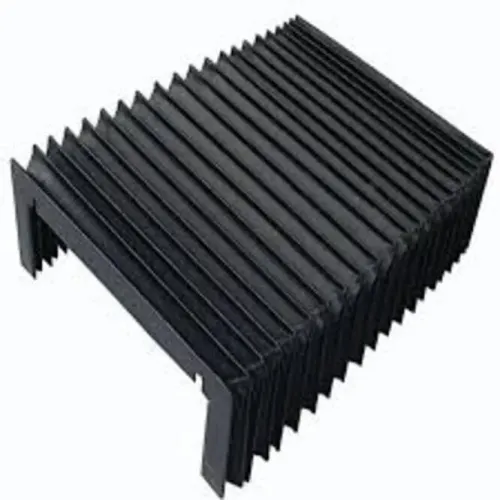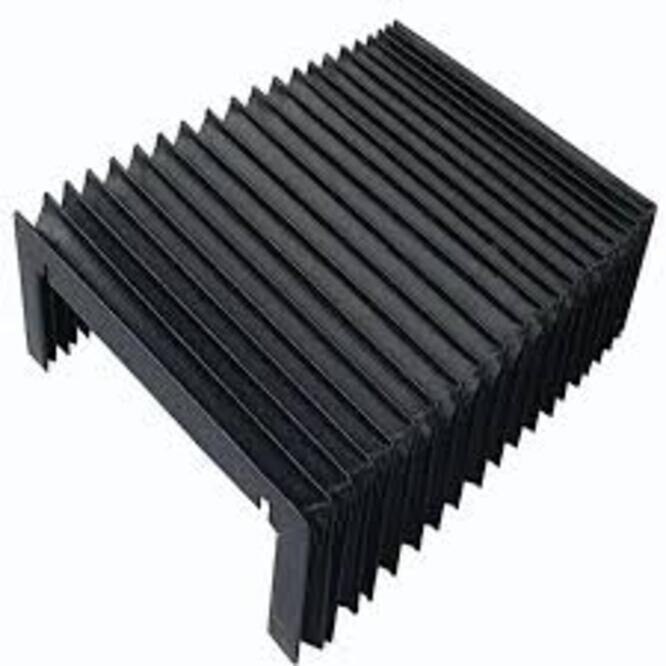
A flap bellow can close access to parts of a scissor lift, but its suitability depends on the lift’s full movement envelope rather than a photograph taken at one height. You will be able to assess the operator-protection role, check the critical dimensions and clearances, and specify a cover without confusing it with a guardrail, interlock, or fall-protection system.
Key takeaways
- Confirm the bellow closes the hazard gap through the complete lift cycle.
- Reject covers that enter linkages, restrict movement or alter controls.
- Match fabric, coating and fasteners to heat, oil, chips and cleaning chemicals.
- Inspect attachment points, folds and clearances after installation and during use.
When a flap bellow helps operators—and when it does not
A flap bellow can shield a scissor lift’s moving linkage, hydraulic components, cables and operators’ feet from access, dirt and falling debris. Flap bellow scissor lift suitability depends on whether it closes the identified gap throughout the lift’s movement without entering the mechanism or changing the machine’s stability, rated capacity or controls.
It can reduce exposure to:
- Pinch-point access around the scissor pack
- Dust, mud, oil, water and hydraulic-fluid spray
- Falling chips and debris
- Contact with hot or contaminated surfaces
That protection is supplemental, not a complete guarding system. A bellow cannot arrest a fall, support a person’s weight, stop a high-energy crush event or compensate for failed hydraulic or mechanical restraints. It must not replace the platform guardrail, toe-board, emergency stop or a safety interlock.
If the lift operates with a torn, removed or incorrectly fitted cover, the cover is not controlling access by itself.
Reject the arrangement if the material can catch in scissor joints, hoses or cables, or if it restricts the minimum-height fold or maximum-height extension. Include its condition in pre-use checks, and inspect attachment points for tearing, detachment and trapped material.
Under PUWER 1998, guarding, suitability, maintenance and inspection still apply; LOLER requirements also remain where the lift raises people or loads.
Check the complete scissor movement before choosing a cover
Measure the cover against the lift at minimum height, maximum height, and every change in between. A bellow that closes the gap at mid-stroke can fold inward, buckle outward, stretch tight, or expose a shear point at either travel limit.
Record the scissor-pack width, arm angles, platform-to-chassis gap, attachment points, and the bellow’s folded and extended lengths. Check the complete movement slowly with the power isolated, then repeat under controlled operation while watching the cover from both sides and below.
| Position | What to check | Failure sign |
|---|---|---|
| Minimum height | Fold depth, side clearance, and contact with the chassis | The flap is crushed, trapped, or pulled into the linkage |
| Mid-stroke | Alignment as the arms cross and the opening changes | A gap appears or the flap bows into a pinch point |
| Maximum height | Extension, attachment tension, and remaining coverage | Seams pull tight, fasteners load up, or access opens |
| Full cycle | Clearance from arms, hoses, cables, and floor obstructions | Rubbing, snagging, tearing, or restricted travel |
Reject the design if any accessible opening reaches the moving scissor arms, or if the cover itself can enter the mechanism. Confirm that its attachments add no force that changes stability, rated capacity, or emergency lowering.
The phrases flap bellow scissor lift for operators london and scissor lift flap cover london describe searches, not geometry standards. Request drawings at minimum and maximum travel, plus a full-stroke validation record for the exact lift model.
Match the construction and material to the site hazards
Choose the construction by the hazard and the material by its exposure, not by the lift’s location. A flap bellow must fold clear of scissor joints, tolerate the full stroke, and remain light enough not to affect stability, rated capacity, or movement. If it can be pulled into a pinch point, reject the design.
| Construction or material | Suitable exposure | Selection consequence |
|---|---|---|
| Reinforced, overlapping coated-fabric flaps | Dust, metal chips, mud, water, oil mist | Specify abrasion-resistant fabric, sealed edges, and a fold pattern that sheds debris |
| Oil-resistant polyurethane- or PVC-coated polyester | Hydraulic oil, coolant, outdoor dirt | Confirm chemical compatibility, UV resistance, minimum bend radius, and cleaning temperature |
| Neoprene or equivalent elastomer flap | Repeated flexing with oil and weather exposure | Check temperature limits and swelling data; a softened flap can enter the scissor pack |
| Silicone-coated glass fabric or other heat-rated laminate | Radiant heat or contact with hot surfaces | Use only with stated temperature data; heat resistance does not prove tear or abrasion resistance |
For a flap bellow for lifting equipment london specification, state the lift model, minimum and maximum height, travel speed, cycle frequency, and exposure to oil, water, chips, heat, and cleaning agents. Request test evidence for cycle life, attachment loads, seam strength, and replacement access.
PUWER suitability and guarding duties remain, while LOLER examination requirements still apply where the lift raises people or loads. Include the bellow in pre-use inspections for tears, loose fasteners, contamination, and interference.
Validate installation without creating a new trapping hazard
Run the fitted flap bellow on industrial lifting equipment through its complete working range before operators use the scissor lift. Test at slow speed, with the platform unloaded and then under the lift’s permitted operating conditions, while watching every fold, flap, fastener and attachment point.
- Check the fully lowered and fully raised positions, plus intermediate points, for catching on scissor arms, guides, wheels, curbs, hoses or loose objects.
- Repeat several complete cycles and inspect for displaced panels, stretched fabric, torn stitching, loose clamps, open hook-and-loop sections or falling parts.
- Confirm positive retention: no section can detach, enter the mechanism or fall below the platform if a fastener fails.
- Verify that the cover does not block controls, emergency stops, access routes, inspection points or safety devices.
- Measure clearances again after installation and confirm the cover has not changed the lift’s stability, rated capacity, travel, levelling or hydraulic operation.
Record the test, defects, corrective actions and acceptance criteria in the lift’s maintenance and risk-assessment records. Under the Provision and Use of Work Equipment Regulations 1998, confirm suitability, guarding and maintenance; where the lift raises people or loads, keep the LOLER thorough-examination regime unchanged.
Obtain competent-person approval before release, and quarantine the lift if any flap creates a new crush, shear, entanglement or falling-object hazard.
Specify, inspect and maintain the cover for its actual lift model
Approve a flap bellow only against evidence for the exact lift model, not a photograph or a generic “scissor lift cover” description. Ask the manufacturer for a signed drawing and test pack.
1. Request drawings showing the cover envelope, attachment points and clearances at minimum and maximum platform travel, including folded and fully extended positions.
2. Confirm the fabric, coatings, temperature range, resistance to oil, hydraulic fluid, water, mud and cleaning chemicals, plus permitted cleaning methods and limits.
3. Obtain attachment loads, fastener details, cycle-life evidence, replacement instructions and the inspection criteria for tears, loose fixings, distortion and interference.
4. Require a model-specific risk assessment or validation test covering pinch-point access, visibility, platform entry, escape, emergency lowering, lubrication and isolation or rescue access.
A specialist supplier can measure the lift through its full stroke, identify where the bellow could be drawn into the scissor pack, and develop a trial fit before production. SCUTES INDIA PRIVATE LIMITED can contribute by translating those measurements and site exposures into a model-specific bellow specification rather than selecting from a nominal size.
Record the cover in the lift’s PUWER maintenance and pre-use inspection arrangements. Keep access to the manufacturer’s instructions and LOLER thorough-examination points; never make emergency release or routine inspection depend on removing a damaged cover. A flap bellow is supplemental guarding, not a safety interlock.
Frequently asked questions
When is a flap bellow suitable for scissor lift operators?
It is suitable when it shields the identified gap throughout the full scissor movement without entering the mechanism or affecting stability, rated capacity or controls.
What must you check before fitting a scissor lift flap cover?
Check the complete movement, including folded and fully raised positions, linkage clearances, hydraulic hose paths, cable travel, access points and operator sightlines.
How do you choose flap bellow construction and material?
Match the fabric, coating, fold design and fasteners to the site’s chips, dust, oil, coolant, heat, cleaning chemicals, abrasion and weather exposure.
How can a flap bellow create a new trapping hazard?
Loose edges, exposed fasteners, unsupported folds or incorrect clearances can enter moving linkages or catch clothing, tools and body parts.