A spring cover that fits the shaft but fails at full compression can obstruct motion, trap chips, or wear out before the machine reaches its expected cycle life. You will be able to size the cover, compare it with other protection systems, test its limits, and prepare a supplier brief for a reliable machine design.
Key takeaways
- Measure the complete shaft travel envelope, including retraction space and end clearances.
- Choose cover material and construction for chips, coolant, heat, dust or abrasion.
- Check compressed length, extension length, speed, mounting and guarding limits before ordering.
- Send travel, dimensions, environment and motion data in one supplier-ready specification.
How a spiral spring cover follows machine motion
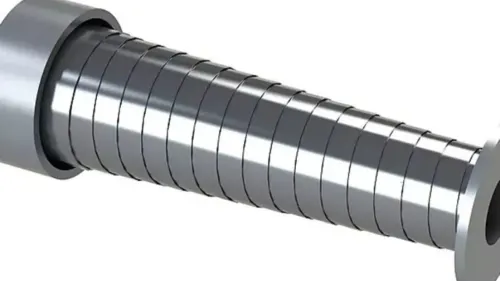
An anchored end fixes to the machine while the other end connects to the moving member. As the shaft travels, the spring-steel strip winds into tighter overlapping turns or unwinds into a longer stack. Each turn remains under spring tension, so adjacent turns shield the exposed shaft without an external guide rail.
The cover follows axial motion instead of forcing the shaft through a fixed tunnel.
For machine builders, the main spiral spring cover benefits are:
- Compact installation: the cover occupies little space beside the shaft and compresses into a short axial length.
- Low obstruction: there is no separate telescopic structure or guide rail competing for space around the ballscrew, guideway or shaft.
- Chip and coolant protection: overlapping steel turns block chips and reduce direct exposure to coolant, cutting cleaning time.
- Easier integration: fixed mounting ends allow the cover to be fitted during machine assembly before surrounding guards are closed.
That movement makes spiral spring protection for machine builders useful where stroke is long but retracted space is tight. It does not mean the cover can tolerate every condition: abrasive chips, trapped swarf, excessive acceleration or contact with nearby surfaces can damage the strip.
Jaipur builders should confirm the compressed and extended lengths, clearance, orientation and mounting access, then test a sample through the actual travel with representative chips and coolant. Local availability helps only when it also provides a correct dimensional drawing and practical replacement support.
Size the cover from the complete travel envelope
A shaft diameter alone is not a specification. Measure the entire travel envelope, including where the cover sits at full compression and full extension; otherwise the spring can interfere with the carriage, lose overlap, or leave the guideway exposed.
- Record the protected shaft, ballscrew or guideway diameter, plus the required inside diameter and outside diameter of the cover.
- Measure maximum stroke and calculate both end positions. Note the fully collapsed length and fully extended length available in the machine.
- Specify the spring-strip width and cover diameter, then check radial clearance to guards, tooling, cable carriers, coolant lines and nearby moving parts.
- Describe each mounting end: thread, flange, clamp, bore, bolt pattern and axial fixing method. Include the distance from the cover ends to the machine structure.
- Record orientation—horizontal, vertical or inverted—and the travel speed, acceleration, deceleration and cycle frequency. A cover sized for stroke alone can fail when acceleration pulls it out of alignment.
- Map the contamination envelope. Identify chip size, sharp edges, coolant type, grinding dust, heat sources and any point where debris can collect between turns.
Use a dimensioned drawing with retracted and extended positions, not a single catalogue diameter. Leave access for inspection and replacement before finalising guards. Local sourcing can shorten replacement lead time and permit dimensional correction after trials, but the supplier still needs a functional check under representative chips, coolant and motion conditions.
These checks reveal the real spiral spring cover benefits for machine builders in Jaipur without confusing location with suitability.
Match the cover to the protection problem
Choose a spiral spring cover when compact axial movement and hot-chip protection matter more than complete enclosure. The case for spiral spring protection for machine builders is strongest around exposed ballscrews, shafts and guideways where a separate telescopic structure would consume valuable space.
| Option | Main strength | Choose it when |
|---|---|---|
| Spiral spring cover | Compact retraction, low obstruction and good chip deflection | Space is tight and motion is linear |
| Bellows | Flexible, broad-area enclosure | You need to cover irregular geometry, but check fabric, coolant and temperature limits |
| Telescopic steel cover | Rigid, sealed protection | Heavy chips, abrasive debris or a large exposed way demand structural shielding |
| Roll-up cover | Compact storage with flexible deployment | The opening is wide and the environment is less aggressive |
| Apron cover | Simple overlapping-strip protection | You need economical coverage over a long, relatively accessible way |
| Cable drag chain | Routes and protects cables and hoses | The problem is cable movement; it does not replace a sealed way cover |
Do not select the spring design from purchase price alone. Compare compressed and extended length, chip and coolant type, noise, inspection access, replacement interval, allowable acceleration and the consequence of failure.
It is the wrong choice when the cover must carry a load, resist impact as a safety barrier, seal an irregular opening, or tolerate debris that can lodge between spring turns. A drag chain is also the wrong substitute for guideway protection.
Check pinch points and personnel access separately; preventing chips from reaching a screw does not make the cover a guarding device.
Check motion, contamination and guarding limits
Verify survival with a representative motion-and-contamination trial, then assess guarding separately. A cover that keeps chips off a ballscrew is not a load-bearing guard or safety barrier.
Run the cover through its full stroke at the machine’s intended speed and acceleration. Check the retracted and extended positions for rubbing, coil interference, mounting movement, excessive noise and contact with nearby surfaces. A tight installation can fail even when the cover diameter matches the shaft.
Use the actual contamination, not a clean-room substitute. Introduce representative hot chips, abrasive dust, coolant and cutting fluid, then inspect the spring strip, overlaps, end fittings and protected component for dents, wear, corrosion or trapped debris.
- Confirm that the cover clears the shaft, coupling, bearing housings and adjacent tooling at every travel position.
- Record the trial temperature, coolant type, chip form, travel speed, acceleration and cycle count.
- Check that cleaning and replacement access remains possible without entering a moving-part hazard zone.
- Inspect every opening and pinch point separately; do not call the cover compliant with a guarding standard because it blocks chips.
- Define the failure response: stop the machine if a torn strip, loose fitting or displaced cover can expose the moving element.
For a machine spiral spring cover in Jaipur, local availability can shorten replacement or dimensional-correction lead time, but location proves nothing about suitability. Request the test record, installation limits, maintenance instructions and replacement identification for the machine’s technical file.
Turn the application into a supplier-ready specification
A quotation request that states only shaft diameter and cover length is incomplete. Give the spiral spring cover supplier in Jaipur the full operating envelope, contamination conditions and mounting constraints so the quoted part fits the machine rather than requiring redesign after assembly.
Include these items in the request:
- Shaft diameter, maximum stroke, extended length, compressed length, cover diameter, spring-strip width and available radial and axial clearance.
- Steel or strip material, thickness, surface treatment, orientation, fixed and moving mounting details, rated speed, acceleration, cycle frequency and temperature range.
- Chip size and shape, coolant type, splash direction, cleaning method and the consequence of cover failure.
- A machine sketch showing access for installation, inspection and replacement before guards and cable carriers are frozen.
SCUTES INDIA PRIVATE LIMITED can be included in a supplier comparison, but Jaipur location alone proves nothing about suitability. Request a dimensioned drawing, mounting tolerances, inspection points and replacement dimensions.
| Stage | Require from the supplier | Acceptance evidence |
|---|---|---|
| Quotation | Material, dimensions, travel, motion rating and environment limits | Signed specification with exclusions |
| Drawing review | Mounting faces, compressed envelope, clearances and service access | Approved drawing overlaid on the machine |
| Acceptance test | Full travel at operating speed with representative chips and coolant | No binding, unsafe exposure, damaging contact or unacceptable leakage |
Record noise, strip deformation and coolant ingress during the test. Treat the cover as a chip-management component, not a personnel guard; assess openings and pinch points separately. These controls turn the spiral spring cover benefits for machine builders in Jaipur into measurable integration results.
Related products
 | TELESCOPIC SPRING COVER Telescopic Spring Covers provide protection under extreme conditions. View product → |
 | TELESCOPIC COVERS A telescopic cover protects guide-way surfaces and components of moving axis of machines. View product → |
Frequently asked questions
How does a spiral spring cover follow machine motion?
One end anchors to the machine and the other attaches to the moving member. Shaft travel winds the strip into overlapping turns or unwinds it into a longer stack.
What dimensions do you need to size a spiral spring cover?
Measure the complete travel envelope: exposed shaft length, maximum travel, retracted length, available diameter, mounting space and end clearances.
How do you match a spiral spring cover to the protection problem?
Identify the hazard first, such as chips, coolant, dust, heat, moisture or abrasion, then specify a construction suited to that exposure.
What information should machine builders send to a spiral spring cover supplier?
Provide shaft dimensions, travel, speed, acceleration, mounting orientation, contamination type, temperature, guarding limits and required compressed and extended lengths.