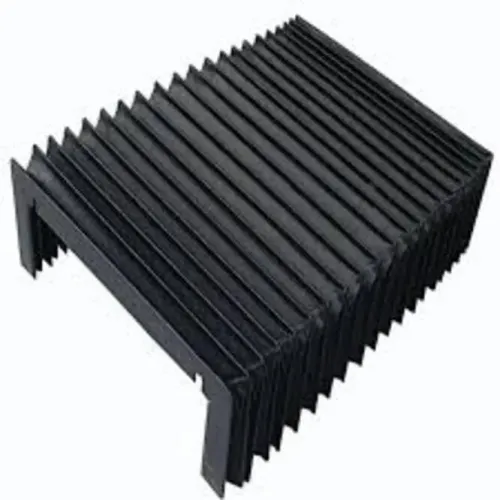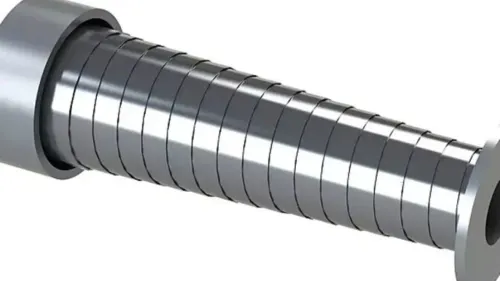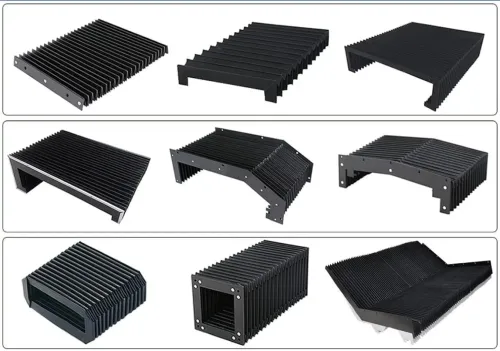

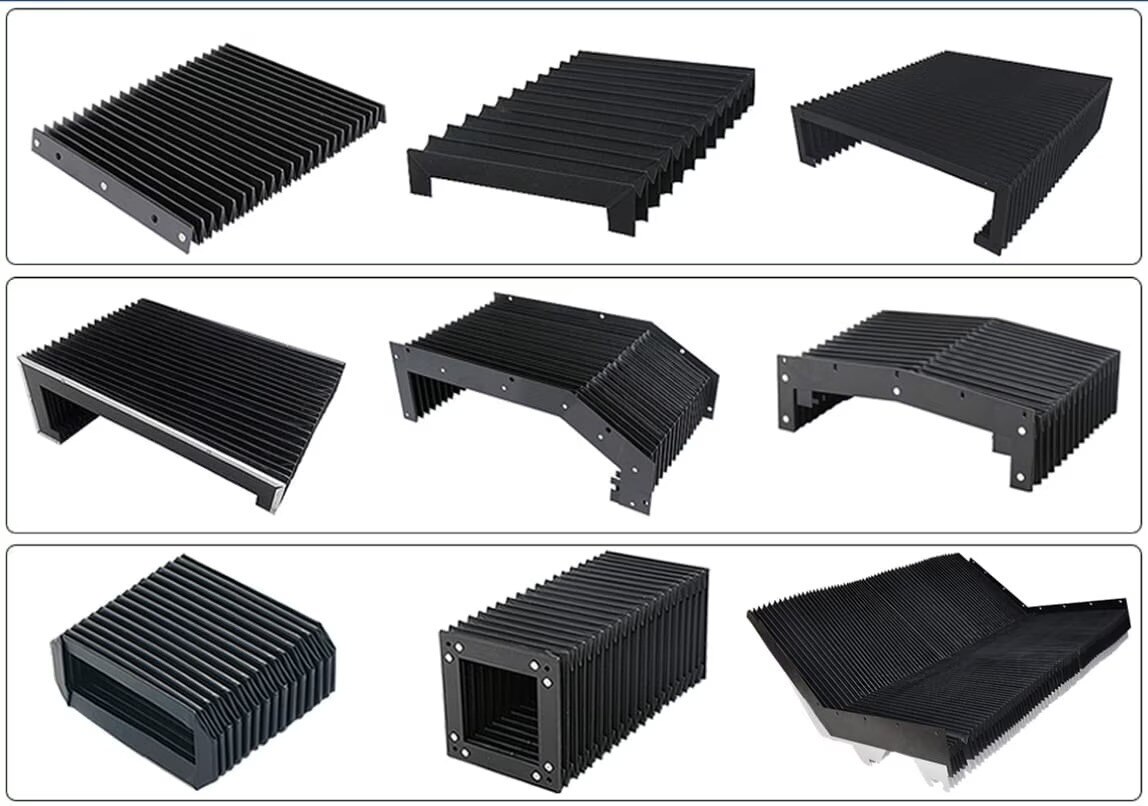
Choose a round bellows when you need to shield a cylindrical moving part; choose a duct bellows when you need to connect an air path across movement, vibration, or a gap between machine sections. The decision depends on the protected geometry, pressure, motion, contaminants, temperature, and the way the assembly will be measured and mounted.
Key takeaways
- Use round bellows around moving cylindrical parts and duct bellows around airflow passages.
- Measure stroke, compressed length, extended length, diameter, clearance and mounting points.
- Specify fabric, coating, temperature range, chemical exposure and movement before ordering.
- Account for Pune factory dust, coolant, oil, chips and seasonal humidity.
Which form matches the automation problem?
Choose by the protected path: a round bellows covers a moving cylindrical component, while a duct bellows preserves a passage for air, fumes, cooling air, vacuum, or chips.
| Option | What it is | Choose it when |
|---|---|---|
| Round bellows | A protective sleeve around a rod, spindle, cylinder, screw, shaft, guide, sensor assembly, or cable bundle | Chips, abrasive dust, coolant, lubricant, or moisture threaten a moving part |
| Duct bellows | A flexible connector between duct sections, plenums, fans, filters, extraction lines, guarded openings, or fixed and moving machine sections | Air, fumes, cooling air, vacuum, or chips must pass through a defined route |
A round bellows is a cover, not a motion guide. It does not carry cable weight, correct shaft alignment, or replace a cable carrier or linear guide. Do not specify it as a pressure-rated expansion joint unless the complete design has been tested for that duty.
Before requesting a quotation, state the primary function:
- Air containment
- Vibration isolation
- Movement compensation
- Particle exclusion
- Personnel guarding
For a round bellow in Pune, specify the moving cylindrical part and its motion. For duct bellows in Pune, specify the duct geometry, airflow, temperature, pressure or vacuum, movement, and leakage requirement. These products are not interchangeable.
When should you use each type in an automation cell?
Use a round bellows when the hazard surrounds a moving cylindrical component; use a duct bellows when air, fumes, chips, or vacuum must cross a flexible machine interface. That geometric distinction resolves most searches for round bellow or duct bellows for automation systems in Pune.
- Choose round bellows for linear actuator rods, pneumatic and hydraulic cylinder rods, ball screws, lead screws, linear slides, spindles, rotary shafts, optical assemblies, exposed guides, sensor mechanisms, and moving cable or hose bundles.
- Choose duct bellows for fume removal from a robot enclosure, chip extraction, vacuum lines, cooling-air connections, air-handling links, and connections between a moving machine enclosure and a fixed duct.
Match the construction to the motion. A rod cover, rotary-shaft cover, and repeatedly bending cable cover have different design requirements, so do not treat one catalogue pattern as universal.
For cable protection, check the cable manufacturer’s dynamic bend radius separately from the bellows’ allowable deformation. Prevent twisting, pinching, and tensile loading at the end fittings; a round cover does not replace a cable carrier or guide.
Record positive and negative pressure for duct bellows for automation. A connector that survives fan discharge can collapse under suction without reinforcement or internal support.
If the cell has both moving-part contamination and air-transfer risks, use both as separate engineered components. These are the practical round bellow applications: shielding motion on one side, preserving an air passage on the other.
How do you size and measure the installation?
Size from the moving envelope, not the nominal rod or duct size.
- For a round bellows, measure the protected part at its largest diameter, including fittings, collars, eccentric movement and nearby fasteners. Record full stroke, installed length, collapsed length, required extension, outside diameter, mounting diameter, axial speed, acceleration, cycle frequency, temperature, chemical exposure and chip or washdown protection.
- Allow clearance for folds to expand and for lateral vibration. An off-axis rod can make folds rub even when the bore matches the shaft; check that the compressed length fits the machine envelope and that the bellows cannot bottom out or overstretch.
- For duct bellows for automation, measure opening width and height or diameter, flange dimensions, bolt pattern, transition shape, available space, bend radius, airflow, positive pressure or vacuum, temperature and adjoining duct support.
- Mark every movement as axial, lateral, angular, torsional or combined. Include the movement in each axis, not only the main stroke.
- Specify fold spacing, inspection access, drainage and cleaning clearance. Contaminated folds can trap chips and coolant, turning a sealed connection into an abrasive failure point.
Round bellow applications need the largest moving profile and the actual machine envelope. Duct bellows need the duct geometry, service conditions and support arrangement. Send a movement sketch and photographs with the measurements; nominal diameter and stroke alone are not a complete purchase specification.
Which material and construction suit Pune factory conditions?
Choose the material from the actual exposure, not a label such as “weather resistant.” For duct bellows in Pune, specify ambient temperature, monsoon condensation, UV, coolant, oil, chips, dust, solvents, and cleaning agents before selecting fabric or elastomer.
| Material | Strength | Check before approval |
|---|---|---|
| Coated fabric | Flexible, reinforced, low restoring force; suits tailored shapes | Coating compatibility, abrasion, pinholing, delamination, UV, condensation, and chemicals |
| Neoprene | Useful for abrasion and general industrial exposure | Exact fluid compatibility and temperature range |
| Silicone | Flexible at higher temperatures | Tearing, mechanical abuse, and heat ageing |
| Polyurethane | Strong abrasion resistance for particulate service | Chemical and heat limits |
| PVC-coated fabric | Economical for duct connections | Flex-fatigue, coating delamination, and low-temperature behaviour |
| Heat-resistant fabric | Suitable for specified high-temperature duty | Continuous and peak temperatures, not merely the fabric name |
Compare sewn or stitched, moulded, welded, and flexible duct-connector constructions against the motion profile. Sewing supports repair and custom shapes, but inspect seams for leakage and particle entry. Moulded forms control geometry, while replacement is usually more practical than field repair. Welded joints require validated material and process controls.
Flexible duct connectors may need frames, clamps, reinforcement, or internal support under vacuum.
Ask for minimum bend radius, cycle life, leakage, pressure, temperature, seam strength, and chemical-compatibility data. A duct bellows for automation that survives fan discharge can still collapse under suction without adequate support.
What should you specify before ordering in Pune?
Write a one-page specification before ordering a round bellow in Pune: name the application, movement direction, collapsed and extended lengths, stroke, internal and external diameters, bend radius, mounting method, end rings or flanges, available envelope, travel speed, cycle frequency, and largest moving profile.
List every exposure: dry dust, metal chips, coolant, oil, washdown water, solvent, UV, monsoon condensation, and heat.
1. For a round bellow or duct bellows for automation systems in Pune, state whether the component protects a moving part or carries air across a machine interface. For duct bellows in Pune, add airflow, positive pressure, negative pressure, leakage limit, duct support, frame dimensions, and whether the connector must prevent particle entry.
2. Request drawings of the folded and extended states, plus the proposed material and coating, seam or weld method, temperature limits, chemical compatibility, and any pressure, vacuum, leakage, or cycle test evidence.
Ask SCUTES INDIA PRIVATE LIMITED to review these dimensions and operating conditions across protective covers, bellows, guideway protection, and cable-management components; compare the submitted drawing and test evidence, not the product name.
3. Do not assign an IEC 60529 IP rating to the bellows alone. The assembled enclosure, fittings, seams, flanges, and drainage arrangement determine whether an enclosure-level claim is defensible. A bellows is not automatically a machine safety guard; apply ISO 12100 to the complete safeguarding arrangement.
Related product
 | Duct Bellows HVAC systems and industrial ducting rely on high-quality duct bellows for durability and performance. View product → |
Frequently asked questions
What is the difference between a round bellow and a duct bellow?
A round bellow protects a moving cylindrical component such as a shaft, screw or guide. A duct bellow maintains a flexible passage for air, fumes, cooling air, vacuum or chips.
When should you use each type in an automation cell?
Use a round bellow around linear or rotary moving parts. Use duct bellows between equipment, enclosures or extraction points where the protected requirement is continuous airflow or material transfer.
What measurements are needed before ordering automation bellows?
Record the protected diameter or duct dimensions, stroke, compressed and extended lengths, bend radius, mounting space, attachment method and nearby clearance.
Which material suits Pune factory conditions?
Choose the fabric, coating and reinforcement from the actual exposure: coolant, oil, chips, dust, heat, humidity, cleaning chemicals and movement speed. Confirm the operating temperature range and service-life requirement.