
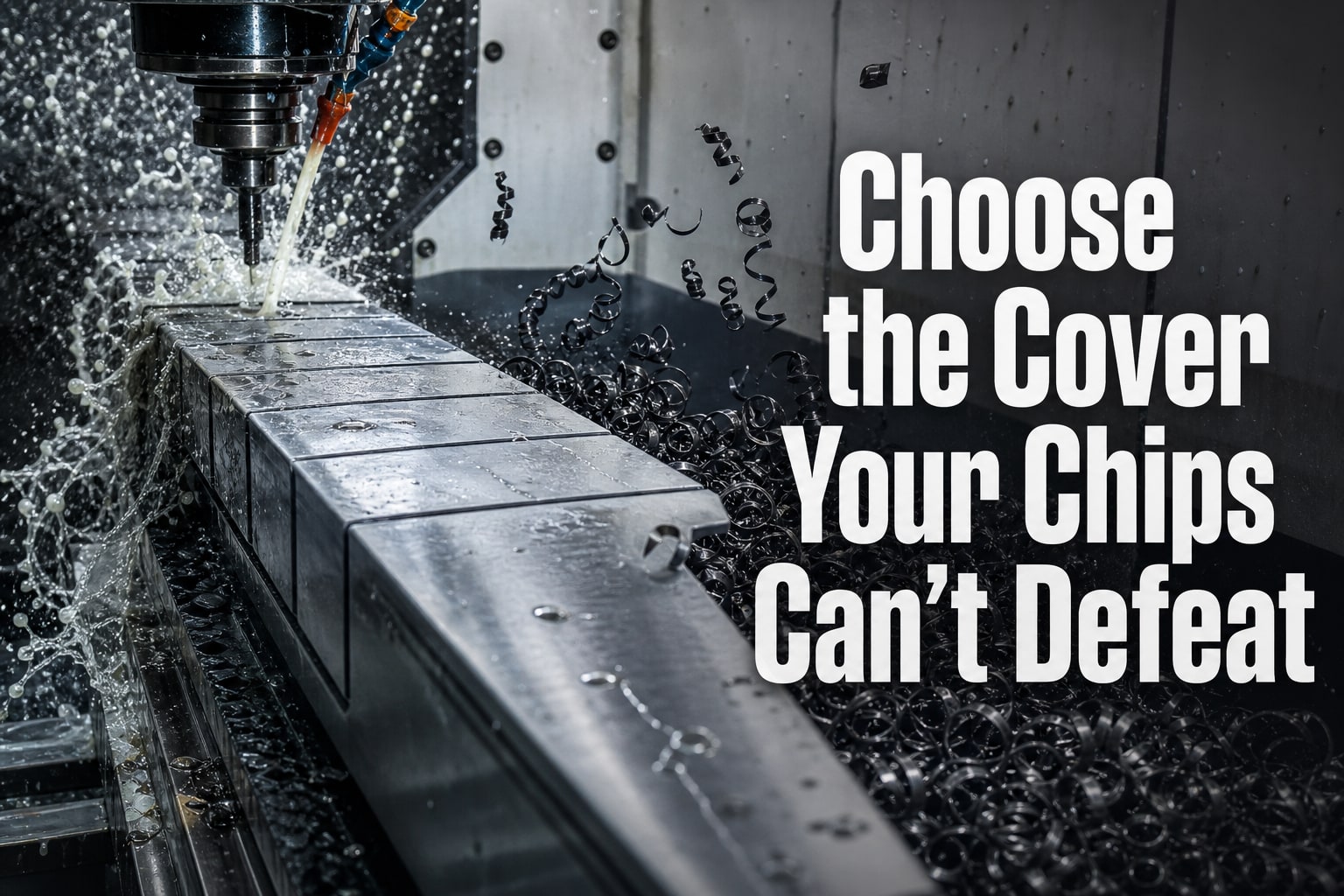
Hot chips, sharp swarf and flood coolant place different demands on a machine-way cover, so the correct choice depends on more than the machine’s nominal axis travel. You will be able to compare apron, bellows, roll-up and telescopic designs, then specify dimensions and operating conditions for a reliable selection or replacement.
Key takeaways
- Use steel slats for sharp chips and heavy machining debris.
- Choose bellows for flexible protection around complex or limited machine envelopes.
- Measure travel, opening width, package space and mounting points before ordering.
- Give chip type, coolant, temperature and maintenance access when specifying a replacement.
What an apron cover does on a machine tool
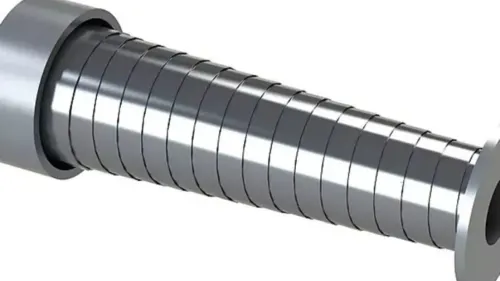
An apron cover for machine tools is a linked or overlapping strip curtain that travels with an axis, shielding the exposed way opening from chips, swarf and coolant. It normally uses steel slats linked at their edges, so the cover rolls into a compact package instead of occupying the full protected travel.
That roll-up construction suits long horizontal or vertical openings where a bellows or telescopic box cover would need more storage space or length.
Unlike an accordion bellows or a telescopic box cover, an apron cover for machine ways concentrates its retracted length in a roll, but its moving joints need careful protection from chip entry and liquid leakage.
Coolant resistance depends on the details, not simply on whether the slats are steel:
- Slat overlap
- Wiper design
- Side seals
- End seals
- Drainage paths
- Installation orientation
A chip-deflection apron is not automatically a liquid-tight way seal. Flood coolant can pass through poor overlaps, worn wipers or an unfavourable slope, then reach the guideway.
Cover the complete vulnerable opening throughout the axis stroke, including both end positions. Check the way geometry, mounting flanges, adjacent guards, lubrication lines and the space needed by the retracted roll; nominal opening width alone is not enough.
An apron cover protects a way opening, but it does not automatically replace a machine enclosure or safety-rated guard. Containing broken tools, stopping high-energy fragments, controlling access and meeting interlocking requirements demand a separate risk assessment.
When steel, aluminium, bellows or telescopic covers make sense
An apron cover for CNC machines suits hot, sharp or heavy chips when compact retraction and chip tolerance matter. Choose aluminium strips when reducing moving mass and noise matters more than maximum stiffness; choose steel when chip impact could dent or deform the cover.
| Option | Main advantage | Best fit |
|---|---|---|
| Aluminium-strip apron | Lower moving mass and noise | Moderate chips, faster axes and limited impact |
| Steel apron | Higher stiffness and impact resistance | Hot, sharp or heavy chips |
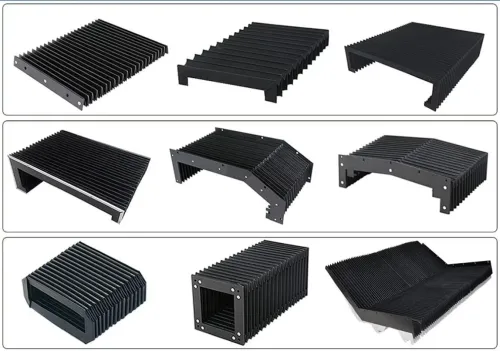
| Fabric or polymer bellows | Flexible geometry and clean, low-impact protection | Fine dust, light chips and complex movements |
| Roll-up cover | Compact package during retraction | Long openings where space is limited |
| Telescopic steel cover | Stronger sealing and chip evacuation | Short, fully enclosed axes |
A steel apron cover for machine tools is a stronger choice than fabric, PVC or polyurethane bellows when chips strike the guard. Bellows win when contamination is cleaner and impact is low; a telescopic steel cover wins when the axis is short and fully enclosed.
A generic roll-up cover gives compact storage, but confirm that its construction handles your chip load.
For a steel apron cover for machinery, select carbon steel for general machining and stainless steel or a corrosion-resistant finish for aggressive coolant, washdown chemicals or humid service. Material alone will not prevent joint or wiper wear: abrasive chips and contaminated coolant can damage those parts.
Specify overlaps, side and end seals, drainage, wipers and a chip-shedding path rather than assuming the cover is liquid-tight.
Match the cover to chips, coolant and maintenance conditions
Match a steel apron cover for machine tools to the debris and cleaning method, not to dimensions alone. Hot chips and sharp swarf favour steel slats because they tolerate impact and short-duration heat better than many fabric, PVC or polyurethane bellows; abrasive chips can still wear links, joints, wipers and seals.
- Identify the debris before specifying an apron cover for machinery. Cast-iron dust and carbide-grinding debris abrade joints and wipers faster than dry aluminium chips. Long, sharp swarf can catch between slats, while packed debris increases drag and can damage the rewind mechanism.
- Check the coolant path. Flood coolant and cutting oil can attack finishes, carry abrasive particles into seals and expose steel to corrosion. Confirm coolant chemistry, washdown pressure, cleaning method, operating orientation and drainage; a chip-deflecting apron cover for machine ways is not automatically liquid-tight.
- Design the approach to shed debris. Give horizontal transitions a deliberate slope, and add deflectors, brushes or scrapers where chips collect at the roll entrance, pockets or unsupported changes in direction. Remove trapped chips before they enter the roll.
- Inspect wipers and side seals as replaceable wear parts. Check them during planned maintenance, and never force a jammed cover; stop, clear the obstruction and inspect slats, links and the rewind system.
- Provide the operating data: axis speed, acceleration, duty cycle, chip temperature, abrasive content and orientation. A cover suited to dry aluminium machining can fail early on hot cast-iron chips even when its dimensions are correct.
Calculate apron cover dimensions from the real machine envelope
Calculate apron cover dimensions for machine tools from the actual opening and carriage path, not the nominal CNC axis size. Record these measurements before requesting a replacement or custom quotation:
- Clear way-opening width and the usable carriage travel.
- Covered length with the carriage fully closed and fully extended.
- Strip pitch, overlap, and cover thickness.
- Mounting height, side clearance, and the available mounting length.
- Permitted bend or rolling radius.
- End-attachment type, flange dimensions, and mounting-hole pattern.
- Available retracted roll diameter or folded-package height.
- Roll-up direction and the space available for the wiper and end seals.
For practical apron cover sizing for machines, add the length required for both end attachments, strip overlap, wiper engagement, and movement into the roll. Check the cover at both end positions; a cover that protects the opening at mid-stroke can leave a way exposed when the carriage reaches either limit.
Verify clearance through the complete stroke from the spindle, table, enclosure, adjacent guards, lubrication lines, chip conveyor, and every moving part. Include the cover’s thickness and rolling radius in this check, not just its flat width.
The retracted envelope can decide whether an otherwise suitable apron cover fits. A roll that clears the way at full extension may strike the spindle housing, enclosure roof, or chip conveyor when fully retracted.
For an apron cover replacement for CNC machine service, supply measured dimensions and photographs of both end attachments rather than relying on the machine model alone.
Specify a replacement or custom cover without guessing
An apron cover replacement for CNC service needs measured identification, not a model number alone. Treat the machine make and model as a starting point: retrofits and production changes can leave one model with different cover versions.
An apron cover replacement for CNC machine service should be specified from the existing assembly and its actual operating space.
- Measured axis travel and required extension
- Guideway width and clear opening width
- Slat width, thickness, pitch and overlap
- Slat profile, link or hinge construction
- Roll location and roll-up direction
- Mounting-hole pattern and available mounting length
- End attachments, flange dimensions and fixing details
- Retracted envelope, including roll diameter or package height
- Extended envelope, side clearances and bend or rolling radius
- Wiper arrangement, contact position and seal condition
- Axis speed and acceleration
- Photographs of both ends, showing attachments, guides and the roll
- Coolant exposure, chip type and any nearby interference
Send a drawing if one is available, but verify it against the machine before ordering. Ask for measurements at both end positions; a nominal CNC stroke will not reveal interference with the spindle, enclosure, lubrication lines or chip conveyor.
For custom apron covers for machinery, inspect the rewind spring or mechanism before matching a replacement. A new visible curtain will not correct worn links, fatigued springs, damaged wipers or distorted end fittings.
SCUTES INDIA PRIVATE LIMITED can discuss an apron cover replacement for CNC equipment from supplied dimensions, photographs and operating conditions; the design remains conditional on those measurements and the mechanism’s condition.
Related products
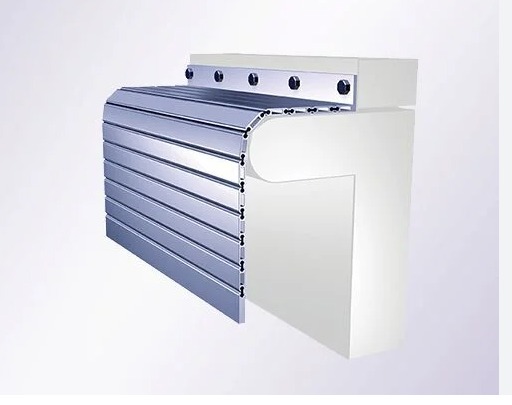 | APRON COVER Effectively engaged in offering a vast collection of outstanding quality products which include Apron Covers. View product → |
 | Machine Covers Machine covers are specially designed shields used to protect industrial equipment and machinery from environmental elements. View product → |
Frequently asked questions
What does an apron cover do on a machine tool?
An apron cover travels with an axis and shields exposed machine ways from chips, swarf and coolant. Linked or overlapping slats roll into a compact package during movement.
When should you choose steel, aluminium, bellows or telescopic covers?
Choose steel for sharp chips and demanding machining, aluminium when lower weight matters, bellows for flexible protection around irregular spaces, and telescopic covers for rigid, guided way protection.
How do you calculate apron cover dimensions for a machine?
Measure the full protected travel, way-opening width, available rolled package space, mounting points, clearance and the cover’s movement direction. Include access for cleaning and maintenance.
What information is needed for an apron cover replacement for a CNC machine?
Provide machine and axis details, travel length, opening width, mounting dimensions, chip type, coolant or oil exposure, temperature, speed, cycle frequency and photographs of the existing cover.
Related product
 | TELESCOPIC COVERS A telescopic cover protects guide-way surfaces and components of moving axis of machines. View product → |